Stripe Smart Retries Alternatives for Subscription Businesses (October 2026)
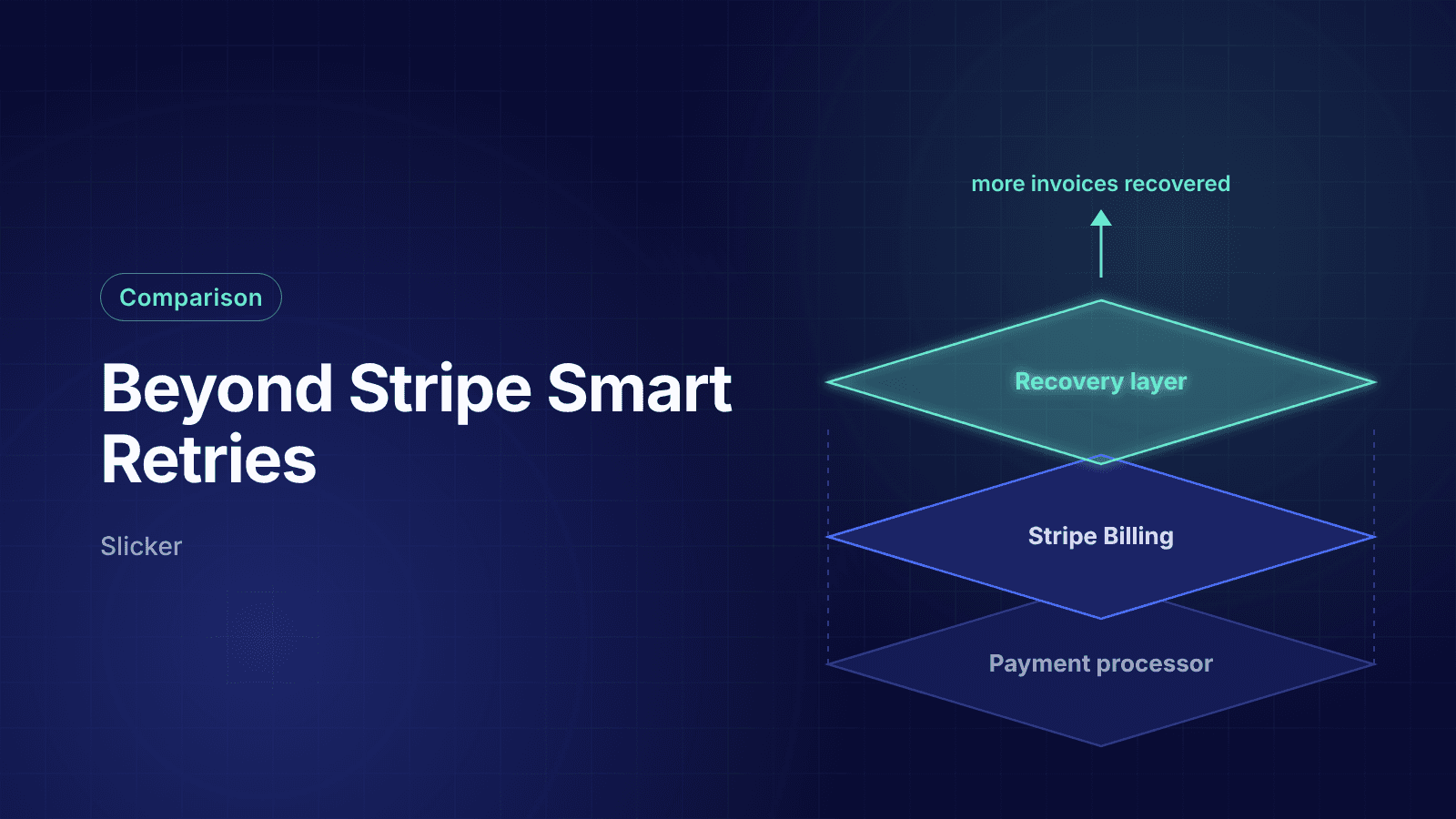
You turned on Stripe Smart Retries because it was free, it was one toggle, and Stripe said it beats a fixed schedule. Months later your past-due list still looks the same, your recovery rate has flattened, and nobody on the team can say whether a different approach would recover more.
That is the point where most subscription teams start searching for Stripe Smart Retries alternatives. The options range from tuning Stripe's own settings to adding a dedicated recovery layer on top of Stripe Billing, and each one solves a different problem. This guide compares them on the things that move recovered revenue: retry logic, how customers are contacted, what it costs, and how you prove it worked.
TLDR:
- Stripe recommends Smart Retries at 8 tries within 2 weeks, but it never retries India-issued cards, does not retry SEPA Direct Debit failures by default, and skips hard declines until a new payment method arrives.
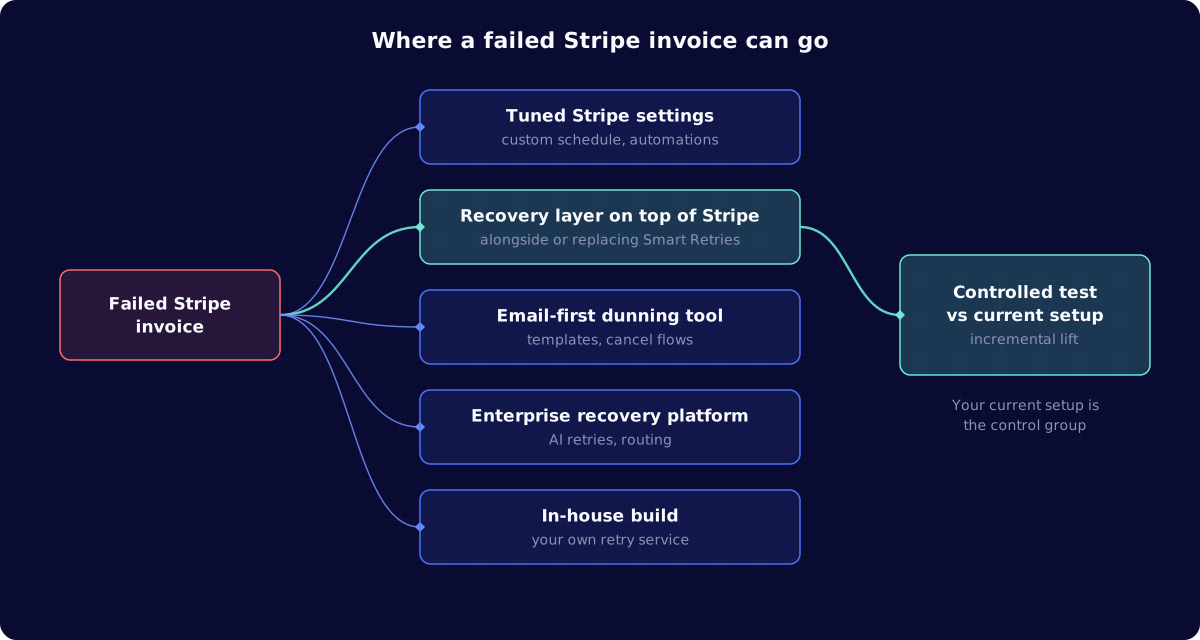
- Alternatives fall into five groups: tuned Stripe settings, recovery layers that run alongside Stripe, email-first dunning tools, enterprise recovery platforms, and in-house builds.
- The biggest gaps teams try to close are per-decline strategy, emails decoupled from retries, sender branding, and proof of incremental lift.
- Any alternative should be judged with a controlled test against Smart Retries on your own traffic, not on vendor case studies.
- Slicker can run alongside Stripe Smart Retries or replace them entirely, adds decline-aware timing and hyper-personalized emails, and proves its uplift with AABB testing before you pay.
What Stripe Smart Retries Does Well
Smart Retries is a reasonable default. According to Stripe's documentation on automated retries, it uses an AI model with time-dependent signals, such as how many devices have presented a card recently and the best local time to charge certain debit cards, to pick when each retry happens. You choose the number of attempts and a maximum window of 1 week, 2 weeks, 3 weeks, 1 month or 2 months.
It also costs nothing extra on Stripe Billing and needs no engineering. Stripe's subscriptions page says its automated tools, Smart Retries plus the card account updater, help businesses recover 55% of failed payments on average. For an early-stage company that has never retried anything, that is a large improvement for very little work.
If you want a refresher on how retry engines differ from fixed schedules before comparing tools, start with the complete guide to smart payment retries.
Where Teams Hit the Limits of Smart Retries
The limits show up as you grow, add markets, or start asking finance-grade questions about recovery.
- One policy for most failures. You set a count and a window. The model picks timing inside it, but an insufficient funds decline on a consumer debit card and a corporate card over its daily limit share the same envelope unless you build segment-specific automations.
- Emails ride on the retry schedule. Stripe's failed-payment emails follow its attempts, so a long retry policy can mean many messages to the same customer. Slicker's comparison with Stripe Smart Retries covers this coupling in detail.
- Stripe-branded communication. Customers often see Stripe-hosted pages and Stripe's email style rather than your own.
- Some failures get no retry at all. India-issued cards are never retried, and local payment methods such as SEPA Direct Debit are not retried unless you turn that on. More on this below.
- Hard declines wait. Codes such as
lost_card,pickup_cardandauthentication_requiredare not retried at all; Stripe keeps scheduling attempts but only executes them once it detects a new payment method. - No built-in experiment. You can see recovery analytics, but there is no control group, so you cannot say how much Smart Retries recovers beyond what would have paid anyway.
None of these are bugs. They are the trade-offs of a free, general-purpose default.
Where Stripe Smart Retries Does Not Retry at All
Two gaps catch growing businesses by surprise, because the failures never show up as "retrying" in the first place.
India-issued cards. Stripe's retry documentation lists India-issued cards among the payments it does not retry. Recurring card payments in India run on e-mandates under RBI rules, explained in Stripe's guide to India recurring payments, and a failed renewal gets no second attempt from Smart Retries. Without another plan, the subscription simply moves to whatever end state you configured, often cancellation. The RBI approval required guide covers how to recover these.
SEPA Direct Debit and other local payment methods. By default, Stripe does not retry failed payments made with local payment methods at all. If you switch retries on, SEPA Direct Debit is retried only for insufficient funds, at most 2 times within 30 days; ACH Direct Debit gets 2 retries within 40 days. For a European business where SEPA is a large share of renewals, that means many failures go straight to cancellation or unpaid. Debit failures also follow scheme timing that card retry logic does not model, as the direct debit solution page explains.
| Payment type | Smart Retries behavior | What happens without another plan |
|---|---|---|
| Cards (most countries) | Up to your configured tries and window | Recovered or exhausted |
| India-issued cards | Not retried | Moves to your end state, often cancellation |
| SEPA Direct Debit | Not retried by default; if enabled, insufficient funds only, max 2 in 30 days | Most failures go straight to your end state |
| ACH Direct Debit | Not retried by default; if enabled, insufficient funds only, max 2 in 40 days | Most failures go straight to your end state |
If either group is a meaningful part of your revenue, check your Stripe settings first, then look at what an alternative does with these failures specifically.
The Five Types of Stripe Smart Retries Alternatives
"Alternative" covers very different products. Grouping them makes the choice clearer.
| Option type | Example | What it changes | Main trade-off |
|---|---|---|---|
| Tuned Stripe settings | Custom schedule, Stripe automations | Retry count, spacing, segment rules | Still rules you maintain by hand |
| Recovery layer alongside Stripe | Slicker | Per-failure timing, decoupled emails, proof of lift | Another vendor in the stack |
| Email-first dunning tool | Churn Buster, Churnkey | Customer communication, cancel flows | Retry intelligence is secondary |
| Enterprise recovery platform | Revaly, Butter | AI retries, routing, network integrations | Longer onboarding, contract terms vary |
| In-house build | Your own retry service | Full control of logic and data | Engineering time and compliance risk |
The rest of this guide walks through each group, then covers how to test them.
Alternative 1: Tune Stripe's Own Retry Settings
The cheapest alternative is a better configuration of what you already have. Stripe lets you replace Smart Retries with a custom schedule of up to three retries, each a set number of days after the previous one, and use Stripe Billing automations to apply different policies to different customer segments.
This works when you already know what your failures look like. A business with mostly annual B2B invoices might stretch the window and add a finance-team notification for high-value accounts. A consumer app might shorten the window so it stops retrying cards that will never clear. The automatic payment retry best practices guide has a starting checklist.
The catch is maintenance. Rules you write today drift as your card mix, markets and issuers change, and nobody revisits them until recovery drops.
Alternative 2: Add a Recovery Layer That Runs Alongside Stripe
A recovery layer sits above Stripe Billing rather than replacing it. Stripe keeps creating invoices and processing charges on your existing rails; the layer decides which failed invoices to retry, when, and whether a customer message is needed.
This is the category Slicker belongs to. A recovery layer can work next to Smart Retries or replace them entirely and take over the retry schedule. The practical difference from Smart Retries is that each failure gets its own strategy based on the decline code, card type, issuer and geography, and customer emails run on their own schedule instead of following every attempt. Because you do not migrate billing, you can test it on a slice of traffic first. The recovery layer above Stripe Billing post explains the architecture.
What to check in any recovery layer:
- Whether it can both run alongside Smart Retries and fully replace them, so you can test both setups
- What it does with India-issued cards and SEPA or ACH debit failures
- Whether retries go through your existing Stripe account or an external hop
- How it handles hard declines and
authentication_required - Whether emails come from your own domain
- Whether it offers a controlled test with a holdout group
Alternative 3: Use an Email-First Dunning Tool
Some teams decide the real problem is communication, not retry timing. Email-first tools focus on branded sequences, update-card pages, SMS nudges and, often, cancellation flows.
Churn Buster, for example, is known for editable templates that escalate in urgency, sending from your own domain, an SMS follow-up, and email sequences that start after retries fail to recover a payment. Churnkey pairs dunning campaigns with its cancel-flow product and a separate retry component.
These tools are strong when involuntary churn is mostly expired or replaced cards that need a customer to act. They are weaker when most of your failures are soft declines that a well-timed retry would recover with no email at all. Slicker's Churn Buster comparison lays out that trade-off.
Alternative 4: Move to an Enterprise Recovery Platform
Revaly (formerly FlexPay) and Butter offer AI retry optimization and, in some cases, gateway routing and direct network integrations, typically under longer enterprise contracts. They are one option for large merchants, but not the only one: dedicated recovery layers such as Slicker also serve enterprise billing setups.
The questions to ask are about operations rather than features. How long does onboarding take? Does the platform route retries through its own middleware or through your existing processor? How is pricing structured, and is it tied to incremental recovery or to all recovered revenue? Slicker's comparisons with Revaly and Butter document where each one differs on architecture, onboarding and attribution.
Alternative 5: Build Retry Logic In-House
Some engineering-led teams build their own retry service on Stripe webhooks. You listen for invoice.payment_failed, read the decline and advice codes, and schedule your own attempts.
It gives you full control, but the work is larger than it looks. You need decline-code mapping across networks, card network retry limits (Visa and Mastercard both cap reattempts and can charge fees for excessive ones), pay-cycle and holiday timing, email orchestration, and a way to measure lift. The in-house payment retry logic post estimates the real build and maintenance cost.
How the Alternatives Compare on Retry Logic
Retry logic is where the options differ most. The question is how much context each one uses when deciding whether and when to retry.
| Option | Uses decline code | Uses card and issuer patterns | Respects network retry limits | Adapts over time |
|---|---|---|---|---|
| Stripe Smart Retries | Skips hard declines | Partly, via Stripe's model | Yes, within Stripe | Yes, Stripe-wide model |
| Stripe custom schedule | Skips hard declines | No | Depends on your rules | No |
| Recovery layer (Slicker) | Yes, per failure | Yes | Yes | Yes, per business |
| Email-first tool | Mostly no | No | Not applicable | Templates only |
| In-house build | If you build it | If you build it | If you build it | If you build it |
A good retry engine also knows when to stop. Retrying a card that will never clear wastes fees and can trigger network penalties, which is why stopping retries earlier can raise net recovery.
How the Alternatives Compare on Customer Communication
Retries recover soft declines silently. Hard declines, expired cards and authentication requests need the customer, and that is where communication decides the outcome.
Look at three things. First, timing: emails should go out when customer action is the only path to recovery, not on every retry. Second, content: an expired card, a bank asking for authentication, and a PayPal billing agreement that was cancelled each need different words and a different link. Third, sender: messages from your own domain and brand are more likely to be recognized and trusted than messages that look like they come from a payment processor.
The dunning email sender domain best practices post covers authentication and deliverability in more detail.
How to Prove an Alternative Beats Smart Retries
Every vendor in this space claims an uplift. The only number that matters is the incremental recovery on your own traffic, measured against a control group.
A fair test has four properties:
- A split decided before anything runs, ideally 50/50 at random across failed invoices.
- Stratification by decline code, region, billing cadence and card type, so one side does not get easier failures.
- A clear success definition, such as dollars recovered within 30 days of the first failure, net of refunds.
- A significance test before anyone declares a winner.
Slicker's lift evaluation protocol and its post on AABB testing for payment recovery explain why two control arms and two treatment arms catch problems a plain A/B test misses.
Which Stripe Smart Retries Alternative Fits Your Business
The right choice depends on where your recovered revenue is leaking today.
- Early stage, small volume: keep Smart Retries, add Stripe's card updater and failed-payment emails, and review recovery analytics monthly.
- Growing on Stripe Billing, mixed failure types: a recovery layer that runs alongside Stripe usually adds the most for the least change.
- Mostly expired or replaced cards, strong cancel-flow needs: an email-first tool may be enough.
- Enterprise with a payments team: shortlist dedicated recovery platforms, Slicker included, and compare onboarding time, contract terms, whether retries stay on your existing rails, and how each handles India, SEPA and multi-entity billing. Insist on a holdout test.
- Unusual billing logic and spare engineering capacity: build, but budget for ongoing maintenance and measurement.
Whatever you choose, keep a short list of questions for every vendor: what happens to hard declines, how many emails a customer can receive, and how incremental lift is measured.
How Slicker Works as a Stripe Smart Retries Alternative
Slicker is available on the Stripe App Marketplace and connects to Stripe Billing without code changes. You choose how it works with Stripe: alongside Smart Retries, finding better windows between Stripe's own attempts, or as a full replacement that takes over the retry schedule. Either way it times smart retries for each failure based on the decline code, card type, issuer, geography and timing patterns, adapts debit retries to scheme timing, and skips hard declines that should not be retried. Slicker serves startups and enterprises alike, including multi-entity Zuora setups and in-house billing systems.
When a customer has to act, Slicker sends hyper-personalized dunning emails from your own domain, decoupled from the retry schedule and tailored to the failure reason, with a one-click page to update payment details. Onboarding starts with an AABB test on a slice of your failed payments, which is also how you decide between running alongside Smart Retries and replacing them, and with performance-based pricing you only pay if Slicker beats your current setup with statistical significance. Across customers, Slicker averages a 20% recovery rate uplift.
Final Thoughts on Stripe Smart Retries Alternatives
Stripe Smart Retries is a sensible starting point, and for some businesses it is enough. The reason to look at alternatives is not that Smart Retries is bad; it is that a single general-purpose policy leaves money behind once your failure mix gets more varied, and without a control group you cannot see how much.
Pick the alternative that matches where revenue is leaking, then make it prove itself against Smart Retries on your own data. If you want to see what that test would look like for your Stripe account, talk to the Slicker team.
FAQ
What is the best alternative to Stripe Smart Retries for a SaaS company?
It depends on your failure mix. If most failures are soft declines on Stripe Billing, a recovery layer that runs alongside Stripe usually adds the most recovered revenue with the least change. If most are expired or replaced cards, better customer communication matters more than retry timing.
Should a recovery tool replace Stripe Smart Retries or run alongside them?
Either can be right, and the best way to choose is to test both on your own traffic. Some tools require you to disable Smart Retries and hand over the whole schedule. Slicker supports both setups: it can find better windows between Stripe's own attempts, or replace Smart Retries entirely, and its AABB test shows which recovers more.
How many retries does Stripe Smart Retries make?
Stripe's recommended default is 8 tries within 2 weeks. You can change the number of tries and set the window to 1 week, 2 weeks, 3 weeks, 1 month or 2 months, or replace Smart Retries with a custom schedule of up to three retries.
Does Stripe Smart Retries retry hard declines?
No. Stripe does not automatically retry hard decline codes such as lost_card, stolen_card, pickup_card, transaction_not_allowed and authentication_required. Retries stay scheduled but only execute after a new payment method is detected, so these failures need customer outreach.
How do I know whether an alternative recovers more than Smart Retries?
Run a controlled test on your own failed payments. Split traffic at random, stratify by decline code, region, cadence and card type, define recovery the same way for both groups, and check statistical significance before switching. Vendor case studies cannot tell you what will happen on your traffic.
Related Articles

Authorization Rate in Subscription Billing: October 2026
There's a number sitting in your payments data that most finance and retention teams never report on separately: the share of renewal charges your issuing...
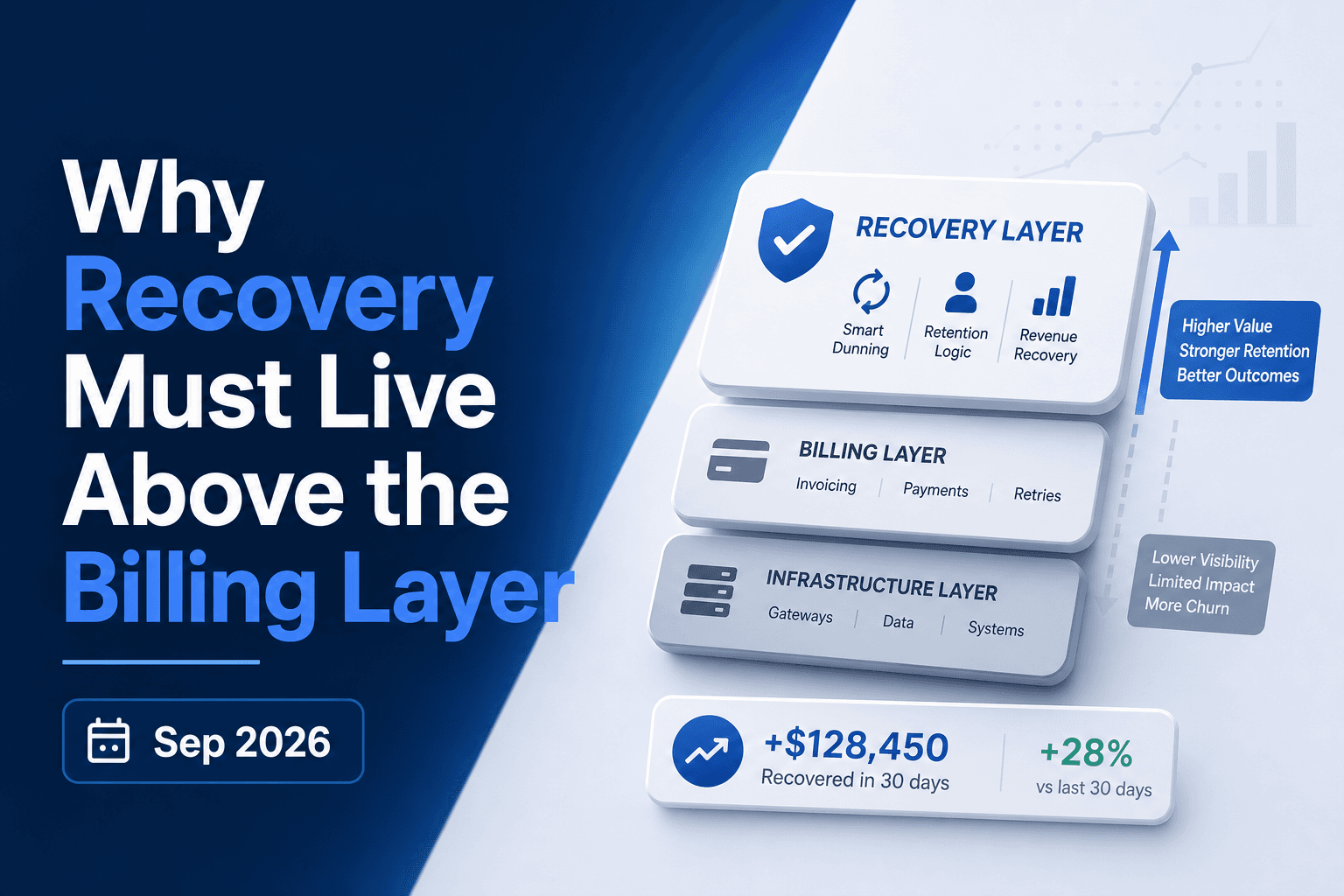
Why Payment Recovery Must Live Above Billers October 2026
A payment fails. Your biller retries it three days later, then again at seven, then at fourteen. What the biller never checks is whether the issuer sent a...
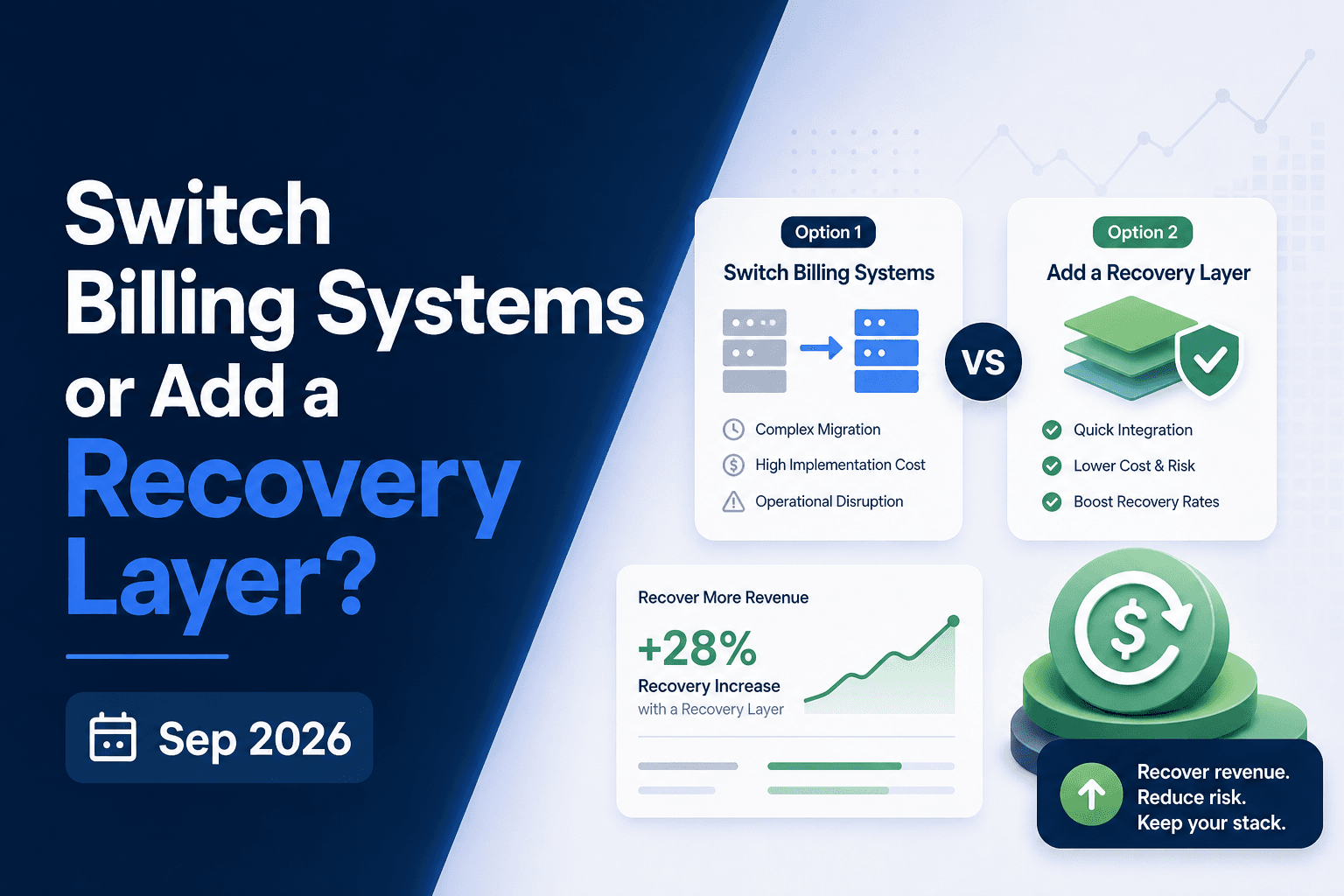
Billing Migration vs Recovery Layer: The Right Call October 2026
Switching billing systems feels like the right move when revenue collection starts breaking down. Sometimes it is. But soft declines, weak retry logic, and...
Stop losing revenue to failed payments
Join leading subscription businesses using Slicker to recover failed payments automatically.
Get Started