Smart Dunning & Personalized Recovery Emails Explained: July 2026
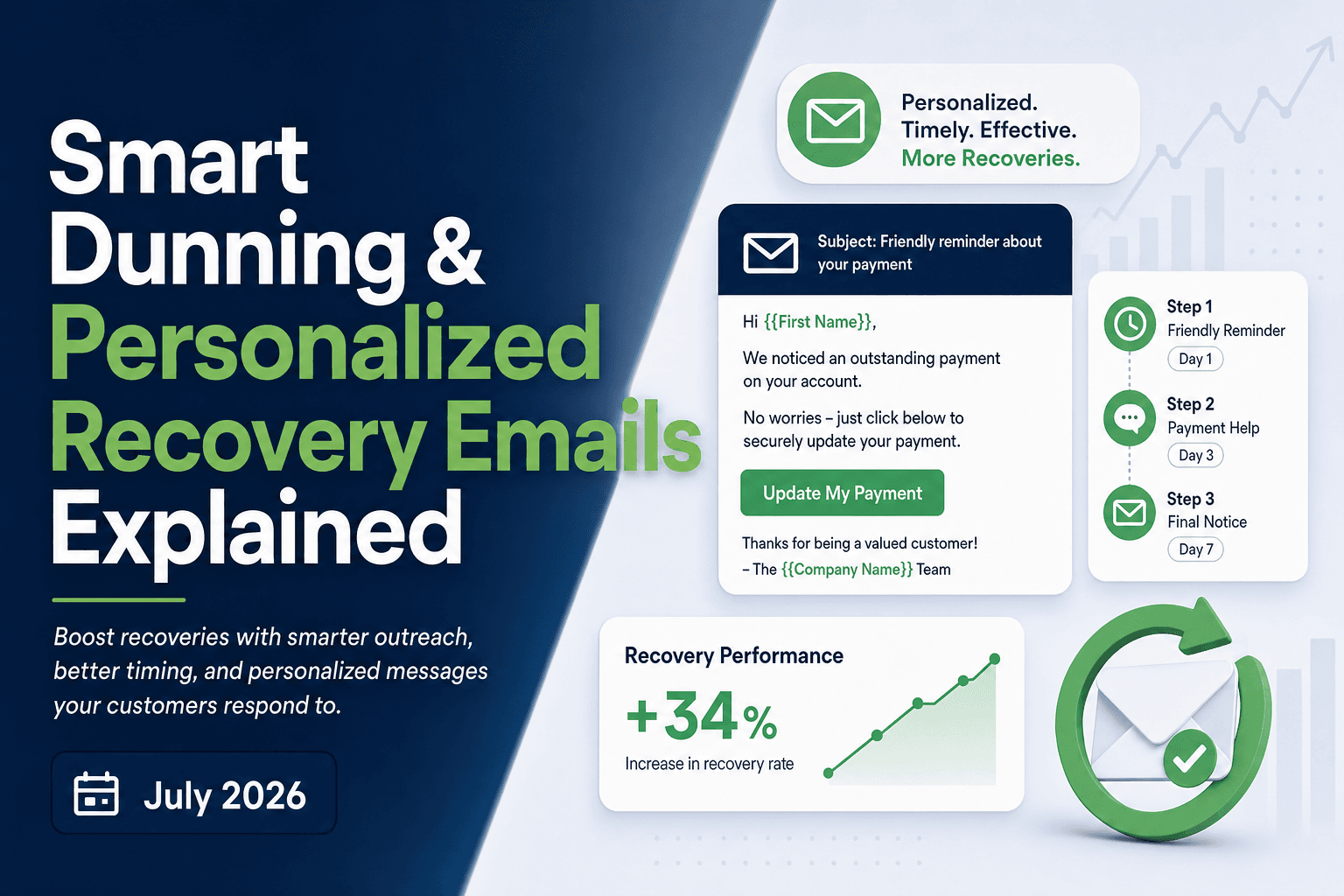
Your subscribers aren't all failing to pay for the same reason, so your dunning emails probably shouldn't all say the same thing. A temporary overdraft, an expired card, and a fraud flag each have a different fix, a different timeline, and a different message that works. Smart dunning starts with that classification. Silent retry is the first move. Hyper-personalized dunning emails, timing, and tone handle what silent recovery cannot. Here's how it all fits together.
TLDR:
- Silent recovery comes first: soft declines can resolve via a well-timed retry, with no subscriber friction or cancellation risk.
- Industry data shows roughly 15% of recurring payments fail on the first attempt, but most of that revenue is recoverable through silent retries and targeted outreach.
- Hyper-personalized dunning emails vary copy, tone, and timing by failure type: stolen card, insufficient funds, and expired card each get a distinct message.
- AI classifies each decline code and routes the account to the right recovery path, whether a silent retry or a targeted outreach sequence.
- Slicker routes subscribers into failure-specific sequences, with customers seeing a 4-10 percentage-point recovery rate uplift confirmed through AABB testing on their own data.
What Smart Dunning Is
Smart dunning is the practice of recovering failed subscription payments through automated, AI-driven outreach that adapts to each subscriber's specific situation. Where traditional dunning sends the same generic "update your payment method" email to every churning subscriber, smart dunning treats a stolen card as an entirely different problem from insufficient funds on a prepaid card, because it is.
The goal is to recover revenue you already earned from customers who already said yes, without making them feel like a collections notice landed in their inbox.
The Revenue Scale of Failed Payments
Industry data shows roughly 15% of recurring payments fail on the first attempt. At scale, that adds up fast. A subscription business with 100,000 active subscribers and a $50 average monthly charge stands to lose $750,000 in a single billing cycle from failed payments alone.
Most of that revenue is recoverable. The payment didn't fail because the customer wanted to leave. It failed because of a soft decline, an expired card, or a temporary bank-side issue. That's involuntary churn (lost subscribers due to payment failure, not cancellation intent), and it quietly erodes MRR (monthly recurring revenue) every month without a single cancellation request. 2025 benchmarks show the industry median recovery rate sits at 47.6%, with top-performing subscription businesses reaching well above that.
The companies that recover it efficiently are the ones treating each failed payment as a distinct problem with a specific cause, not a generic billing error to blast with reminders.
Why Failure Type Determines Recovery Strategy
Not every payment failure is the same problem. Soft declines are temporary: insufficient funds, network timeouts, processor errors where the card is valid and a well-timed retry can succeed without any customer involvement. Hard declines are permanent: stolen card, closed account, active fraud flag. No retry recovers these. The customer has to act first.
Failure Type | Examples | Recovery Path |
|---|---|---|
Soft decline | Insufficient funds, network timeout, processor error | Automated retry at optimal timing |
Hard decline | Stolen card, closed account, fraud flag | Customer outreach required |
Ambiguous | Generic decline, "do not honor" | AI classification needed before acting |
Generic dunning ignores this classification entirely. Every failed payment gets the same outreach sequence regardless of cause. Customers receive requests to update payment details they don't need to update, while silently recoverable failures sit unretried. Getting this classification right is what makes hyper-personalized recovery possible in the first place.
Silent Recovery vs. Customer Outreach
When a payment fails, the first question is whether the customer needs to do anything at all. For soft declines like insufficient funds or a temporary bank hold, the answer is often no. A well-timed retry can recover the payment silently, with the subscriber never knowing there was a problem.
Dunning emails come into play when silent recovery has been exhausted or when the failure reason makes customer action unavoidable. An expired card or a reported-stolen card cannot be resolved by retrying. Those situations call for outreach.
Getting this sequence right matters for revenue. Silent recovery costs nothing in subscriber friction. Every email you send carries a small risk of cancellation.
What Hyper-Personalized Dunning Emails Actually Look Like
The best dunning emails in 2026 read nothing like generic "update your payment info" blasts. They are written to a specific subscriber, about a specific failure reason, at a specific moment in their relationship with your brand.
Here is what that looks like in practice:
- A stolen card triggers an immediate dunning letter acknowledging the issue, explaining the card was flagged by the issuer, and giving the subscriber a frictionless path to add a new one before their next billing cycle.
- An insufficient funds decline on a prepaid card gets a softer, value-retention message timed to the subscriber's likely payday window, reminding them what they would lose access to instead of leading with the payment failure.
- An expired card prompts a short, confident note that skips urgency entirely since the fix is simple, with a single clear call to action.
The copy, tone, and timing are all different because the failure reason, subscriber tenure, and recovery probability are all different.
Hyper-personalized dunning emails treat every failed payment as its own recovery problem, not a queue to blast through.
How Customer Segmentation Shapes the Dunning Sequence
Segmentation determines which subscribers receive which dunning sequence, and getting it wrong means sending the same generic "update your payment info" email to a customer whose card was stolen and one who simply hit a temporary overdraft. Those two situations call for completely different actions, urgency levels, and messaging.
Most dunning management frameworks sort subscribers across a few key dimensions.
Common Segmentation Variables
- Decline type: soft declines (insufficient funds, temporary hold) versus hard declines (stolen card, account closed) require different calls to action entirely. Soft declines often resolve on their own; hard declines require the customer to act.
- Subscriber tenure and LTV: a five-year subscriber with high lifetime value warrants more recovery attempts, a more empathetic tone, and possibly a retention offer before cancellation.
- Payment method: credit cards, debit cards, and bank transfers each have distinct failure patterns and recovery windows that should shape send timing, a key factor when choosing dunning email tools for subscription businesses.
- Engagement recency: a subscriber who logged in yesterday is far more likely to respond quickly than one who hasn't touched the product in months.
The practical result is that a well-segmented dunning sequence might run three to five variations simultaneously, each calibrated to a different subscriber profile. That granularity is what separates hyper-personalized dunning from a batch-and-blast retry campaign, and it has a direct bearing on how much revenue you recover before a subscriber lapses.
Dunning Cadence and Grace Period Optimization
Timing and sequence matter as much as the message itself. Even a well-written recovery email fails if it lands at the wrong moment in a subscriber's billing cycle.
Smart dunning systems build cadences around each subscriber's actual pay schedule. A weekly-paid worker in the UK and a bi-monthly salaried employee in the US have very different windows of likely account replenishment, and sending the same email on the same day treats them identically when they aren't.
How optimized grace periods work
In place of a fixed 7- or 14-day grace window applied to every account, smart dunning AI-driven cadences adjust based on:
- The specific decline code returned (a temporary hold clears faster than an expired card)
- Historical replenishment patterns for that subscriber's BIN range
- Time-zone-aware send windows that hit inboxes during peak engagement hours
The result is a cadence that shrinks or extends the grace period per account, recovering revenue sooner where possible and holding off where patience pays.
Connecting this back to the P&L: tighter, smarter cadences reduce days sales outstanding (DSO) without increasing unsubscribe rates, which means recovered revenue lands faster without burning the subscriber relationship you worked to build.
Measuring Smart Dunning Performance
Track the metrics that connect dunning performance to revenue, beyond open rates. Industry data shows payment failure rates can reach up to 14.7% in certain sectors, making precise measurement critical for understanding your true recovery ceiling.
The Numbers That Matter
- Recovery rate by failure reason: measure what percentage of stolen-card emails, insufficient-funds emails, and expired-card emails each convert separately. Blended averages hide which segments need attention.
- Revenue recovered per cohort: dollars saved is the only metric your CFO cares about. Track it monthly against your involuntary churn baseline.
- Time-to-recovery: how many days between initial failure and successful payment. Shorter windows mean less subscriber anxiety and less exposure to voluntary cancellation, a key distinction in the dunning emails vs. AI retries debate.
Tie every metric back to MRR retained. If your dunning reporting stops at "email delivered," you're measuring the wrong thing.
What AI Adds to Smart Dunning in 2026
Heading into 2026, AI has moved dunning well past the era of scheduled email blasts. Where older systems sent the same recovery sequence to every churned subscriber, AI-powered dunning reads the actual failure signal and responds accordingly.
The reason a payment fails tells you a great deal about what to do next. A stolen card needs the subscriber to act. A temporary bank-side issue may resolve on its own with a well-timed retry. Sending a generic "please update your card" email in the second scenario is noise at best, friction at worst.
AI changes how recovery decisions get made across a few key areas:
- Failure reason classification: AI reads the decline code and routes the account toward the right recovery path, whether that is a silent retry, a targeted email, or a pause in communication while the system waits for a better retry window.
- Send-time optimization: models trained on historical payment behavior identify when a specific subscriber is most likely to have funds available or to open and act on an email, instead of sending at a fixed hour.
- Copy and channel selection: subscriber behavior signals, such as past email open rates and engagement history, inform which message framing and which channel is most likely to recover the account without generating cancellations, a capability central to the best AI dunning tools available.
The upstream benefit is that dunning emails only go out when they genuinely need to. Silent recovery handles what it can first, and the emails that do reach subscribers are tailored to the actual situation instead of a one-size script. That keeps your brand relationship intact while recovering revenue you already earned.
How Slicker Implements Smart Dunning
Slicker's dunning logic starts at the transaction level. AI classifies each failure before any outreach decision is made, routing subscribers into sequences calibrated to the exact decline code, not a generic queue. Message copy and timing vary by failure reason, the call-to-action reflects what each subscriber actually needs to do, and every email goes out from your domain to keep brand trust intact.
The performance is verifiable before any commitment. Slicker has recovered over 1 million failed payments, with customers seeing a 4-10 percentage-point recovery rate uplift confirmed through AABB testing in payment recovery on their own transaction data. As one CFO put it after seeing the results:
"Slicker improved our margins by more than 1%. In my world, even 0.1% is a game-changer."
The 4-month pilot (first month free, three paid months, no minimum commitment) launches in under 5 minutes with zero engineering lift, running against live data without touching your existing billing infrastructure.
Final Thoughts on Smart Dunning and Hyper-Personalized Payment Recovery
Every billing cycle, a portion of your MRR slips out quietly through failed payments that looked like churn but were not. Smart dunning closes that gap by treating each failure as its own problem with its own fix, whether that is a well-timed silent retry or a dunning email written around the actual decline reason. You already did the hard work of acquiring those subscribers. The recovery is just a matter of responding precisely. If you want to see what a smarter approach recovers on your own data, talk to Slicker's team.
FAQ
What's the difference between smart dunning and hyper-personalized dunning?
Smart dunning is the broader category: automated, failure-aware recovery outreach that routes each subscriber into a sequence based on why their payment failed. Hyper-personalized dunning goes further, calibrating the message copy, tone, timing, and call-to-action to the specific subscriber's tenure, payment method, and decline code. A stolen card gets a fraud-alert message; a prepaid card with insufficient funds gets a value-retention note timed to the subscriber's likely payday window.
Can you recover failed subscription payments without emailing the subscriber at all?
Yes, for soft declines like insufficient funds or temporary bank holds. A well-timed retry can recover the payment silently, with the subscriber never knowing there was a problem. Dunning emails come into play only when silent recovery has been exhausted or the failure reason requires customer action, such as an expired or stolen card. Sending email when a silent retry would suffice adds unnecessary cancellation risk.
How do I measure whether my dunning emails are actually working?
Track recovery rate broken down by failure reason, not blended averages, since stolen-card recovery and insufficient-funds recovery behave very differently. Pair that with revenue recovered per cohort (the metric your CFO will ask for) and time-to-recovery (days between initial failure and successful payment). Open rates tell you almost nothing about revenue retained.
What is AABB testing and how does Slicker use it to prove dunning performance?
AABB testing is a crossover methodology borrowed from clinical drug trials that splits failed payments into four stratified groups, two control and two treatment, to eliminate cherry-picking and confirm results with statistical significance. Slicker uses this to measure recovery in actual dollars recovered on a merchant's own transaction data, not on vendor benchmarks. If Slicker's dunning and retry logic does not outperform the control group with statistical significance, the merchant does not pay.
Should I replace my existing dunning system with Slicker or run them alongside each other?
Slicker supports both approaches: it can run alongside your existing dunning infrastructure, layering failure-reason-specific messaging on top of generic sequences, or it can replace your current transactional email system for payment recovery entirely. The right starting point depends on how targeted your current sequences are. Slicker's 4-month pilot (first month free, three paid months, no minimum commitment) runs against live data so you can compare performance directly before committing to a full migration.
Related Articles

Expired Cards as a Churn Vector: The Plastic Aging Problem (Sep 2026)
A surprising share of lost subscribers didn't cancel. Their card aged out, the charge failed hard, and your billing system had no path forward. Separating...
Retry Velocity Limits: Issuer Caps Explained September 2026
When a retry velocity limit gets tripped, the damage shows up in two places: the per-attempt fees on transactions that were never going to convert, and the...

Involuntary Churn Is Draining Your LTV (September 2026)
If your monthly churn sits around 6% and you're pouring budget into win-back campaigns, there's a good chance you're solving for the 3% while the other 3%...
Stop losing revenue to failed payments
Join leading subscription businesses using Slicker to recover failed payments automatically.
Get Started