Personalized Retry Schedules vs. Rules-Based Dunning: October 2026

Introduction
Generic retry schedules are leaving millions on the table. While most subscription businesses rely on rigid 3-, 7-, 14-day retry patterns, industry leaders are adopting AI-powered personalization that treats each failed payment as a unique recovery opportunity. Up to 70% of involuntary churn stems from failed transactions - customers who never intended to leave but are forced out when a card is declined (Slicker). The stakes couldn't be higher: in some industries, decline rates reach 30%, and each one represents a potential lost subscriber (Solidgate).
This playbook reveals how companies like Stripe, Chargebee, and Slicker are redefining payment recovery through AI-powered retry schedules. Instead of treating all failures identically, these tools analyze hundreds of signals, from decline codes to customer behavior patterns, to determine the optimal retry timing for each transaction. Machine-learning engines predict the perfect moment, method, and gateway for each retry, lifting recovery rates 2-4x above native billing logic (Slicker).
TLDR:
- Up to 70% of involuntary churn comes from failed payments, not cancellations; generic 3-, 7-, 14-day retry rules leave recoverable MRR on the table.
- Mapping decline codes to failure-specific retry windows (e.g., insufficient funds to payroll cycles, processing errors to 1-4 hours) measurably outperforms blanket schedules.
- Recurly's 2026 enterprise data found optimized retry logic lifted recovery rates from 53% to 71%, translating to $11.6M in annualized recovered revenue for one retailer.
- Segment high-value customers (LTV over $1,000) with up to 7 retry attempts at 1-2 day intervals; trial accounts warrant 2-3 attempts at 5-7 day intervals.
- Slicker applies AI at the individual transaction level across Stripe, Chargebee, Recurly, Zuora, and Recharge, with a 5-minute no-code setup and performance-based pricing on recovered revenue only.
TLDR:
- Up to 70% of involuntary churn comes from failed payments; generic 3-, 7-, 14-day retry rules leave recoverable MRR on the table.
- Map decline codes to failure-specific windows: insufficient funds to payroll cycles (3-5 days), processing errors to 1-4 hours.
- Recurly's 2026 enterprise data found optimized retry logic lifted recovery rates from 53% to 71%, producing $11.6M in annualized recovered revenue for one retailer.
- Segment high-value customers (LTV over $1,000) for up to 7 retry attempts at 1-2 day intervals; trial accounts warrant 2-3 attempts at 5-7 day intervals.
- Slicker applies AI at the individual transaction level across Stripe, Chargebee, Recurly, Zuora, and Recharge, with a 5-minute no-code setup and pricing on recovered revenue only.
The Hidden Cost of Generic Retry Rules
Traditional dunning management treats payment failures like a one-size-fits-all problem. A customer whose card expires gets the same retry schedule as someone with insufficient funds, despite requiring completely different recovery strategies. This approach ignores critical nuances that determine retry success rates.
Failed payments cause nearly 20-30% of all lost online sales (Medium). The biggest reason behind failed transactions is relying on a single payment gateway and uniform retry logic. When businesses apply blanket retry schedules across all decline types, they miss the optimal recovery window for specific failure categories.
A staggering 62% of users who hit a payment error never return to the site (Solidgate). This statistic underscores why timing matters: retry too aggressively, and you risk customer frustration; wait too long, and the customer moves on. Paddle's analysis of 2,000+ SaaS companies found involuntary churn accounts for 13-15% of total churn across segments, making recovery optimization a revenue-critical initiative.
Understanding Stripe's 500-Signal Smart Retries Model
Stripe's Smart Retries system represents the gold standard for personalized payment recovery. Instead of applying uniform retry schedules, Stripe analyzes over 500 signals to determine the optimal retry strategy for each failed payment. These signals include:
- Decline code specifics: Hard declines (expired cards) versus soft declines (insufficient funds)
- Customer payment history: Previous successful retry patterns and timing
- Merchant category and geography: Industry-specific success rates and regional banking patterns
- Time-based factors: Day of week, time of month, and seasonal trends
- Card issuer behavior: Bank-specific retry success windows
The global digital payments market is projected to reach $14.78 trillion by 2027, with cash payments predicted to make up less than 10% of total Point of Sale transactions by 2026 (Saufter). This shift toward digital payments makes retry optimization increasingly critical for subscription businesses.
Stripe's machine learning models continuously learn from billions of transactions, identifying patterns that human-designed rules would miss. For example, the system might find that customers in specific geographic regions have higher retry success rates on weekends, or that certain card types respond better to longer retry intervals.
Chargebee's Smart Dunning Framework
Chargebee takes a different but equally sophisticated approach to retry personalization. Their Smart Dunning system focuses on customer lifecycle stage and subscription value to optimize retry strategies. Chargebee recognizes that a high-value enterprise customer deserves different treatment than a trial user.
Key components of Chargebee's approach include:
- Customer segmentation: Retry frequency and messaging vary based on customer lifetime value
- Subscription context: Annual subscribers get more aggressive retry attempts than monthly users
- Payment method intelligence: Different retry schedules for credit cards versus ACH payments
- Geographic optimization: Localized retry timing based on regional banking practices
Smart dunning systems can lift recovery rates by up to 25% compared with static rules, according to industry analysis. This improvement translates directly to reduced churn and increased monthly recurring revenue (MRR).
Slicker's Transaction-Level Machine Learning Approach
Slicker represents the next evolution in payment recovery, applying AI at the individual transaction level. Founded in 2023 in London by payments veterans and backed by Y Combinator, Slicker delivers 2-4× better recovery than native billing-provider logic (Y Combinator).
Slicker's proprietary AI engine processes each failed payment individually and schedules an intelligent, data-backed retry instead of blindly following generic decline-code rules (Slicker). Slicker supports Stripe, Chargebee, Recurly, Zuora, and Recharge, offering a 5-minute setup with no code changes required.
Customers typically see a 10-20 percentage point recovery increase and a 2-4x boost versus native billing logic (Slicker). This improvement stems from Slicker's ability to analyze hundreds of variables for each failed transaction, including:
- Real-time decline code analysis: Understanding the specific reason for failure
- Customer behavior patterns: Previous payment success timing and methods
- Merchant-specific data: Historical recovery rates for similar transactions
- External factors: Banking holidays, regional events, and seasonal patterns
Mapping Decline Codes to Optimal Retry Windows
Effective retry personalization starts with understanding soft vs. hard declines and their optimal recovery strategies. Here's a full mapping framework:
Hard Declines (Immediate Action Required)
Decline Code Category | Optimal Retry Window | Recovery Strategy |
|---|---|---|
Expired Card | 0-1 hours, then 24-48 hours | Immediate customer notification + card update prompt |
Invalid Card Number | No retry | Customer contact required |
Stolen/Lost Card | No retry | New payment method needed |
Restricted Card | 7-14 days | Allow time for customer to resolve with bank |
Soft Declines (Retry Opportunities)
Decline Code Category | Optimal Retry Window | Recovery Strategy |
|---|---|---|
Insufficient Funds | 3-5 days, then 7-10 days | Align with typical payroll cycles |
Processing Error | 1-4 hours | Quick retry for temporary issues |
Velocity Limit | 24-48 hours | Allow daily limits to reset |
Generic Decline | 2-3 days, then 7 days | Conservative approach for unknown issues |
Adaptive retries represent a measurable leap forward because the system processes nuances in real time, producing higher accuracy and success (Solidgate). Instead of applying these windows uniformly, AI-powered systems adjust timing based on additional context signals.
Building Your Personalized Retry Schedule Template
Creating an effective personalized retry schedule requires balancing multiple factors. Here's a step-by-step template:
Step 1: Customer Segmentation
High-Value Customers (LTV > $1000):
- More retry attempts (up to 7)
- Shorter initial intervals (1-2 days)
- Personal outreach after 3rd failure

Standard Customers (LTV $100-$1000):
- Standard retry attempts (4-5)
- Balanced intervals (2-5 days)
- Automated email sequences

Trial/Low-Value Customers (LTV < $100):
- Fewer retry attempts (2-3)
- Longer intervals (5-7 days)
- Minimal manual intervention
Step 2: Decline Code Mapping
Tools like Slicker process each failing payment individually and convert past-due invoices into revenue by applying sophisticated decline code analysis. Your template should include:
- Immediate retries: Processing errors, temporary network issues
- Short-term retries: Insufficient funds, velocity limits
- Medium-term retries: Generic declines, issuer-specific blocks
- Long-term retries: Restricted cards, fraud holds
- No retry: Expired cards, invalid numbers, stolen cards
Step 3: Timing Optimization
Consider these factors when scheduling retries:
- Day of week: Avoid Mondays for B2B customers, optimize weekends for consumers
- Time of month: Align with payroll cycles (1st, 15th, 30th)
- Geographic factors: Account for banking holidays and regional patterns
- Industry specifics: B2B vs. B2C timing preferences
Expected Uplift Ranges and ROI Calculations
Industry data shows consistent improvement ranges when moving from rules-based to AI-powered retry schedules:
Recovery Rate Improvements
- Conservative estimate: 10-15 percentage point increase
- Typical improvement: 15-20 percentage point increase
- Best-case scenarios: 25-30 percentage point increase
If AI can deliver the documented 10-20-point uplift enjoyed by Slicker clients, translate that into annualized MRR to secure budget (Slicker). For a company with $1M ARR and 15% involuntary churn, a 15-point recovery improvement could recover an additional $22,500 annually.
Current State:
- Monthly failed payments: $50,000
- Current recovery rate: 40%
- Monthly recovered revenue: $20,000
- Monthly lost revenue: $30,000

With AI-Powered Retries:
- Improved recovery rate: 55% (+15 points)
- Monthly recovered revenue: $27,500
- Additional monthly recovery: $7,500
- Annual additional recovery: $90,000
Dunning systems with automatic card-updater services recover up to 20% more invoices before a retry is even needed, further improving overall recovery rates.
Implementation Best Practices
Technical Integration
Slicker boasts a 5-minute setup with no code changes, plugging into Stripe, Chargebee, Recurly, Zuora, and Recharge. When implementing personalized retry schedules:
- Start with high-impact segments: Focus on high-value customers first
- A/B test retry strategies: Compare personalized vs. rules-based approaches
- Monitor customer experience: Track complaint rates and satisfaction scores
- Iterate based on data: Continuously refine retry windows based on results
Monitoring and Optimization
Up to 30% of online payments fail due to card declines, fraud checks, and inefficient processing routes (Solidgate). Effective monitoring requires:
- Real-time dashboards: Track retry success rates by segment and decline code
- Customer feedback loops: Monitor support tickets related to payment issues
- Competitive benchmarking: Compare recovery rates against industry standards
- Seasonal adjustments: Adapt retry schedules for holiday and seasonal patterns
Advanced Strategies for 2026
Multi-Gateway Routing
Intelligent payment routing directs transactions through the most efficient payment processors, acquirers, or gateways based on real-time data (Solidgate). In Brazil, using an international acquirer instead of a domestic one can reduce approval rates by over 20% due to low credit card penetration and preference for local payment methods.
Predictive Analytics
AI systems in payments are built to make hundreds of real-time microdecisions on each transaction, identifying which failures are likely to resolve and predicting the optimal retry window before the next attempt fires. Stripe's Payments Intelligence Suite, for example, powers retry logic that recovered more than $6 billion in legitimately declined transactions for users in 2024 alone, with businesses seeing acceptance rate improvements of up to 7% (Stripe).
Customer Communication Optimization
Personalized retry schedules should include coordinated customer communication:
- Pre-dunning alerts: Notify customers before payment attempts
- Failure notifications: Immediate, clear communication about payment issues
- Recovery assistance: Proactive support to resolve payment problems
- Success confirmations: Positive reinforcement when payments recover
Measuring Success: Key Metrics and KPIs
Track these metrics to assess your personalized retry schedule performance:
Primary Metrics
- Recovery Rate: Percentage of failed payments successfully recovered
- Time to Recovery: Average days from failure to successful payment
- Customer Retention: Percentage of customers retained after payment failure
- Revenue Recovery: Dollar amount recovered through retry attempts
- Retry Performance: Success rate per retry attempt
- Customer Satisfaction: Support ticket volume and satisfaction scores
- Running Cost: Resources required for retry management
- Churn Prevention: Reduction in involuntary churn rates
Future-Proofing Your Retry Strategy
The payments industry continues evolving rapidly. Slicker only charges you for successfully recovered payments, offering a risk-free way to test advanced retry strategies (Slicker). Consider these new trends:
Real-Time Decision Making
Modern AI retry engines operate as event-driven processes: the moment a payment fails, the model ingests decline code, card metadata, customer history, and issuer signals to produce a retry decision in milliseconds. Payments are a data-rich domain requiring hundreds of microdecisions in real time, making them well-suited to AI-powered optimization (Stripe). This event-driven architecture delivers instant, context-aware retry decisions instead of waiting for the next scheduled batch window.
Cross-System Intelligence
Future retry systems will aggregate data across multiple payment processors and merchants, creating industry-wide intelligence that benefits all participants.
Regulatory Compliance
As payment regulations evolve, retry systems must adapt to maintain compliance while optimizing recovery rates.
What's Changed in 2026: The Recovery Gap Is Now Measurable
For years, the case for AI-powered retry personalization rested largely on projections. In 2026, the data is in, and the gap between optimized and unoptimized retry logic is now quantifiable at enterprise scale.
Recurly's analysis of enterprise transaction data found that optimized retry strategies lifted failed payment recovery rates from approximately 53% to 71%, without replacing a single component of existing billing infrastructure. For one enterprise membership retailer, that 18-point improvement translated to an estimated $11.6 million in annualized recovered revenue. A second analysis on a global food-delivery subscription service projected $21.6 million in annualized recovery uplift from the same optimized logic.
The macro cost of inaction is equally stark. Failed subscriptions are now projected to cost businesses $129 billion in lost revenue in 2025 alone, a figure that shows why payment recovery has graduated from a billing-ops detail to a board-level revenue initiative. Meanwhile, Baremetrics' May 2026 benchmark report, drawn from 119 active recovery customers, found a median attempted recovery ROI of 808% and reported that 95% of customers saw Recover pay for itself within a single month (Baremetrics).
Two structural changes define the 2026 picture. First, AI-driven dunning is moving from "nice to have" to standard practice: Stuut reports a 40% average cash flow increase and a 37% reduction in past-due AR across 74 customers in 2025, with the gains driven by timing precision. A soft decline on a Friday afternoon carries a materially different optimal retry window than an insufficient-funds failure on a Monday morning. Second, the evaluation standard has tightened. Buyers now expect vendors to report statistical significance, p-values, and methodology alongside recovery rate numbers, not headline percentages alone. That change mirrors exactly the clinical-grade, prove-don't-promise standard Slicker has built its measurement framework around.
The takeaway for subscription finance and operations teams heading into Q4 2026: the question is no longer whether personalized retry logic outperforms static rules. The data is settled. The question is how much revenue your current schedule is leaving on the table, and how quickly you can close that gap.
AI Payment Recovery Tools for Subscription E-Commerce in 2026
The field of AI-powered failed payment recovery has matured rapidly. In 2026, subscription e-commerce businesses have a range of specialist tools to choose from, each with a distinct approach to retry intelligence, pricing, and integration depth. Here is how the leading tools compare.
Slicker
Founded in 2023 and backed by Y Combinator, Slicker applies transaction-level machine learning to each failed payment individually. It integrates with Stripe, Chargebee, Recurly, Zuora, and Recharge in under five minutes with no code changes required. Customers report a 10-20 percentage point recovery uplift and a 2-4x improvement over native billing logic. Slicker charges only for successfully recovered payments, using a risk-free pricing model that aligns incentives precisely with the subscription e-commerce operator's bottom line.
Churn Buster
Churn Buster is a dunning and failed payment recovery tool built for subscription businesses. It combines automated card-update workflows, customizable email sequences, and retry logic to reduce passive churn. The tool is particularly well-suited to Shopify and WooCommerce subscription merchants and positions itself on ease of setup and transparent reporting of recovered revenue.
Gravy Solutions
Gravy (now part of Gravy Solutions) takes a human-assisted recovery model: its team contacts subscribers directly via text, phone, and email to resolve failed payments, a high-touch approach that suits businesses with high average order values or membership communities where brand relationship is central. This complements automated retry logic for high-LTV segments instead of replacing it.
Baremetrics Recover (formerly Recover by Baremetrics)
Baremetrics Recover is tightly integrated with Stripe and Braintree. It focuses on automated in-app and email nudges that prompt customers to update payment details before a subscription lapses. Per the same May 2026 benchmark report cited above, the tool delivers strong ROI with most customers seeing it pay for itself within a single month.
ProfitWell Retain
ProfitWell Retain (a Paddle product) tackles both voluntary and involuntary churn. On the involuntary side, it uses card-updater integrations and behavioral email triggers to recover failed payments. Its differentiation is the breadth of analytics it layers on top, connecting payment failure recovery data to broader subscription health metrics, which makes it appealing to finance teams that want unified dashboards.
Recurly Revenue Recovery
Recurly's native recovery suite includes Account Updater, an intelligent retry engine, and configurable dunning email sequences. Its 2026 enterprise analysis found that optimized retry strategies lifted failed payment recovery rates from approximately 53% to 71% - an 18-point improvement. For businesses already on Recurly, the native tooling is a low-friction starting point, though third-party AI layers like Slicker can stack on top for additional uplift.
Choosing the Right Tool
The right choice depends on three variables: your billing system, your average customer LTV, and how much engineering bandwidth you have. For high-volume e-commerce subscriptions running on Stripe or Chargebee, a zero-code AI layer like Slicker delivers the fastest time-to-value. For businesses with high-value members where a human touch matters, a hybrid model (automated retries plus Gravy's outreach) recovers revenue that automation alone would miss. For teams already deep in the Paddle or Recurly ecosystem, the native tools provide solid baselines that specialist AI can layer on top of.
Conclusion
Personalized retry schedules represent a fundamental shift from reactive dunning management to proactive revenue recovery. By moving beyond generic 3-, 7-, 14-day rules, subscription businesses can capture the 10-20 percentage point uplift that AI-powered systems deliver.
The evidence is clear: AI-powered retry optimization consistently outperforms rules-based approaches (Slicker). Companies that adopt transaction-level personalization will capture more revenue, reduce involuntary churn, and improve customer experience.
Start by mapping your current decline codes to optimal retry windows, segment customers by value and behavior, and implement A/B testing to validate improvements. The technology exists today to overhaul your payment recovery. The question is whether you'll act before your competitors do.
With tools offering 5-minute integrations and pay-for-success pricing models, there's never been a lower barrier to entry for advanced payment recovery. The cost of inaction (continued revenue leakage through suboptimal retry schedules) far exceeds the investment in modern solutions.
Frequently Asked Questions
What is the difference between personalized retry schedules and rules-based dunning?
Rules-based dunning uses rigid, one-size-fits-all retry patterns like 3-, 7-, 14-day intervals for all failed payments. Personalized retry schedules use AI to analyze individual customer behavior, payment history, and failure reasons to create customized recovery timelines. This personalized approach can deliver 10-20 point improvements in recovery rates compared to generic rules.
How much revenue is lost due to involuntary churn from failed payments?
Up to 70% of involuntary churn stems from failed transactions, with customers who never intended to leave being forced out due to payment issues. Failed payments cause nearly 20-30% of all lost online sales, representing millions of dollars in lost revenue annually. Each failed payment represents a recovery opportunity that personalized retry schedules are better positioned to convert.
What factors should AI-powered retry schedules consider for personalization?
AI-powered retry schedules should analyze customer payment history, failure reasons (expired cards, insufficient funds, technical glitches), transaction timing patterns, and customer engagement levels. The system should also consider payment method preferences, geographic location, and historical success rates for different retry intervals. This data-driven approach produces more precise timing and messaging for each recovery attempt.
How does Slicker's AI-powered payment recovery outperform traditional batch retries?
Slicker's AI system treats each failed payment as a unique recovery opportunity instead of processing them in generic batches. By analyzing individual customer patterns and payment failure contexts, Slicker can optimize retry timing, payment method selection, and recovery messaging. This personalized approach measurably outperforms one-size-fits-all batch processing methods that ignore customer-specific factors.
What are the main causes of payment failures that retry schedules need to handle?
The primary causes include expired credit cards, insufficient funds, technical glitches in payment processing, and outdated billing information. Up to 30% of online payments fail due to card declines, fraud checks, and inefficient processing routes. Understanding these failure types allows personalized retry schedules to adjust timing and approach based on the specific reason for each failed transaction.
How can businesses measure the success of their personalized retry schedule implementation?
Key metrics include recovery rate improvements (targeting 10-20 point increases), reduction in involuntary churn rates, time-to-recovery for failed payments, and overall revenue recovery percentages. Businesses should also track customer satisfaction scores and retention rates post-recovery. Comparing these metrics against previous rules-based systems provides clear ROI measurement for personalized retry schedule investments.
What are the best practices for dunning emails that get customers to update their payment information?
Effective dunning emails combine timing precision, clear language, and a frictionless update path. Send the first email within one hour of a failed payment while the transaction is fresh. Use plain, non-alarming subject lines: "Your payment didn't go through" outperforms "URGENT: Account suspension" because it reduces defensive reactions. Include a single, high-visibility call-to-action that links directly to the payment update page, not the account dashboard. Personalise the email with the last four card digits so the customer immediately understands what to fix. For soft declines like insufficient funds, a second email aligned with the customer's likely payroll date (3-5 days later) measurably outperforms a fixed 24-hour follow-up. Space the sequence: day 1, day 4, day 7, and a final notice before cancellation. Throughout, maintain your brand voice; recovery happens through your relationship with the customer, not through a collections-style scare tactic.
What are best practices for retrying failed subscription payments without hurting your merchant reputation?
Card networks (Visa, Mastercard, and American Express) publish explicit retry rules for recurring transactions, and violating them triggers fines or higher decline rates that compound the original problem. The core rules: do not retry a hard decline (stolen card, invalid number, closed account) under any circumstances; for soft declines, retry velocity limits restrict merchants to 15 retry attempts within 30 days before the card enters a blocked state. Space retries intelligently instead of hammering the same card on consecutive days, as issuers interpret rapid-fire retries as potential fraud. Always use the "recurring" transaction indicator so issuers can apply the appropriate authorisation logic. Maintain a low overall decline rate: consistently high decline rates signal poor portfolio hygiene to acquirers and can lead to increased interchange or account review. AI-powered retry systems like Slicker are designed with these card network constraints built in, so the model learns issuer-specific behaviour and avoids retry patterns that damage your merchant standing while maximising recovery within the permitted window.
How does machine learning improve subscription payment recovery rates compared to static retry rules?
Static retry rules apply the same schedule, typically 3, 7, and 14 days after failure, regardless of why a payment failed, who the customer is, or what their bank's behaviour patterns look like. Machine learning replaces that single schedule with a per-transaction decision. The model ingests decline code category (soft vs. hard), the customer's prior payment success timing, card issuer behaviour, day-of-week and day-of-month patterns, geography, and merchant category, hundreds of signals in combination. It then predicts the probability of a successful retry at each candidate time window and selects the highest-probability moment. Critically, the model continuously retrains on new outcomes: a retry that succeeds on a Tuesday morning for customers of a specific regional bank updates the model's priors for that cohort. The compound effect is a retry schedule that becomes more accurate over time, instead of one that stays static until a human reviews the rules. Slicker's ensemble approach delivers 2-4× the recovery rate of native billing logic precisely because the model captures interactions between variables that no human-written rule set can cover.
What are the best failed payment recovery tools for subscription businesses in 2026?
The leading tools in 2026 are Slicker, Churn Buster, Gravy Solutions, Baremetrics Recover, ProfitWell Retain, and Recurly's native recovery suite. Slicker leads on pure recovery-rate uplift (2-4x over native billing logic) for businesses running on Stripe, Chargebee, Recurly, Zuora, or Recharge, with a performance-based pricing model that charges only for recovered payments. Churn Buster and Baremetrics Recover are strong fits for Shopify and Stripe-native merchants that want automated email sequences plus retry logic in one tool. Gravy Solutions suits high-LTV subscription businesses where human-assisted outreach meaningfully increases save rates. ProfitWell Retain is the natural choice for teams already in the Paddle ecosystem that need involuntary and voluntary churn covered together. Recurly's native recovery engine provides a solid baseline for Recurly customers, with third-party AI layers available for additional uplift. Selection criteria: billing system compatibility, LTV of the at-risk subscriber base, engineering bandwidth available for setup, and whether the vendor charges a flat fee or a percentage of recovered revenue.
What PII does Slicker need to send dunning emails, and is that compatible with GDPR data minimisation?
Slicker operates on the principle of data minimisation by design. To run its retry engine and send dunning emails, Slicker accesses only the data fields required for the task: customer email, subscription and invoice identifiers, payment method metadata (card last four digits, expiry status), and decline codes returned by your billing system. No full card numbers, no sensitive identity documents, and no data beyond what is necessary to identify the failed payment and contact the subscriber. Under GDPR Article 5(1)(c), processing is lawful provided it is adequate, relevant, and limited to what is necessary. Slicker's integration scope is scoped accordingly. Slicker processes data as a data processor on behalf of your business (the data controller), and the Data Processing Agreement covers the lawful basis for each data category. If your legal team needs a DPA or a record of processing activities for due-diligence purposes, Slicker provides these as standard ahead of go-live.
What data signals and integrations does Slicker need to run its retry engine?
Slicker connects to your existing billing system (Stripe, Chargebee, Recurly, Zuora, or Recharge) via API in under five minutes, with no code changes required on your side. The retry engine ingests invoice and subscription data, decline codes, payment method metadata, and customer identifiers from your billing system. Slicker also uses a partnership with Mastercard's network intelligence, which provides issuer-level signal data (approval probability scores, issuer behaviour patterns, and card-status indicators) that sit above what any individual merchant's transaction history can supply. This network-level data is what allows the model to distinguish, for example, between a soft decline that is likely to resolve in three days versus one where the issuer window is typically 24 hours. No separate Mastercard contract is required on your side; the data flows through Slicker's integration layer. Your billing credentials are the only technical requirement for setup.
How does delta-based (incremental recovery) pricing work, and why is it fairer?
Most payment recovery tools charge a percentage of every successfully recovered payment, including the payments you would have recovered anyway through your existing retry logic. Slicker's delta-based pricing charges only on the incremental uplift: the additional revenue recovered above your baseline. In practice, Slicker uses clinical-grade AABB testing to measure your baseline recovery rate on a control group, then tracks only the additional dollars recovered in the treatment group. You pay a percentage of that delta, not of your total recovered revenue. For a business already recovering 40% of failed payments natively, a tool that charges on all recovered revenue is effectively taxing work you were already doing. Delta pricing means Slicker's fee is proportional to the value it actually created, a direct alignment of incentives. This model also makes the ROI calculation straightforward: every pound or dollar you pay Slicker represents a recovery that would not have happened without it.
How can I monitor invoice recovery performance in Slicker after a dunning window change?
Slicker's dashboard provides real-time visibility into recovery performance at the invoice, cohort, and campaign level, not a single aggregate A/B test summary. After a dunning window change, you can track in-flight invoice status, retry attempt history, and outcome by decline code to verify the new window is performing as expected. Cohort-level reporting lets you compare recovery rates for invoices that entered the dunning window before and after the change, so the effect of the configuration adjustment is directly measurable. For teams that want to go deeper, Slicker supports data export and webhook events for every retry attempt and outcome, so you can pipe recovery data into your own BI stack or data warehouse. If you change the dunning window length, invoices already in-flight continue under the original window parameters unless you explicitly apply the new settings to existing open invoices. Slicker's support team guides this transition to avoid double-billing or premature cancellation.
How should the dunning window length be set, and what happens to in-flight invoices when I change it?
Dunning window length (the number of days Slicker attempts to recover a failed invoice before marking it unrecoverable) has a direct effect on both recovery rate and subscriber experience. Longer windows increase the probability of recovery for soft declines tied to short-term liquidity (insufficient funds, velocity limits), but they also extend the period during which a subscriber may lose access or receive repeated payment nudges. The optimal window length varies by business model: B2C subscription businesses with monthly billing typically see diminishing returns beyond 21 days, while B2B annual-contract businesses often benefit from windows of 30-45 days for high-value accounts. Slicker's A/B testing framework lets you run a controlled experiment across two window lengths simultaneously, splitting invoice cohorts 50/50, so you can measure recovery rate, time-to-recovery, and subscriber cancellation rate for each configuration before committing to a change. When you do change the window, in-flight invoices (those already in an active dunning cycle) are not automatically migrated to the new window. Slicker applies the new setting to invoices entering the dunning queue after the change date; your existing open invoices continue under their original window unless you explicitly request a bulk migration, which the Slicker team can support with guidance on the trade-offs.
Can Slicker run a head-to-head test against Stripe Smart Retries or another competing solution to prove incremental lift?
Slicker reports the recovery rate, recovered revenue, and p-value for each arm of the test, so the incremental lift attributable to Slicker is measured on your own transaction data, not inferred from industry benchmarks. Customers who have run this test against Stripe Smart Retries have seen Slicker deliver materially higher recovery rates; the exact uplift varies by billing system, decline code mix, and customer base, but the 2-4x improvement over native billing logic figure cited across Slicker's customer base holds across multiple head-to-head evaluations. Because the test runs on live traffic, you begin recovering additional revenue from day one of the trial, so the evaluation pays for itself.
Sources
- medium.com/@paytringorchestration/smart-payment-routing-convert-failed-transactions-into-revenue
- https://saufter.io/recurly-vs-stripe-pros-and-cons/
- https://solidgate.com/blog/intelligent-payment-routing/
- https://stripe.com/blog/using-ai-optimize-payments-performance-payments-intelligence-suite
- https://www.ycombinator.com/companies/slicker
Related Articles

Recurly Revenue Recovery Tactics That Win

Zuora Retry Logic: CPR Limits and Layering

Build vs Buy: Payment Retry Logic
Stop losing revenue to failed payments
Join leading subscription businesses using Slicker to recover failed payments automatically.
Cookie preferences
Your privacy matters
We use analytics to understand how you use our site and improve your experience. Privacy Policy
Related Articles
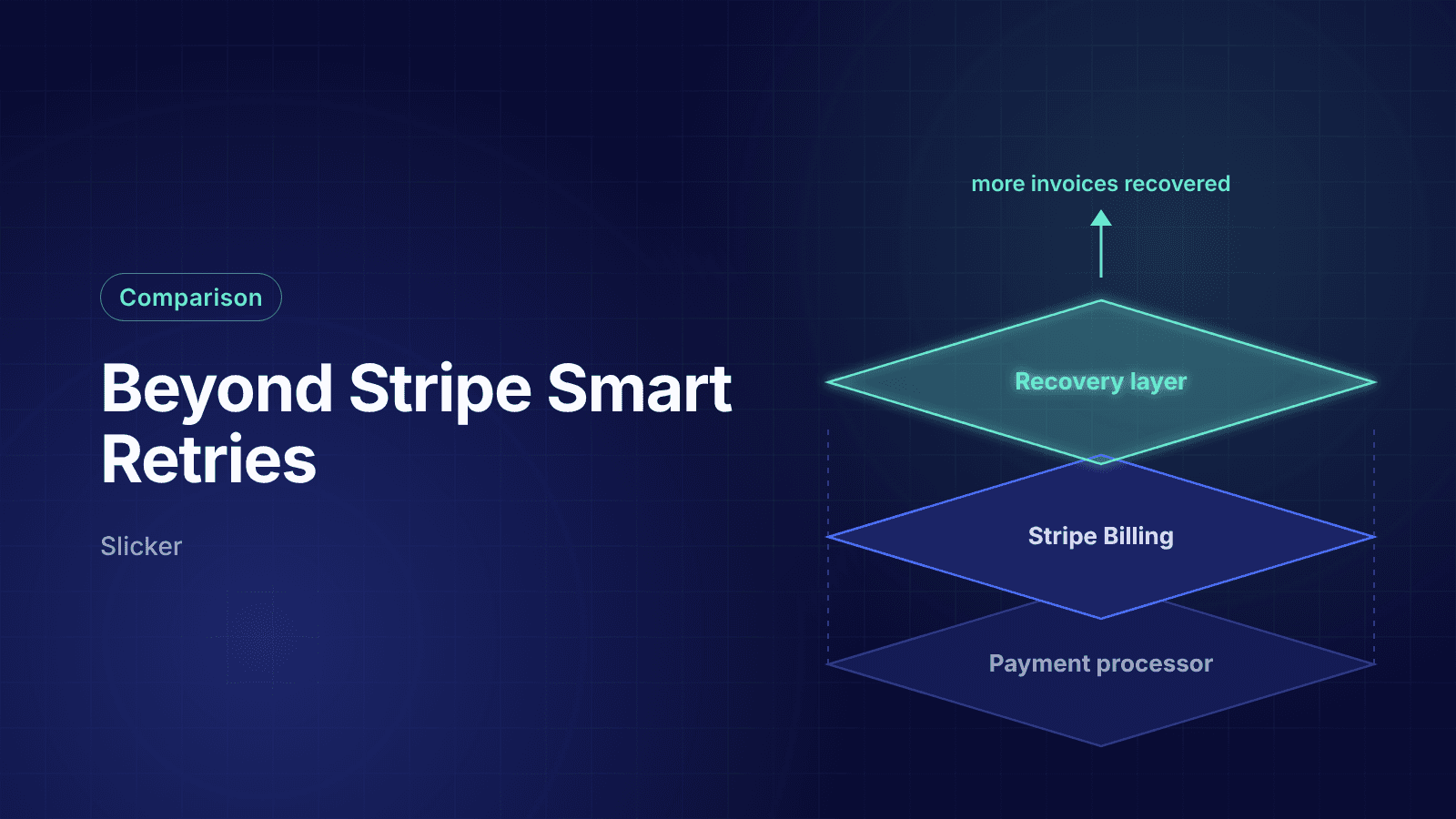
Stripe Smart Retries Alternatives for Subscription Businesses (October 2026)
You turned on Stripe Smart Retries because it was free, it was one toggle, and Stripe said it beats a fixed schedule. Months later your past-due list still...
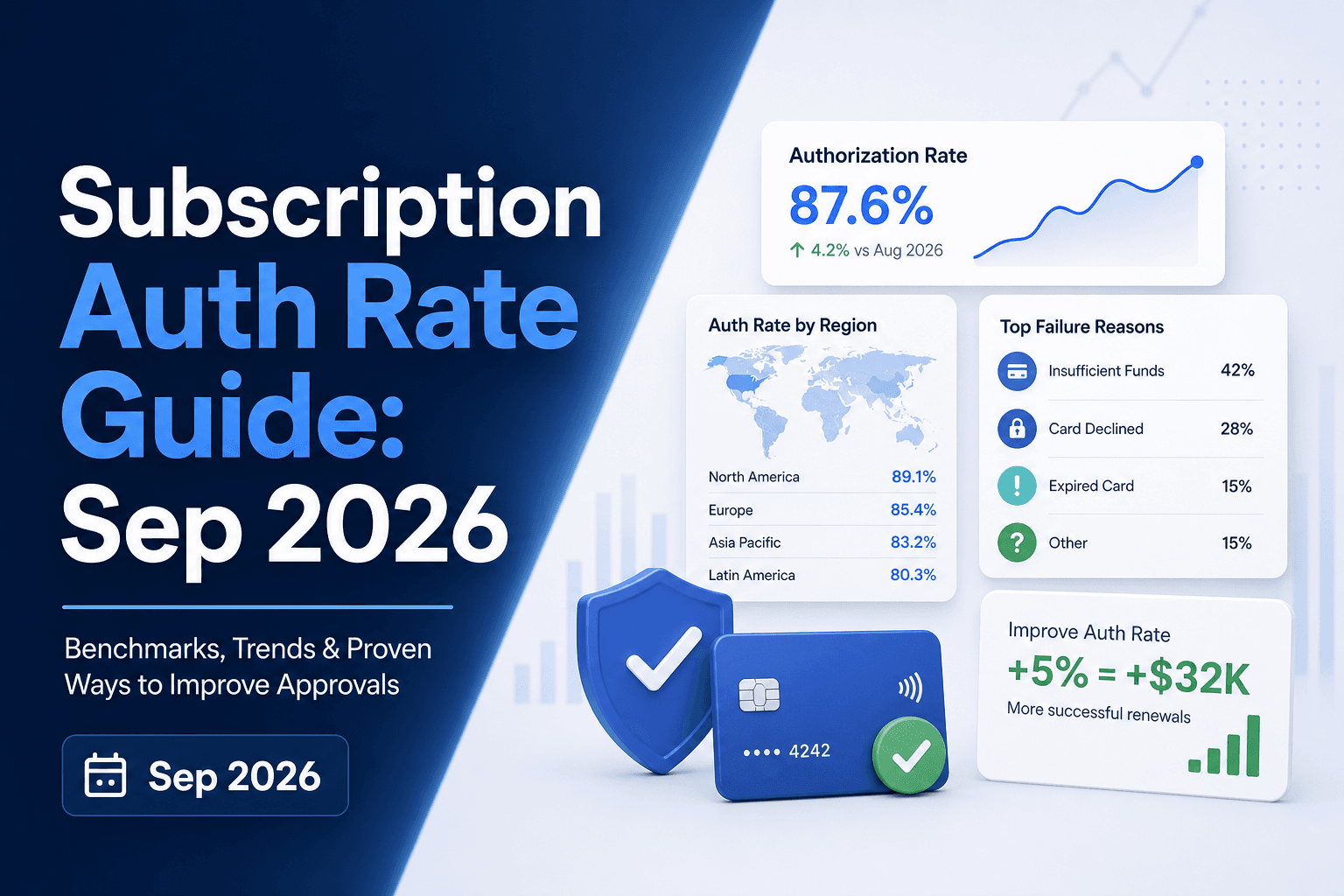
Authorization Rate in Subscription Billing: October 2026
There's a number sitting in your payments data that most finance and retention teams never report on separately: the share of renewal charges your issuing...
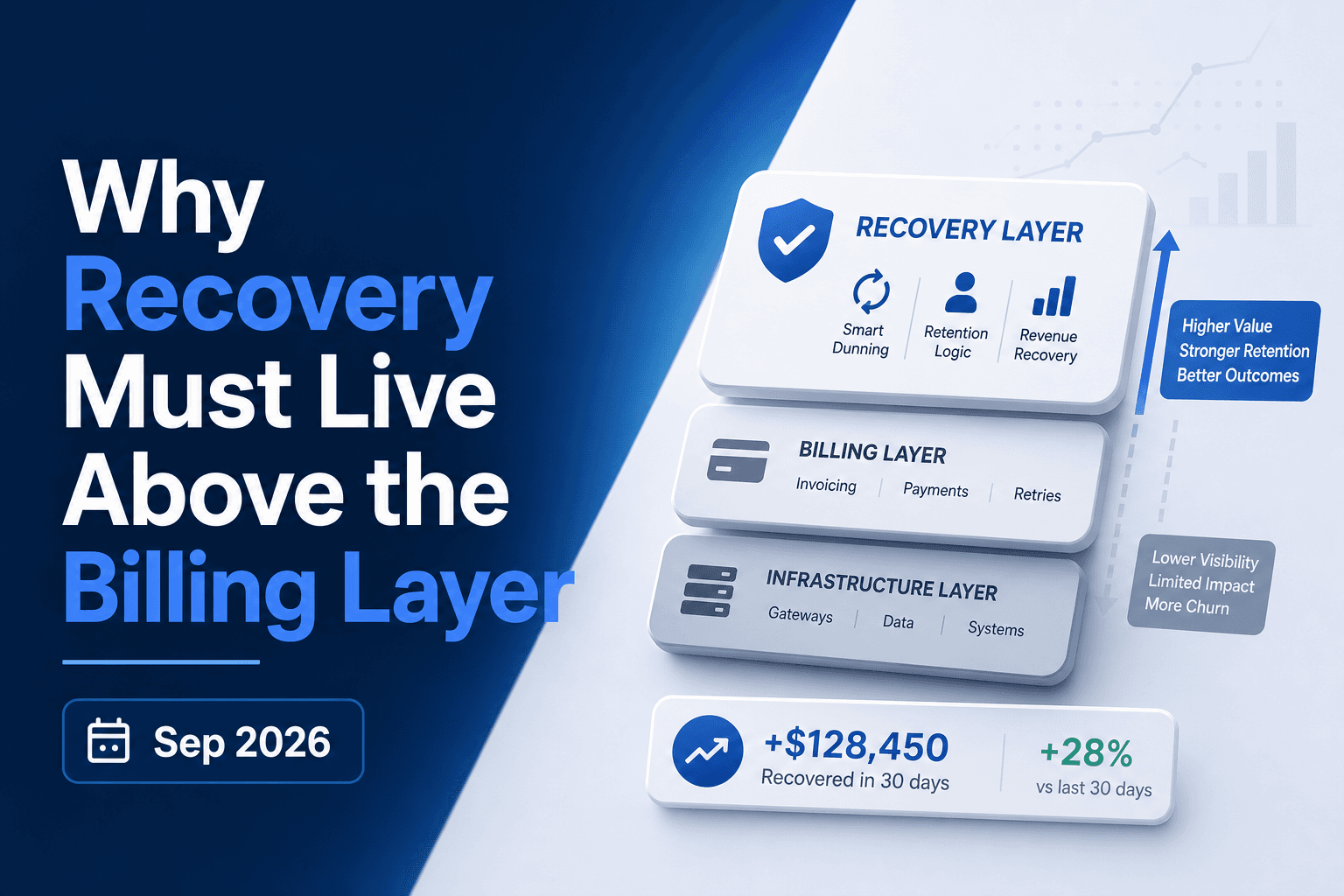
Why Payment Recovery Must Live Above Billers October 2026
A payment fails. Your biller retries it three days later, then again at seven, then at fourteen. What the biller never checks is whether the issuer sent a...
Stop losing revenue to failed payments
Join leading subscription businesses using Slicker to recover failed payments automatically.
Get Started