How to Measure Subscription Churn Rate and Cut Involuntary Churn (August 2026)
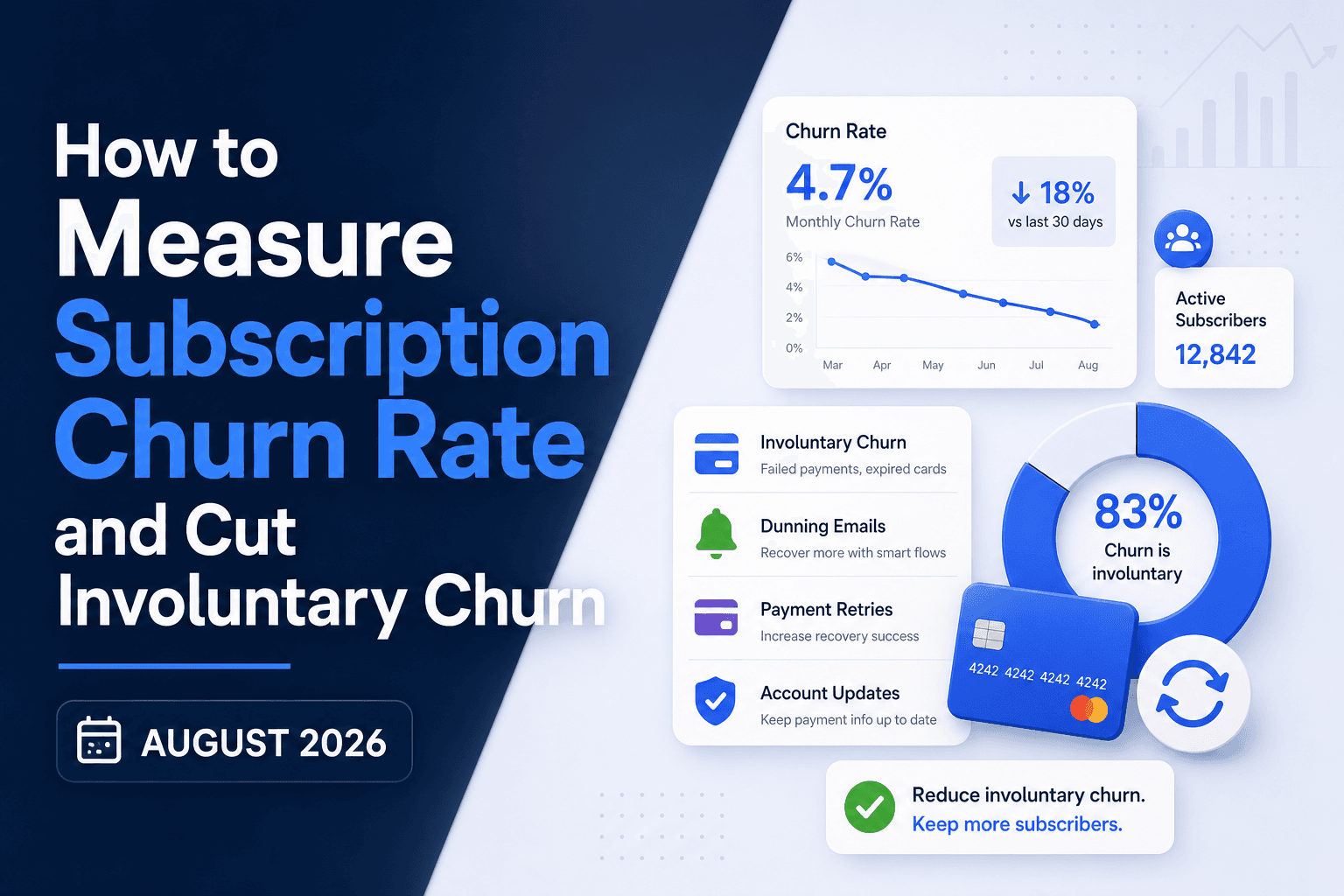
Most churn rate conversations focus entirely on why customers decide to leave. But 20 to 40% of subscription churn comes from customers who didn't decide anything, their payment just failed. Before you can act on your churn rate, you need to know which kind you're actually looking at.
TLDR:
- Calculate churn rate by dividing customers lost by customers at start of period, then multiplying by 100.
- Separate voluntary churn (cancellations) from involuntary churn (failed payments) before acting; the fixes are completely different.
- Industry data shows failed payments account for roughly 48% of all subscription churn, making it a recoverable revenue problem.
- A "good" monthly churn rate sits below 2%; B2B SaaS targets 5 to 7% annually, but your effective rate is lower once you strip out failed payments.
- Slicker recovers involuntary churn by reading decline codes and retrying silently, with every recovery decision validated through clinical-grade AABB testing on your own data.
What Is Subscription Churn Rate
Subscription churn rate measures the percentage of subscribers who cancel or fail to renew within a given period. It sits at the center of every recurring revenue business because it directly determines whether you grow, plateau, or shrink.
The standard churn rate formula is straightforward:
Churn Rate = (Customers Lost During Period / Customers at Start of Period) × 100
But the number itself only tells part of the story. Churn has two distinct causes that require entirely different responses: voluntary churn, where a customer actively decides to leave, and involuntary churn vs voluntary churn, where a failed payment ends the subscription without any intent to cancel. Conflating the two leads to misdiagnosed problems and wasted retention spend.
Voluntary vs. Involuntary Churn
Not all churn looks the same on a dashboard, but the distinction matters enormously for how you respond to it.
Voluntary churn happens when a customer actively decides to cancel. They found a cheaper option, outgrew your product, or simply no longer need it. This is a signal about product-market fit, pricing, or customer success.
Involuntary churn is different. The customer never chose to leave. A payment failed, the billing system couldn't recover it, and the subscription lapsed without any cancellation intent. Industry data suggests passive churn accounts for 20 to 40% of total subscription churn, making it one of the largest recoverable revenue leaks in any subscription business.
The two types require entirely different responses. Voluntary churn calls for win-back campaigns, exit surveys, and product iteration. Involuntary churn calls for smarter payment recovery before the subscription ever lapses. Conflating them inflates your churn rate artificially and obscures where the real fix lies.
How to Calculate Your Subscription Churn Rate
The subscription churn rate formula is straightforward: divide the number of customers lost during a period by the number of customers at the start of that period, then multiply by 100.
Churn Rate = (Customers Lost ÷ Customers at Start of Period) × 100
If you started the month with 1,000 subscribers and lost 30, your monthly churn rate is 3%.
Voluntary vs. Involuntary Churn
Before you act on that number, you need to know what's inside it. Churn has two distinct causes:
- Voluntary churn happens when a customer actively decides to cancel, whether due to price, fit, or dissatisfaction.
- Involuntary churn happens when a payment fails and the subscription lapses without the customer intending to leave.
Treating both as the same problem leads to the wrong fixes. Voluntary churn calls for product or pricing changes. Involuntary churn calls for smarter payment recovery.
Churn Rate vs. Retention Rate
Churn rate and retention rate measure the same underlying movement from opposite angles. Churn rate tells you what share of subscribers left; retention rate tells you what share stayed. The relationship is direct: a 5% monthly churn rate means a 95% monthly retention rate.
Neither metric is redundant. Retention rate tends to appear in investor reporting and cohort analysis, where compounding matters. Churn rate is the working signal, the number your billing and retention teams act on month to month.
One distinction worth keeping clear: churn rate captures both voluntary cancellations and involuntary churn from failed payments. Retention rate, as most teams calculate it, does the same. If you are not separating those two causes before reporting either number, you are mixing a customer satisfaction problem with a payments infrastructure problem, and the fix for each is entirely different.
Average Subscription Churn Rate by Industry
Churn rates vary widely depending on your business model, price point, and customer segment. That said, industry benchmarks give you a useful starting point for gauging where you stand.
Benchmarks to Know
Here is a breakdown of involuntary churn benchmarks by industry for average annual churn rates:
Industry | Average Annual Churn Rate |
|---|---|
SaaS (SMB-focused) | 31 to 58% |
SaaS (enterprise-focused) | 6 to 10% |
Streaming / media | 25 to 35% |
Subscription boxes | 20 to 30% |
Telecom | 15 to 25% |
Financial services | 15 to 20% |
B2B SaaS companies targeting enterprise accounts tend to see the lowest churn, partly because switching costs are high and contracts are annual. Consumer-facing subscriptions sit at the other end of the range, where low commitment and easy cancellation keep churn high. ChartMogul's SaaS benchmarks, drawn from over 2,500 businesses, put the median monthly churn for early-stage SaaS at 6.5%, dropping to 3.7% as companies scale past $1-3M ARR.
One number worth isolating: across subscription businesses broadly, involuntary churn accounts for roughly 20 to 40% of total churn. That share is recoverable revenue, not a verdict on product quality or customer fit. Knowing your industry benchmark matters, but knowing how much of your churn is involuntary tells you where to act first.
What Is a Good Churn Rate for Subscription Services
There is no single answer, but context makes the range clear.
For most subscription businesses, a monthly churn rate below 2% is considered healthy. Annual churn in the 5 to 7% range is a reasonable benchmark; see good involuntary churn rate SaaS benchmarks for mature SaaS companies, while consumer subscription boxes tend to run higher, often between 6 to 10% annually given the discretionary nature of the purchase.
Industry and business model shape expectations considerably.
Benchmarks by Segment
Segment | Typical Annual Churn |
|---|---|
B2B SaaS | 5-7% |
Consumer subscriptions | 6-10% |
Telecom | 20-40% |
Streaming / media | 10-20% |
One factor that skews these numbers in a misleading direction is the source of churn itself. A company reporting 8% annual churn where 3-4 points come from failed payments is in a very different position than one where nearly all churn is voluntary cancellation. Voluntary churn reflects a product or fit problem. Involuntary churn (payment failures leading to account lapse) reflects a recoverable revenue problem, and the two require entirely different responses.
Before benchmarking against your industry, separate your churn into those two buckets. Your effective "good" churn rate is lower than any published benchmark suggests, because a meaningful portion of what gets counted as churn was never an intentional cancellation to begin with.
The Hidden Revenue Cost of Involuntary Churn
Involuntary churn (customers lost not because they chose to leave, but because their payment failed) is frequently the larger churn driver at subscription companies, yet it rarely gets the same scrutiny as voluntary cancellations.
Industry data puts the cost in concrete terms: failed payments account for roughly 48% of all subscription churn. When a payment fails silently, the subscriber often has no idea the relationship is ending. By the time a cancellation notice arrives, the revenue is already gone.
The stakes compound quickly. 58% of consumers have had a legitimate transaction declined, and many simply don't retry. For high-volume subscription businesses, even a one-percentage-point rise in involuntary churn translates to material hidden cost of failed payments that accumulates faster than any voluntary cancellation trend.
How to Reduce Voluntary Churn
Voluntary churn happens when subscribers actively decide to cancel. Unlike involuntary churn, which stems from payment failures, this requires direct engagement with the customer's experience and perceived value.
There are a few proven ways to reduce it:
- Offer a pause option before cancellation. Subscribers who need a break will often return if given the choice to pause instead of canceling outright.
- Identify at-risk accounts early. Drops in login frequency, feature usage, or engagement are leading indicators. Acting on those signals before the cancellation request arrives is far more effective than responding after.
- Anchor cancellation flows to value. Remind subscribers what they would lose, not what they paid.
- Improve onboarding. Many early cancellations trace back to customers who never fully activated. A stronger onboarding sequence directly reduces first-90-day churn.
Reducing voluntary churn comes down to closing the gap between what customers expected and what they actually experienced. That gap is where revenue walks out the door.
How to Reduce Involuntary Churn
Involuntary churn is recoverable, and the fix starts before a payment ever fails. Here are the highest-impact actions subscription businesses take to reduce it.
- Soft decline retry playbook logic that adapts to decline codes: soft declines (insufficient funds, temporary holds) warrant retries; hard declines (stolen card, closed account) do not. Retrying blindly wastes attempts and risks card network penalties.
- Intelligent payday retries tied to payday windows: retrying when a subscriber's account is most likely funded improves recovery without additional customer contact.
- Dunning management emails sent from your own domain, personalized to the specific failure reason, consistently outperform generic "update your payment info" blasts.
- Account updater services from card networks automatically refresh expired or reissued card credentials before a payment even attempts, cutting a meaningful share of involuntary churn at the source.
Slicker's failed payment recovery layer sits on top of your existing billing infrastructure and handles all of this without engineering work on your end.
How Slicker Recovers Involuntary Churn
Slicker is purpose-built to recover revenue lost to involuntary churn, the failed payments that happen not because a customer decided to leave, but because a card was declined.
The recovery process starts silently. When a payment fails, Slicker's AI reads the decline code, issuer signals, and account-level patterns to decide whether to retry, when, and on what cadence. No customer email. No friction. Most recoveries happen before the subscriber ever knows there was a problem.
When a payment error does require customer action, such as an expired or stolen card, Slicker triggers a branded dunning sequence sent from your domain, framed around the value the subscriber would lose, not the transaction that failed.
Every recovery decision is validated through AABB testing in payment recovery on your own data, so you know exactly how many dollars Slicker recovered that your existing billing setup would have missed.
Final Thoughts on Churn Rate Benchmarks and What to Do About Them
Benchmarks give you a reference point, but your real target is lower than any published number suggests once you strip out involuntary churn. The customers lost to failed payments never decided to leave, which means recovering them is a payments problem, not a product one. That distinction changes where you focus your time and budget. Reach out to the Slicker team if you want to see what that recovery looks like in practice.
FAQs
What is a good churn rate for subscription services like SaaS or streaming?
For B2B SaaS, annual churn in the 5-7% range is a reasonable benchmark; consumer subscriptions typically run 6-10% annually, and streaming services often land between 10-20%. But before benchmarking against your industry, separate voluntary cancellations from involuntary churn caused by failed payments, because a meaningful share of what gets counted as churn was never an intentional cancellation to begin with.
How do I calculate monthly subscription churn rate and break it down by churn type?
Divide customers lost during the month by customers at the start of the month, then multiply by 100. Once you have that number, split it into voluntary churn (active cancellations) and involuntary churn (payment failures that caused subscription lapse), since the two require entirely different fixes and mixing them produces a misleading picture of your actual retention problem.
Should I use smart retries or dunning emails first when a subscription payment fails?
Start with automated smart retries: when a soft decline occurs, the right retry at the right time recovers most subscribers before they ever know there was a problem. Dunning emails come second, deployed only when the specific decline code requires customer action, such as an expired or stolen card, where automated recovery is not possible without the subscriber updating their payment details.
Churn rate vs. retention rate: which metric should subscription businesses track?
Track both, since they measure the same movement from opposite directions. A 5% monthly churn rate equals a 95% monthly retention rate. Retention rate tends to appear in investor reporting and cohort analysis; churn rate is the day-to-day signal your billing and retention teams act on month to month. Neither metric is reliable without first separating involuntary churn from voluntary cancellations.
How much subscription revenue does involuntary churn cost a business each year?
Industry data puts failed payments at roughly 20-40% of total subscription churn, with some estimates attributing nearly half of all subscription churn to payment failures and not deliberate cancellations. For a $10M ARR business running 5% monthly churn, that can translate to $1-2M in annual revenue lost to customers who never chose to leave and whose subscriptions are often recoverable with the right retry logic and dunning approach.
Related Articles

Recurly Revenue Recovery Tactics That Win (Sep 2026)
Forty percent of lost subscribers across subscription businesses never decided to leave. Their card expired, their bank blocked a charge, or a billing...

Zuora Retry Logic: CPR Limits and Layering (September 2026)
There's a version of Zuora retry logic that works well, and a version that looks fine in the settings but quietly misfires on soft declines, closes invoices...

Build vs Buy: Payment Retry Logic Deep Dive (September 2026)
Your engineering team can build retry logic. The harder question is whether they should. The gap between a basic retry schedule and something that actually...
Stop losing revenue to failed payments
Join leading subscription businesses using Slicker to recover failed payments automatically.
Get Started