How AI Rewrites Dunning Logic: Playbooks & Testing (July 2026)

If your dunning window is whatever your billing tool shipped with, and your retry timing is day 3, day 7, day 14, you're leaving recoverable revenue on the table every single billing cycle. The issue isn't effort; it's that fixed schedules can't read payday windows, issuer behavior, or failure reasons. Here's how AI changes that logic from the ground up.
TLDR:
- Fixed dunning schedules ignore issuer response codes, card type, and payment history, compounding involuntary churn at scale.
- AI reads each failure in full context before acting: silent retry, customer outreach, or no action at all.
- Signal-based retry timing targets payday windows by geography; for US debit, 12:01am clears the highest-probability recovery window.
- Living playbooks self-adjust timing, messaging, and channel mix each billing cycle, compounding MRR recovery over time.
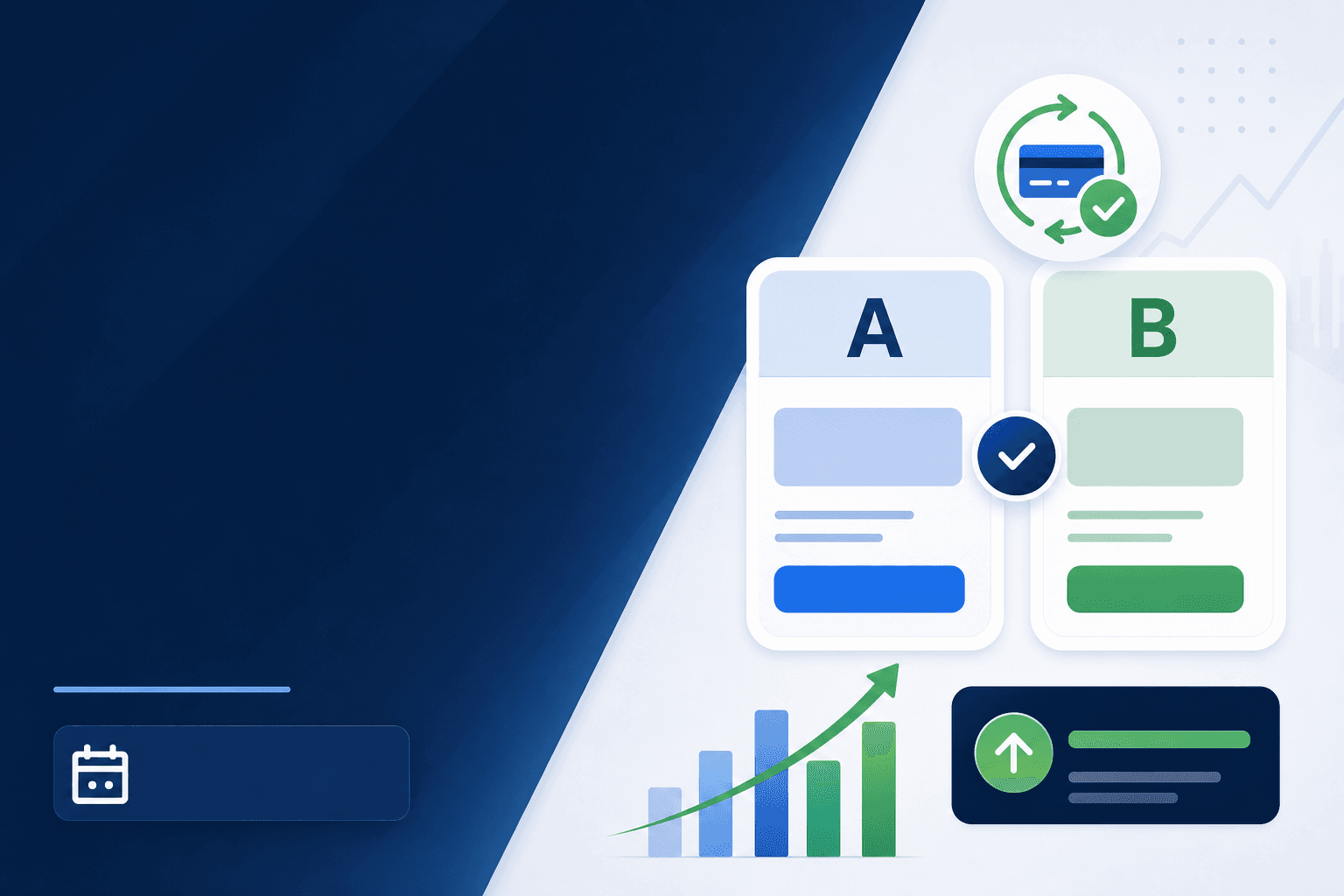
- Slicker runs continuous AABB (A/B/B holdout) experiments across retry timing and email copy, promoting winning variants automatically when p-value confirms significance.
Why Static Dunning Breaks Down at Scale
Subscription businesses running on fixed dunning schedules are leaving recoverable revenue on the table. A static rule that retries every failed payment on day 3, day 7, and day 14 ignores everything that actually predicts recovery. That is the core problem with batch payment retries: the issuer's response code, the subscriber's payment history, the day of the week, and whether that specific card type tends to recover within 24 hours or not at all. At scale, across hundreds of thousands of subscribers, that bluntness compounds into material involuntary churn (MRR, or monthly recurring revenue, lost from payment failures, not cancellations). Research across 148 subscription businesses puts the average MRR lost to failed payments at roughly 9%.
The gap widens further with dunning emails. A one-size message sent after a stolen card failure is the wrong communication for a subscriber whose prepaid card simply ran low. The failure reason determines what action the subscriber needs to take, and a generic "update your payment method" blast obscures that. Recovery rates suffer, and so does the subscriber relationship.
Smart dunning changes the calculus by reading each failure in context and responding accordingly, at a speed and granularity no manual playbook can match.
How AI Classifies Payment Failures Before Acting
Before retrying a payment or sending a dunning email, AI reads the failure. Beyond the decline code, it takes in the full context: card type, issuer behavior, account history, time of day, and geography. A "do not honor" response from a prepaid card in one region carries different recovery odds than the same code from a credit card in another.
This classification step is what separates intelligent recovery from fixed retry schedules for subscription billing. The AI routes each failure to the right response: silent retry, customer communication, or no action at all.
AI-Driven Retry Timing: Payday Windows, Time of Day, and Geography
Timing tells AI when to act. Calendar-based retries fire on arbitrary days regardless of whether funds are available; signal-based systems read payroll calendars, card-type behavior, and issuer authorization windows to attempt recovery when balances actually refresh.
For insufficient funds declines on consumer debit cards in the US, intelligent payday retries target 12:01am, when payroll deposits clear. That hour-level specificity makes the gap between date scheduling and signal-based precision concrete.
Geographic payroll cadences drive the core timing logic:
Region | Pay Cadence | Optimal Retry Window | Key Timing Detail |
|---|---|---|---|
United States | Biweekly | 2-3 days after the 1st or 15th | Target 12:01am overnight clearing window when payroll deposits clear |
United Kingdom | Monthly | Final week of the month | Most salaried deposits land in the last 5 business days |
Western Europe | Monthly | Within 2-3 days of month-end | Clusters around the 25th to the last business day; varies by country |
Australia | Fortnightly | Midweek after the fortnightly pay cycle | Retry after clearing has settled to maximise authorisation success |
Well-timed retries materially outperform fixed schedules; the revenue difference compounds across your subscriber base every billing cycle. The revenue difference between a well-timed retry and a poorly timed one compounds across your full subscriber base every billing cycle.
Living Playbooks: Dunning Sequences That Learn Over Time
Traditional dunning sequences are static: send email on day 3, send again on day 7, give up on day 14. AI rewrites that logic entirely. A living playbook adjusts its own timing, messaging, and channel mix based on what's actually working in your subscriber base, not what worked in a generic template someone built two years ago.
Every send becomes a data point. Recovery rates, open rates, and conversion signals feed back into the sequence, a feedback loop that dunning emails vs. intelligent retry logic research confirms, so the playbook that runs in month six looks meaningfully different from the one that launched in month one.
The business case is direct: a playbook that learns compounds its returns over time, recovering more MRR per failed payment as it accumulates signal about your specific subscriber behavior.
Auto-A/B Testing in Dunning: How Systems Promote Winning Variants Automatically
AI dunning systems today can run continuous split tests across message variants, timing windows, and tone without waiting for a human to greenlight each experiment. When one variant pulls ahead with statistical significance, a threshold measured through AABB testing in payment recovery, the system promotes it automatically and retires the underperformer.
For a Head of Payments, this matters because dunning A/B testing at scale produces compounding gains. Each winning variant raises the baseline, and the next test starts from a higher floor. Over months, that compounding closes meaningful gaps in recovery rates without any manual campaign management.
The business outcome: your dunning playbook gets sharper every billing cycle, even when no one has bandwidth to run a test.
Domain Awareness: The Payment Expertise AI Dunning Requires
AI dunning without payments domain knowledge is pattern-matching in the dark. The model can see sequences, but without understanding that a "do not honor" code means something categorically different from "insufficient funds," the sequences mislead as often as they guide.
Payments expertise shapes every layer of a dunning playbook. A soft decline retry playbook distinguishes retriable failures from hard declines that require customer action. Weekday morning retries outperform weekend attempts for most card types. Prepaid cards behave differently than credit cards across nearly every failure mode.
AI systems trained on payments-specific data absorb these distinctions and apply them automatically, without a human flagging each edge case.
Failure-Reason-Specific Dunning Emails vs Generic Outreach
Hyper-personalized dunning emails are the antidote to a revenue leak in disguise. When a card declines because it was reported stolen, the customer needs to add a new card entirely. When it declines due to insufficient funds, they may just need a few days. Sending the same email to both subscribers wastes goodwill and recovery opportunity alike.
AI dunning reads the failure reason before drafting the message. Stolen card? The email asks for a new payment method, framed around the service value the subscriber would lose. Insufficient funds? It quietly waits, then retries, often without emailing at all.
Your recovery rate climbs when the ask matches the actual problem.
Optimizing the Dunning Window: How Long Is Long Enough
Dunning windows vary more than most billing teams expect. Some subscriptions recover within 48 hours; others need a full billing cycle to resolve. The right window depends on your subscriber mix, payment methods, and the specific decline codes you're seeing.
A window that's too short leaves recoverable revenue on the table. One that's too long risks cancellation requests, service confusion, and brand friction with customers who've already moved on mentally.
Most teams default to whatever their billing tool ships with, often seven to fourteen days, without applying automatic payment retry best practices to test whether that window actually fits their base.
Measuring AI Dunning Performance Without the Noise
Recovery rate numbers mislead when vendors cherry-pick which failures to attempt. A system that only works high-probability cases will show a strong rate while leaving most of your recoverable revenue untouched. Industry research from PYMNTS confirms that involuntary churn from failed payments is one of the largest contributors to total subscriber loss across the subscription economy.
The distinction between static vs adaptive retry is exactly why Slicker's AABB testing splits traffic 50/50, measures actual dollars recovered across the full failure pool, and reports statistical significance before you commit. If the results don't hold up, you don't pay.
What to Demand From Any Performance Report
- Look for dollar-denominated outcomes, not recovery rate percentages alone. A rate can climb while recovered revenue falls if the attempted volume shrinks.
- Confirm the test covers your full subscriber mix, not a pre-screened segment of easy wins.
- Require a p-value. Without statistical significance, a lift could be noise.
The benchmark that matters is your own historical baseline, not an industry average. Recovery rates vary by subscriber mix and billing infrastructure, so any vendor quoting a universal guarantee is selling a number, not a proof.
How Slicker Brings Living Playbooks, Auto-Testing, and Domain Awareness Together
Slicker's AI dunning system runs on three interlocking layers. The living playbook layer reads real-time signals, including issuer behavior, account history, and decline patterns, to rewrite retry logic and email sequencing on the fly without any intervention from your team. The auto-testing layer runs continuous AABB experiments across retry timing, email copy, and send cadence, promoting winners automatically when results cross statistical significance. The domain awareness layer applies payments-specific heuristics, such as payday windows, card network rules, and soft versus hard decline logic, so decisions are grounded in how billing actually works. Every recovered dollar is traced back to a specific rule change or message variant, giving your finance team a clear line from AI decision to revenue outcome.
Final Thoughts on AI Dunning and Living Playbooks
The gap between a fixed dunning schedule and a signal-based one shows up in recovered MRR every single billing cycle. Timing retries to payday windows, matching your message to the actual failure reason, and letting the playbook learn from results are the moves that close that gap. None of it requires manual campaign management once the system is running. Get in touch with the Slicker team to see what smarter recovery looks like on your data.
FAQ
What is a living playbook in dunning, and how does it differ from a static email sequence?
A living playbook is a dunning sequence that continuously rewrites its own timing, messaging, and send cadence based on recovery signals from your actual subscriber base. A static sequence sends the same emails on fixed days regardless of what the data shows; a living playbook treats every send as a data point and compounds those learnings across billing cycles, so the sequence running in month six is materially sharper than the one that launched in month one.
How does Slicker's dunning A/B testing work compared to standard split tests?
Slicker runs continuous AABB experiments across retry timing, email copy, and send cadence, promoting winning variants automatically when results cross statistical significance, with no manual campaign management required. The key structural difference from standard split tests is that Slicker's AABB methodology splits your full failure pool 50/50, measures actual dollars recovered, and reports p-values, so a lift reflects real revenue, not a pre-screened segment of easy wins.
Should I use Slicker's AI dunning or keep my billing platform's built-in dunning?
If your billing platform is recovering failed payments using a fixed day-3, day-7, day-14 sequence with a generic "update your payment method" email, you are leaving recoverable MRR (monthly recurring revenue) on the table at scale. Slicker's AI dunning reads the specific failure reason before acting, applies payday-window retry timing, and auto-tests message variants continuously. The answer depends on your transaction volume; Slicker's 4-month pilot (first month free) runs a live AABB test on your own data so you see the dollar difference before committing.
How do I measure AI dunning performance without being misled by recovery rate percentages?
Require dollar-denominated outcomes across your full subscriber mix, not a rate calculated on a pre-screened segment. Confirm the test covers all failure types, including low-probability failures beyond easy soft declines, and ask for a p-value to confirm the lift is statistically sound and not noise. Your own historical baseline is the most reliable benchmark; any vendor quoting a universal recovery guarantee is selling a number, not a proof.
Can Slicker's AI dunning send failure-reason-specific emails for stolen cards differently from insufficient funds declines?
Yes. Slicker reads the decline code before drafting any outreach, routing stolen card failures to a message requesting a new payment method (framed around the service value the subscriber would lose) while an insufficient funds decline on a debit card often triggers a silent retry timed to a payday window, with no email sent at all. Sending the same generic message to both scenarios wastes subscriber goodwill and recovery opportunity; matching the ask to the actual problem is what moves recovery rates.
Related Articles

Expired Cards as a Churn Vector: The Plastic Aging Problem (Sep 2026)
A surprising share of lost subscribers didn't cancel. Their card aged out, the charge failed hard, and your billing system had no path forward. Separating...
Retry Velocity Limits: Issuer Caps Explained September 2026
When a retry velocity limit gets tripped, the damage shows up in two places: the per-attempt fees on transactions that were never going to convert, and the...

Involuntary Churn Is Draining Your LTV (September 2026)
If your monthly churn sits around 6% and you're pouring budget into win-back campaigns, there's a good chance you're solving for the 3% while the other 3%...
Stop losing revenue to failed payments
Join leading subscription businesses using Slicker to recover failed payments automatically.
Get Started