AI Dunning Retry Interaction and Conflicts (July 2026)
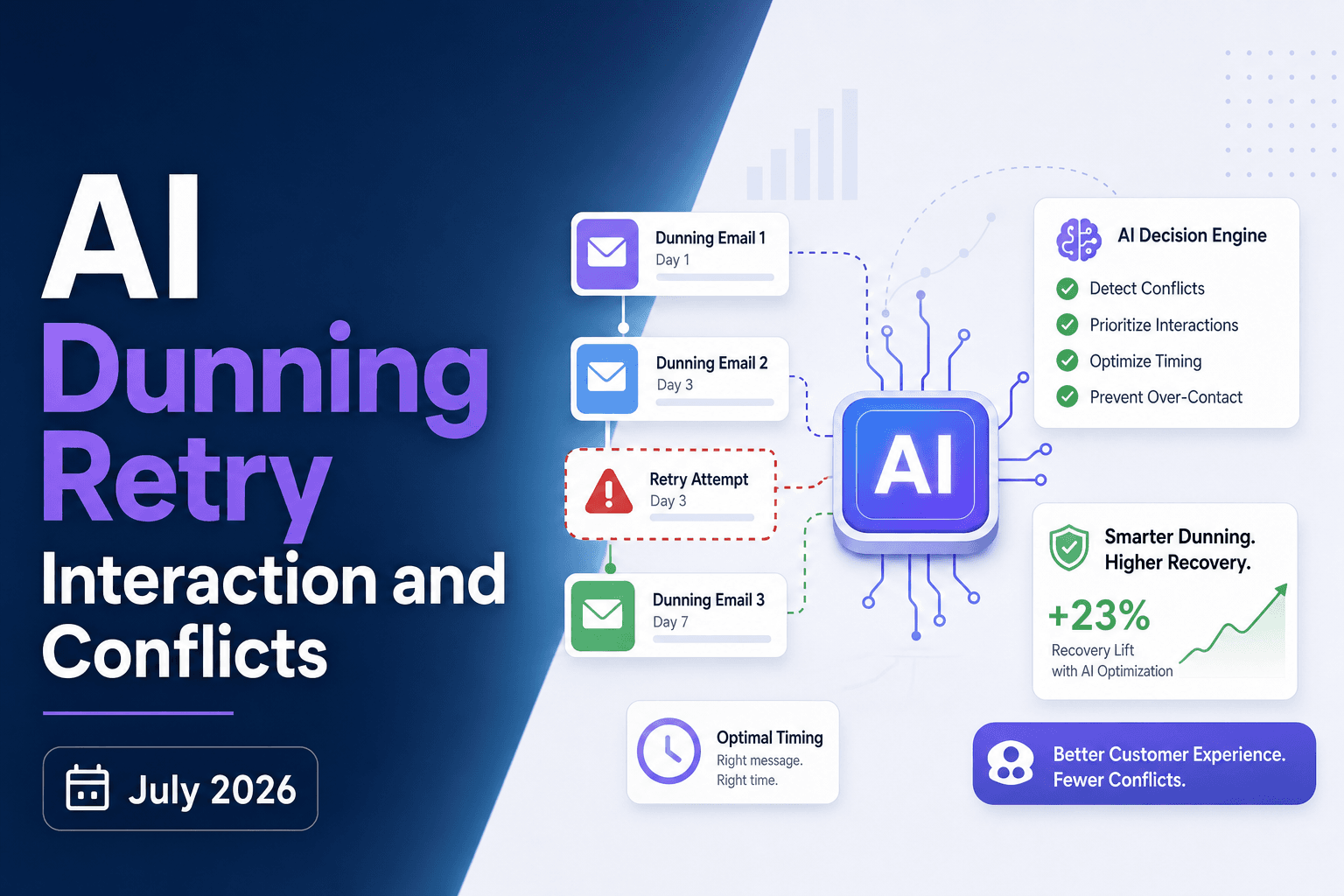
When a payment fails, two systems usually wake up: retry logic and dunning. The problem is they're often running on separate clocks with no shared state between them. That recovery system conflict is where the dunning vs retry debate gets real. AI dunning retry interaction can clean this up, but the sequencing has to be right or the two layers end up creating more confusion for your subscribers than the original failed payment did.
TLDR:
- Dunning is the full recovery system: smart retries run first, customer outreach fires only when subscriber action is genuinely required.
- Decline code classification is the fork: soft declines route to silent retry logic, hard declines route directly to dunning communications.
- Five coordination failures between retry logic and dunning, including simultaneous escalation and post-update retry misfires, bleed recoverable revenue.
- MAC codes and card network rules are hard gates; retrying a do-not-retry signal risks transaction monitoring flags and MID (Merchant ID) termination.
- Slicker's AI reads the decline code first, routes to smart retry or dunning accordingly, and shares a single subscriber state so both systems never fire simultaneously.
Dunning Is the Full Recovery System, Beyond the Emails
When most teams say "dunning," they picture a sequence of payment-failure emails. But dunning management is the full recovery system: smart retries, customer communications, and the orchestration logic that decides which lever to pull first.
Retries come first. If a soft decline can be resolved without contacting the subscriber, the system should try that before sending any email. Customer outreach is the fallback for failures that genuinely require action, like an expired or stolen card.
Getting this order right is where revenue is won or lost.
How the Recovery Stack Layers Together
Smart retry logic and AI dunning don't operate independently. They sit at different layers of the same recovery stack, each handling distinct failure types.
Retries handle the silent layer: they fire automatically when a soft decline suggests the card is valid but the transaction failed for a recoverable reason. No customer contact required.
AI dunning activates when customer action is needed, typically for expired or stolen cards where no retry will succeed.
When the stack is configured correctly, these layers hand off cleanly. Retries run first. Dunning fires only after retry attempts are exhausted or a hard decline makes further retries pointless.
How AI Reshapes Retry Decision-Making Within Dunning
AI goes further than picking a retry time. It reads the failure signal, weighs issuer behavior patterns, subscriber history, and card type, then decides whether a retry makes sense at all before any dunning sequence is considered.
Most retry logic operates on fixed schedules. Smart dunning powered by AI operates on context. When a soft decline carries a "try again later" signal from the issuer, an AI system can estimate the optimal retry window instead of firing on day 3 because a rule says so. Stripe's payment retries guide outlines how data-driven intervals outperform fixed schedules; the same principle applies when those intervals feed into a coordinated dunning layer.
Where this reshapes dunning: fewer premature retries mean fewer failed attempts logged before the dunning sequence triggers, which keeps the subscriber experience cleaner and recovery rates higher.
The Decline Classification Fork: Where Retry and Dunning Split
Every decline carries a signal, and that signal is the first thing a well-designed recovery system reads. When a payment fails, the processor returns a decline code and retry strategy that tells you something specific: is this a temporary cash flow problem, a card the issuer flagged as compromised, or a hard stop the network won't reverse no matter how many times you try?
That classification is where retry logic and dunning split into separate paths.
Decline Type | Examples | Recovery Path | Customer Contact? | Risk of Misrouting |
|---|---|---|---|---|
Soft Decline | Insufficient funds, processor timeout, temporary hold | Silent retry logic with optimal timing based on card type, issuer behavior, payday patterns | No; silent recovery only | Sending dunning creates unnecessary friction; subscriber's card would have cleared on a well-timed retry |
Hard Decline | Stolen card, closed account, do-not-honor flag, MAC "do not retry" | Route directly to dunning communications; customer action is the only path forward | Yes; dunning email or other outreach required | Retrying wastes attempts, risks fraud flags, and can trigger Merchant ID (MID) termination |
Soft Declines Route to Retry Logic
The soft decline retry playbook covers cases like insufficient funds, temporary holds, and processor timeouts that are recoverable without customer involvement. Soft decline payment research puts these recoverable failures at 80 to 90% of all payment failures, making silent retry logic the most frequently triggered path in any recovery stack. The card is valid, the customer relationship is intact, and the right move is a silent retry at the correct moment. Dunning here would be premature and potentially damaging to the subscriber relationship.
Hard Declines Route to Dunning
Hard declines (stolen card, closed account, do-not-honor flags) cannot be resolved by retrying. The issuer has made a definitive call. Customer action is the only path forward, so dunning steps in as the appropriate recovery mechanism.
Getting this fork wrong carries a direct revenue cost. Retrying a hard decline wastes attempts and can trigger fraud flags. Sending dunning on a soft decline creates unnecessary friction with a customer whose card would have cleared on the next well-timed retry.
Five Conflict Scenarios Between Retry Logic and Dunning Communications
When retry logic and dunning communications run without coordinating on shared state, five recurring conflict patterns surface.
- A retry succeeds seconds after a dunning email lands in the subscriber's inbox, creating confusion about whether they owe action. The payment clears, but the customer has already clicked "update card" and is now second-guessing their account status.
- The retry schedule fires on days 1, 4, and 7 (a problem with fixed retry schedules for subscription billing), while the dunning sequence sends urgent "final notice" copy on day 3, before the system has exhausted automated recovery options.
- A hard decline (stolen card) triggers a retry attempt instead of routing immediately to dunning, wasting a charge attempt and potentially flagging the merchant ID for excessive declines.
- Dunning emails go silent after a customer updates their payment method, but the retry queue still holds a pending attempt against the old card, generating a second failure on the corrected account.
- Both systems escalate independently, so a subscriber receives a retry charge and a cancellation warning on the same day, sending contradictory signals about account standing.
Each scenario bleeds recoverable revenue. The fix is a shared decision layer that treats retry outcomes and dunning state as inputs to the same recovery logic, not parallel tracks.
The Email-Retry Coupling Problem
When dunning emails and retry attempts fire in an uncoordinated sequence, they create a compounding problem. A customer receives a dunning email asking them to update their card, then your system retries the original payment method two hours later and succeeds. Now you have a confused subscriber who took action they didn't need to take, and a support ticket is likely on its way.
The reverse scenario carries its own cost. Your retry logic exhausts its attempts across three days, then dunning sends a cancellation warning. The customer updates their card, but the window for a clean retry has already closed, so recovery requires a full manual re-engagement.
Coordination failures like these are where involuntary churn quietly compounds. The fix is sequencing logic that treats retry outcomes as inputs to dunning decisions, not parallel processes running on separate clocks.
Card Network Rules as a Hard Constraint on Recovery Sequencing
Card network rules set hard boundaries that neither AI dunning nor retry logic can cross, and these boundaries directly shape how recovery sequences must be structured.
When a card network issues a "do not retry" response, such as MAC 03 (Do Not Try Again) or MAC 21 (Stop Recurring Payment), retrying is a compliance violation regardless of what your AI dunning model recommends. These Merchant Advice Codes (MACs) are Mastercard's way of giving merchants a hard, transaction-level instruction. The network's directive takes precedence over any predicted recovery probability.
Recovery systems that ignore these signals risk transaction monitoring flags, per-retry network penalty fees, and potential MID (Merchant ID) termination. The business cost of a compliance breach far exceeds the revenue upside of any individual recovered payment.
Your sequencing logic needs to treat MAC codes as gates, not suggestions. Before any retry fires or dunning letter routes, the system should check the decline code class and halt both tracks when the network has explicitly prohibited further attempts.
Grace Period Configuration as the Handoff Point Between Retry and Dunning
The grace period sits at the boundary where retry logic ends and dunning begins. When a payment fails and retries are exhausted, most billing systems wait a defined number of days before sending the first dunning communication. That window is the grace period, and how you configure it determines whether your recovery efforts feel coordinated or contradictory.
Set it too short, and a dunning email arrives while a retry is still pending. Set it too long, and a recoverable subscriber drifts toward cancellation before anyone reaches out.
AI dunning systems can read that configuration and respect it, but they can't rewrite it. If your grace period is misconfigured, even the best dunning email tools for subscription businesses work within a broken boundary. Getting that handoff right is a prerequisite for either system to perform well: a business processing 10,000 failed payments per month with a 2-day misconfigured window can lose an entire retry cycle worth of recoverable revenue.
Building a Coordinated AI Recovery System
When AI dunning and retry logic operate in silos, they often work against each other. A coordinated recovery system treats these two layers as a single pipeline: retry decisions inform dunning timing, and dunning outcomes feed back into retry models. Getting the architecture right is what separates a system that silently recovers the majority of failed payments from one that generates confusion, support tickets, and preventable churn.
Sequence Retries Before Dunning
The practical starting point is sequencing. Retries should run first. If a soft decline resolves without customer contact, dunning never needs to fire. Sending an email during an active retry window creates friction and erodes trust with subscribers who had no idea there was a problem.
- Classify the decline code immediately: soft declines route to the retry layer, hard declines skip directly to dunning communications.
- Hold dunning outreach until the retry window closes or a do-not-retry signal is confirmed.
- Use AI to pick the optimal retry moment based on issuer behavior, card type, and payday patterns, not a fixed day-3 rule.
Hand Off With Full Context
Once retries are exhausted or a hard decline is confirmed, the question of dunning emails vs. AI retries is settled: the AI dunning layer takes over with full context. It knows which payment methods were attempted, which decline codes came back, and how long the recovery window has been open. That context shapes the message, the channel, and the urgency. A subscriber whose card was flagged stolen needs a different email than one who had a temporary hold clear on retry two.
- Pass retry outcome data (attempts made, decline codes returned, elapsed window) into the dunning decision layer before the first email is drafted.
- Let recovered payments cancel pending dunning automatically so subscribers never receive outreach after a silent retry has already cleared the charge.
- Adjust dunning urgency and channel based on how deep into the recovery window the account has drifted.
Measure the Revenue Impact of Coordination
The business impact of getting this right is real. Recovered revenue goes up when customers receive outreach only when their action is genuinely needed, and subscriber trust holds because silent recovery handles everything it can without involving them. Conflicts between retry and dunning logic cost you both, and the only way to know whether your current sequencing is leaving money on the table is to test it against a coordinated alternative on your own transaction data.
How Slicker Handles the Retry and Dunning Coordination Problem
Slicker's AI reads the decline code before deciding whether to retry silently or route the account into a dunning sequence. A do_not_retry hard decline skips retries entirely and triggers a personalized email from your domain, framed around the service value the subscriber would lose. A soft decline with recoverable signals goes to predictive retries first, and dunning only activates if retry attempts are exhausted.
The two systems share a single subscriber state, so they never fire simultaneously. Recovered payments cancel pending dunning. That coordination is what prevents the double-contact problem that erodes subscriber trust in systems where retry logic and dunning run independently.
Final Thoughts on Why Retry and Dunning Sequencing Determines Recovery Outcomes
The gap between a good recovery rate and a poor one often comes down to sequencing, not effort. Retries running in isolation from dunning, or dunning firing before retries are exhausted, bleeds revenue that was already within reach. When both systems read from the same state and hand off cleanly, your subscribers get contacted only when they actually need to be, and recovery happens silently the rest of the time. Get in touch with the Slicker team to see how coordinated recovery handles this in practice.
FAQ
Should I run Slicker's AI dunning and retry logic as separate systems or a single coordinated pipeline?
Run them as a single coordinated pipeline. When retry outcomes and dunning state share the same subscriber record, recovered payments cancel pending dunning automatically, and dunning only fires after retries are exhausted or a hard decline rules out further attempts. Separate systems create the double-contact problem: a subscriber receives a "please update your card" email seconds before a silent retry clears the payment, generating confusion and support tickets that erode trust.
What happens when a Merchant Advice Code conflicts with my dunning window in Slicker?
Slicker treats do-not-retry MACs as hard stops: no retry attempt fires when the network has explicitly prohibited further attempts. For timing MACs (e.g., MAC 30), Slicker targets the earliest compliant window within your grace period instead of missing the recovery entirely. Retrying in violation of a do-not-retry MAC carries real cost: Mastercard charges a $0.10 penalty per retry attempt when merchants ignore those instructions (Mastercard Transaction Processing Rules).
How do I configure grace periods in Slicker to avoid sending dunning emails while retries are still pending?
Set your grace period to extend beyond your full retry window. A grace period shorter than the retry schedule means dunning fires while automated recovery is still running, creating contradictory signals for the subscriber. Slicker's AI reads that configuration and respects it, but it cannot correct a misconfigured boundary on its own. The right sequencing is: retries exhaust first, grace period closes cleanly, then dunning activates with full context on which payment methods were attempted and which decline codes came back.
Stripe Smart Retries vs Slicker for coordinating retry and dunning logic on a high-volume subscription business?
Stripe Smart Retries couples retry attempts directly to email sends and cannot decouple the two cadences. Slicker separates retry timing from dunning timing entirely, so each layer runs on its own logic and only hands off when the other has genuinely exhausted its options. For high-volume businesses where the double-contact problem compounds across thousands of failed payments monthly, that decoupling is where the measurable revenue difference sits. Slicker also proves the lift via AABB testing on your own transaction data before you commit.
Can Slicker recover a failed payment without the subscriber knowing there was a problem?
Yes. When a soft decline carries recoverable signals (insufficient funds, processor timeout, temporary hold), Slicker retries silently at the optimal moment based on card type, issuer behavior, and payday patterns, and the subscriber never receives any outreach. Dunning only activates when customer action is the only remaining path forward, such as a stolen or expired card. Industry data shows smart retry systems consistently reach 70 to 85% recovery on recoverable soft declines, meaning the majority of failed payments in a well-configured recovery stack resolve without a single email sent.
Related Articles

Recurly Revenue Recovery Tactics That Win (Sep 2026)
Forty percent of lost subscribers across subscription businesses never decided to leave. Their card expired, their bank blocked a charge, or a billing...

Zuora Retry Logic: CPR Limits and Layering (September 2026)
There's a version of Zuora retry logic that works well, and a version that looks fine in the settings but quietly misfires on soft declines, closes invoices...

Build vs Buy: Payment Retry Logic Deep Dive (September 2026)
Your engineering team can build retry logic. The harder question is whether they should. The gap between a basic retry schedule and something that actually...
Stop losing revenue to failed payments
Join leading subscription businesses using Slicker to recover failed payments automatically.
Get Started