Lower Dunning Email Fatigue Without Losing Payment Recoveries (July 2026)
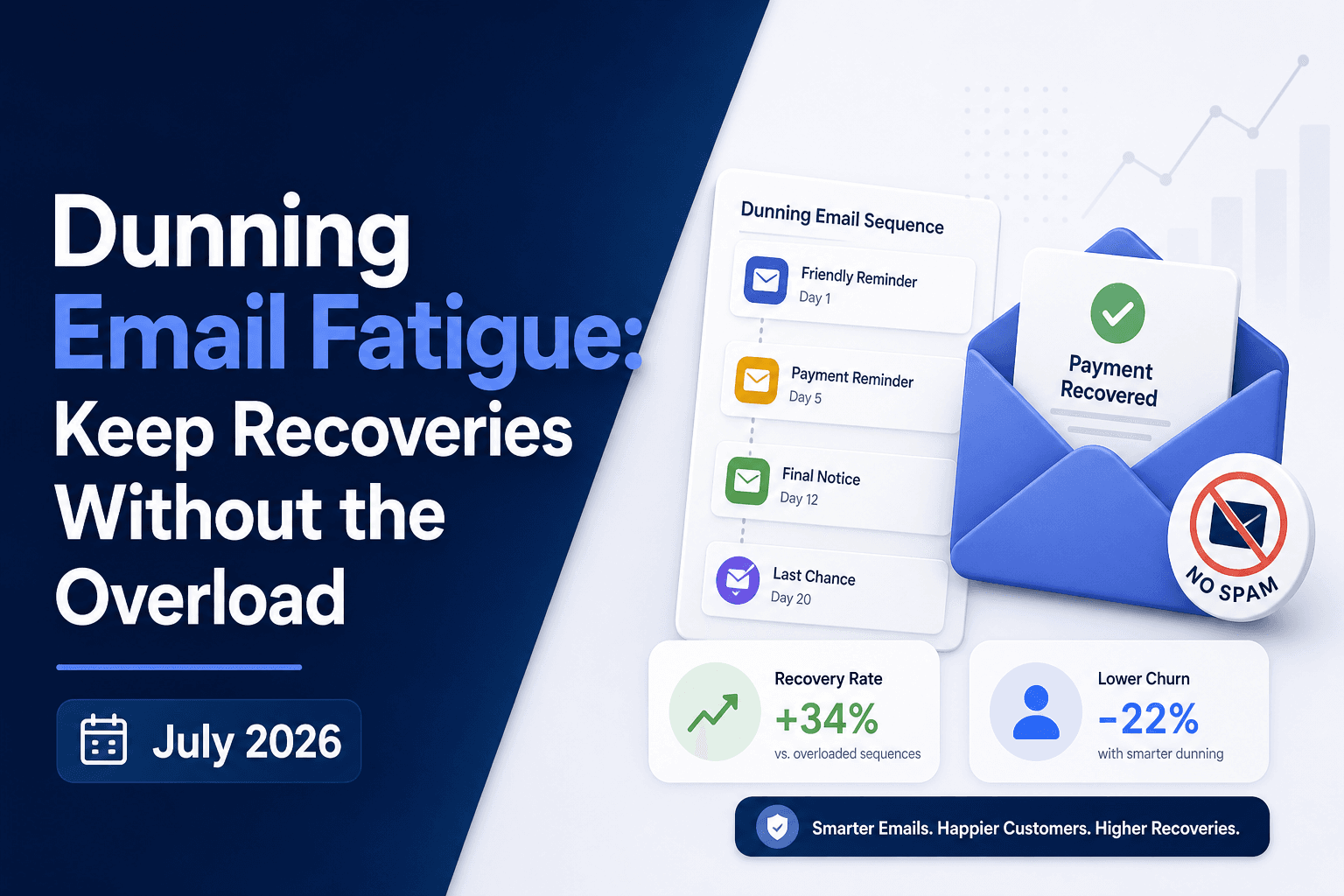
Your dunning emails are only as effective as the trust your subscribers already have in your brand. Send too many in too short a window and that trust erodes fast, taking your deliverability and your recovery rates with it. Getting the balance right means knowing which failed payments actually need a customer to act, and which ones you can resolve quietly on your own.
TLDR:
- High-volume dunning sequences train subscribers to ignore your emails, dropping open rates and damaging sender reputation across all email types you send.
- Silent recovery resolves soft declines without any customer contact; dunning is the fallback, not the default.
- Classify failure types before sending: expired cards, stolen cards, and insufficient funds each require a different message and urgency level.
- A 3-email cadence over 7 days (day 1, day 3-4, day 7) recovers more than aggressive sequences and keeps unsubscribe rates in check.
- Slicker routes soft declines to smart retries first and sends a single, failure-specific email in your brand's voice only when customer action is genuinely required.
Why Dunning Emails Cause Email Fatigue
Most failed payments in a subscription business can be resolved silently, through automated retries that succeed before a subscriber ever knows there was a problem. Dunning emails are the fallback, deployed only when customer action is genuinely required and automated recovery has run its course. The problem is that many businesses treat them as the default. A subscriber base of any real size generates a constant stream of failed payments, and when each one triggers its own email sequence, volume builds fast. Customers receiving multiple payment-related messages per month start tuning them out, and open rates drop. When your next polite payment reminder lands in an inbox already conditioned to ignore you, recovery suffers.
How Email Fatigue Erodes Recovery Outcomes
When subscribers receive too many payment reminder emails, they stop opening them. Unsubscribe rates climb, spam complaints follow, and your sender reputation takes a hit that affects every future email you send, including transactional receipts and onboarding messages. A well-structured dunning management recovery process accounts for these compounding risks from the start.
The deeper problem is that blanket dunning sequences treat every failed payment the same way. A subscriber whose card expired needs a different nudge than one facing a temporary bank hold. Sending identical urgency-laced emails to both erodes trust and trains subscribers to ignore your messages over time.
There are a few ways email fatigue quietly compounds your recovery problem:
- Inbox filtering kicks in faster when engagement drops, so your reminder emails start landing in spam before subscribers ever see them, cutting recovery chances before you have a shot.
- Subscribers who feel pestered are more likely to cancel voluntarily, converting what would have been a recoverable passive churn event into a permanent loss.
- Damaged sender reputation bleeds into your marketing and product emails, raising acquisition costs and hurting retention across the board.
The fix starts with matching email frequency and tone to the actual failure reason. Fewer, targeted emails tend to produce measurably higher open rates and recovered revenue than high-volume sequences, based on observed industry patterns.
Silent Recovery: Resolve Failed Payments Before the Inbox
Automated retries are the first line of defense against failed payments, and the best recoveries happen without the customer ever knowing there was a problem. When a payment fails due to a soft decline retry (a temporary issue like insufficient funds or a bank-side timeout), the right retry at the right moment often resolves it silently, with no email required.
This matters for email fatigue because every recovery that happens before the inbox is one fewer message your subscriber receives. Keeping that volume low preserves the credibility of the emails you do send.
Failure-Type Classification: When Customer Action Is Actually Required
Not every failed payment is recoverable without the customer's involvement. Stolen or expired cards, accounts flagged for fraud, and certain hard declines require the subscriber to take action before any retry will succeed.
Classifying failure types before sending a dunning email matters because it shapes both the message and the urgency, and in many cases points toward recovering failed subscription payments without email dunning. A subscriber whose card expired needs a simple update prompt. One whose card was reported stolen needs clear reassurance and a secure re-entry path. Sending a generic "update your payment info" email to both wastes goodwill and increases unsubscribe risk.
A Simple Framework for Routing Failure Types
Failure Type | Customer Action Required | Recommended First Step |
|---|---|---|
Expired card | Yes | Polite payment reminder with direct update link |
Stolen or blocked card | Yes | Reassurance-first message with secure re-entry |
Insufficient funds | Sometimes | Retry first; email only if retries fail |
Soft decline (generic) | Rarely | Silent retry before any outreach |
Hard decline (fraud flag) | Yes | Email with clear next step; no retry |
Routing customers into the right message based on the actual failure code keeps communication relevant and reduces email fatigue across your subscriber base. Sending fewer, better-targeted emails protects deliverability and subscriber trust far more than volume ever could.
Polite Payment Reminder Principles That Protect the Relationship
When a payment fails and automated retries haven't resolved it, a well-timed, well-worded email can recover the subscription without the customer feeling chased. The goal is to communicate clearly while respecting the relationship your subscriber already chose.
A few principles keep reminder emails effective without wearing out their welcome:
- Lead with what the customer stands to lose, not the mechanics of the failure. "Your access to X is paused" lands differently than "Your payment didn't go through." Frame the message around service continuity. These principles also apply when crafting a dunning letter for higher-stakes or offline recovery scenarios.
- Match the tone to the failure reason. A stolen card needs urgent, specific guidance. A soft decline from a temporary funds issue may warrant a softer, shorter nudge.
- Space emails to feel like helpful reminders, not a collection effort. One email per meaningful recovery window is a reasonable starting point.
- Keep the call to action singular. One link, one ask. Every additional option reduces the chance the customer acts on any of them.
The emails should come from your domain, carry your brand voice, and read like something your team wrote. A subscriber who trusts your brand will extend that trust to the recovery message when it feels like it belongs in the same relationship.
Optimal Dunning Cadence: Frequency, Spacing, and When to Stop
Most recovery sequences fail not because of messaging but because of timing. Send too many emails too fast, and subscribers disengage or mark you as spam. Send too few, and you leave recoverable revenue on the table. The same logic applies when choosing between smart retries vs fixed retry schedules for your automated recovery layer.
A tested cadence for a 7 to 14 day recovery window looks like this:
- Day 1: Send a polite payment reminder immediately after the failed charge, framed around uninterrupted access to the service they already use.
- Day 3 or 4: A brief follow-up if no action has been taken, focusing on what they stand to lose.
- Day 7: A final notice that communicates a clear deadline without sounding punitive.
After day 10 to 14 with no response, stop emailing. Continued outreach past that window rarely converts and measurably increases unsubscribe rates, which compounds involuntary churn (subscribers lost due to payment failure, not cancellation intent) with reputational damage to your sender domain.
Spacing matters as much as frequency. Sending two emails within 24 hours triggers spam filters and erodes trust faster than silence would. Each message needs enough breathing room to feel considered, not automated.
The goal is a sequence your subscribers respect enough to act on, which means fewer, well-timed touchpoints anchored to genuine service value.
Segmentation and Personalization in Payment Recovery Sequences
Every subscriber relationship is different, and a single recovery email sequence rarely fits all of them. Segmenting your dunning by failure reason, tenure, and billing tier lets you send a polite payment reminder that actually matches the situation, which keeps your brand credible and your unsubscribe rates down.
Failure Reason as the First Filter
Card declines fall into distinct categories, and each one calls for different customer action. A stolen card requires the subscriber to add a new payment method entirely. Insufficient funds may only need a few days. Routing those two cases into the same generic "update your payment info" sequence wastes goodwill on subscribers who can't act yet.
Tenure and Value as Secondary Signals
Long-tenured, high-value subscribers warrant more patience and warmer language. A subscriber on month 36 of a premium plan deserves a different tone than a trial convert who has paid once. The broader question of dunning emails vs AI retries shapes how you weight each tool by cohort. Adjusting frequency and urgency by cohort reduces email fatigue without sacrificing recovery on accounts where the revenue impact is highest.
Deliverability Considerations for Dunning Emails
A dunning email that lands in spam recovers nothing. Authenticate your sending domain with SPF, DKIM, and DMARC (Sender Policy Framework, DomainKeys Identified Mail, and Domain-based Message Authentication); without all three, major inbox providers treat outbound mail as suspicious by default. Keep dunning traffic on a separate sending infrastructure from marketing campaigns, because a promotional unsubscribe spike can drag down the deliverability scores your recovery emails inherit. Choosing among the best dunning email tools for subscription businesses also affects how easily you can isolate that infrastructure.
Volume also signals intent to inbox providers. Aggressive sending patterns read as spam behavior, and Gmail's Subscription Center (per Google's official announcement) made bulk unsubscribing structurally easier, raising the stakes further. A subscriber who bulk-unsubscribes from your domain takes their engagement signal with them across every email type you send.
Measuring Whether Your Dunning Strategy Is Causing More Harm Than Good
Two signals tell you your dunning cadence has crossed from helpful to harmful: unsubscribe rate and spam complaints on payment recovery emails. If either climbs above your transactional email baseline, subscribers are actively rejecting your outreach instead of responding to it. That revenue goes unrecovered and the relationship takes damage that makes future retention harder.
A secondary metric worth watching is days-to-cancel after a failed payment. If subscribers who receive more emails churn faster than those who receive fewer, frequency is accelerating the exit. Understanding smart dunning versus rules-based approaches helps clarify which layer of your stack is driving that pattern.
What to Track
- Unsubscribe rate on dunning emails relative to your transactional baseline, segmented by message number in the sequence so you can see exactly where fatigue sets in.
- Spam complaint rate, because inbox providers use complaint signals to filter future sends, meaning email fatigue compounds into deliverability damage over time.
- Days-to-cancel post-failure, compared across cohorts receiving different send frequencies.
These three metrics, read together, give you a clear picture of whether your polite payment reminders are landing as helpful service communications or as pressure that pushes subscribers out the door.
How Slicker Reduces Email Fatigue While Recovering More Revenue
Slicker's approach puts silent recovery first. When a payment fails due to a soft decline, the AI reads issuer signals, account history, and timing patterns to decide whether a smart retry can resolve it without ever contacting the subscriber. Most recoveries happen this way, invisibly.
When customer action is genuinely required, such as an expired or stolen card, Slicker sends a single, targeted email written in your brand's voice and tied to the specific failure reason. The decision between invisible vs engaged payment recovery determines when that contact is warranted at all. Subscribers receive one relevant message, not a generic blast repeated until they unsubscribe.
That precision is what separates recovery from noise.
Final Thoughts on Building a Payment Recovery Strategy That Protects Subscriber Trust
The fix to dunning fatigue starts before the inbox. Silent recovery handles the easy wins, and well-timed, failure-specific emails handle the rest. Your subscribers get fewer messages, your deliverability stays healthy, and your recovery rate reflects the effort you put into the relationship, not the volume of reminders you sent. To see how a more targeted recovery approach could work for your subscription business, connect with the Slicker team.
FAQs
How do you reduce dunning email fatigue without sacrificing payment recovery?
Start with silent recovery: when a payment fails due to a soft decline, smart retries resolve most failures without any customer contact. Emails should only go out when customer action is genuinely required, such as an expired or stolen card. Fewer, targeted messages produce higher open rates and recovered revenue than high-volume sequences in observed industry patterns.
What's the best cadence for polite payment reminders in a 14-day recovery window?
Three touchpoints tend to work: one email immediately after the failed charge, a brief follow-up on day 3 or 4 if no action is taken, and a final notice around day 7 with a clear deadline. Stop after day 10 to 14 with no response; continued outreach past that window measurably increases unsubscribes without lifting recovery rates.
Should I send the same dunning email sequence to every subscriber, or segment by failure reason?
Segment by failure reason first. A subscriber whose card was stolen needs reassurance and a secure re-entry path; one with a temporary insufficient funds decline may only need a retry, not an email at all. Routing each failure type into a matching sequence keeps messages relevant, protects your sender reputation, and reduces the email overload recovery problem that generic blast sequences create.
How do I know if my dunning emails are causing more harm than good?
Track three signals: unsubscribe rate on payment recovery emails relative to your transactional baseline, spam complaint rate, and days-to-cancel after a failed payment. If subscribers who receive more emails churn faster than those who receive fewer, send frequency is accelerating exits, not preventing them.
How does Slicker's approach to dunning differ from a standard billing platform's built-in email sequences?
Slicker sends dunning emails only when customer action is the sole remaining recovery path, keeping email overload recovery low by resolving most failures silently first. When an email is warranted, it is tied to the specific failure reason, sent from your domain in your brand voice, and decoupled from retry timing, so subscribers receive one relevant message instead of a generic sequence fired in lockstep with retry attempts.
Related Articles
2026 Revenue Recovery Playbook for Subscription Businesses
Failed payments are responsible for somewhere between 20 and 40% of subscription churn across the industry. Those subscribers never chose to leave. A good...
Retry Old Card or Wait for CAU? A Sep 2026 Guide
Card account updater retry logic sounds straightforward until you're staring at a mixed queue of expired cards, insufficient funds declines, and closed...

Defining Failed Payment Recovery for Subscription Businesses September 2026
Most subscription finance teams are solving the wrong problem. When a card declines and the account eventually closes, that loss lands in the churn column next...
Stop losing revenue to failed payments
Join leading subscription businesses using Slicker to recover failed payments automatically.
Get Started