Small Subscription Charges and Decline Rates (Oct 2026)

If your low-ticket subscription tier has a stubbornly high decline rate, the instinct is usually to retry more. But the real issue is a card mix problem compounded by timing, and retrying harder on the wrong schedule just burns attempts on charges that would have cleared four days later. Here's what's actually driving that gap, and what recovery logic calibrated to small-payment failure modes looks like.
TLDR:
- Sub-$30 subscriptions fail harder because they attract debit and prepaid cards, where balances are thin and authorization windows are narrow.
- First charges after a free trial fail at roughly 4 times the rate of regular renewals; with no retry logic, the failure becomes immediate involuntary churn.
- Fixed retry schedules ignore payroll timing; a $12.99 charge missing payday by three days would have authorized cleanly four days later.
- Decline codes lie at low price points: the same generic code on a prepaid card can mean an empty balance or a blocked card, with completely different recovery paths.
- Slicker's retry AI reads over 40 variables per transaction and schedules each attempt to the hour around regional payroll cycles, targeting the dominant soft decline failure mode at sub-$30 price points.
The Mechanics of Why Payment Amount Affects Decline Rate
Transaction size influences authorization outcomes in ways most billing teams don't account for. When an issuing bank processes a charge, it runs the transaction through a risk model that weighs dozens of signals simultaneously: merchant category, card history, geography, time of day, and the transaction amount itself. A $5 recurring charge and a $150 one hit the same risk infrastructure differently, even on the same card with the same merchant.
The mechanics work against low-ticket charges in a specific way. Small recurring amounts map statistically to prepaid cards, low-balance debit accounts, and free-trial signups where card quality was never screened. Issuers know this at a portfolio level, and their models price that risk into decline thresholds accordingly.
There's also a pure insufficient funds timing problem. A cardholder carrying a $12 balance on a debit card won't fail a $10 authorization today and pass it tomorrow out of disengagement. They'll pass it the moment their paycheck clears, and that window is narrow. At $150, the same cardholder is more likely to reach for a credit card, where funds availability isn't the constraint at all.
Low-ticket recurring charges sit at the intersection of three structural disadvantages:
- Higher prepaid and debit card concentration, where balances are thin and card quality often goes unscreened at signup.
- Thinner issuer authorization margins, because issuers have trained models on years of outcome data showing $9.99 monthly charges carry a different risk profile than $99 annual ones.
- Tighter funds-availability timing windows, where a fixed retry schedule almost certainly misses the brief gap after a paycheck clears.
Each factor alone raises decline rates. Together, they explain why smaller payments fail harder than aggregate numbers suggest, and why retry logic built for average transaction sizes leaves real revenue on the table.
The Card Mix Problem: Who Actually Pays $5 to $15 Per Month
Price point shapes the payment method mix more than most teams realize. Subscribers at $5 to $15 per month skew heavily toward consumer debit and reloadable prepaid cards, partly because low prices attract budget-conscious buyers and partly because free-trial signups rarely screen for card quality before the first charge fires.
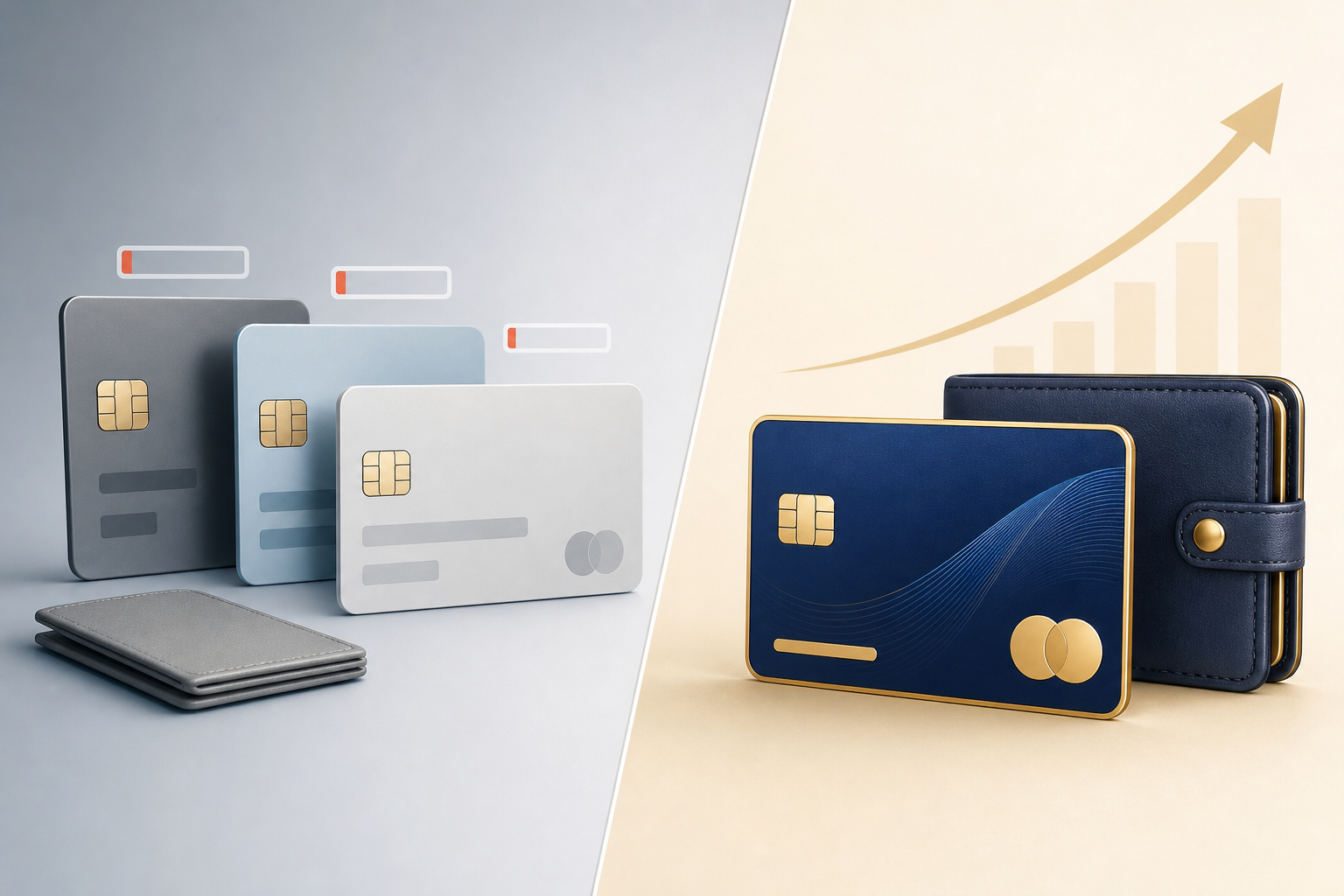
The risk profile of each instrument is structurally different. A prepaid card carries only what was loaded onto it, with no credit line, no overdraft buffer, and no automatic reload when the balance hits zero. A $9.99 charge on a card with an $8 balance fails immediately until the cardholder acts. Consumer debit carries a similar constraint: authorization depends entirely on the linked checking account balance at the moment of the attempt.
Credit card holders in this tier are a smaller share. Credit cards authorize against a credit line, not a live balance, removing the funds-availability problem almost entirely. That card-mix imbalance helps explain why subscription businesses lose 9% of revenue to failed payments on average, with low-ticket tiers running materially higher.
Fixed retry schedules blind to card type miss the narrow post-paycheck authorization windows that debit declines actually require, leaving recoverable revenue on the table.
Insufficient Funds: The Dominant Failure Mode at Low Price Points
Code 51 insufficient funds declines are the specific failure mode that separates low-ticket subscription billing from everything else. Above $50, credit cards carry enough of the transaction mix that balance availability rarely drives the failure rate. Below $30, consumer debit dominates, and debit authorizes against a live account balance that can swing by hundreds of dollars within a single week.
The timing problem compounds the balance problem. Most billing systems fire recurring charges on a fixed calendar date, while payroll arrives on the 1st, the 15th, or a rotating Friday. A $12.99 charge hitting three days before a paycheck clears will fail. The same card, same cardholder, same merchant would have authorized fine four days later. That gap is recoverable, but only if the retry lands inside the narrow post-deposit window.
The industry data reflects this. Health and fitness companies, which commonly price below $30 per month, lose 11% of subscription revenues to failed payments, compared to a cross-industry average closer to 9%. That gap tracks directly with price point and the debit-heavy card mix lower prices attract.
Fixed retry schedules reschedule the attempt, not around payroll. The decline repeats, the dunning clock advances, and a recoverable failure becomes a canceled subscription.
Free-Trial-to-Paid Conversions: The First-Payment Failure Spike
The first post-trial charge carries more failure risk than any other payment in the subscription lifecycle. Data across 100,000+ trial transitions (Redux Payments) shows first charges after a free trial fail at roughly 4 times the rate of regular renewals. At low price points, that spike is even sharper.
The structural reasons are specific. During free-trial signup, cardholders face no immediate financial consequence, so card quality goes unscreened. Prepaid cards with minimal balances, virtual card numbers tied to one-time-use limits, and debit cards from accounts that won't carry a positive balance on billing day all pass the zero-dollar trial authorization without issue. The first real charge exposes every one of those problems at once.
Issuers also treat the inaugural merchant-initiated transaction (MIT) differently from a long-running billing relationship. A card that has renewed six times carries behavioral history the issuer's model trusts. A brand-new MIT from an unfamiliar merchant at a low dollar amount gets scored with no such goodwill, so decline thresholds are effectively tighter on day one.
Billing infrastructure compounds the risk further. Many systems grant recurring renewals an extended retry window spanning days or weeks, but treat first-invoice failures as a single attempt. A failed trial conversion with no retry logic becomes immediate involuntary churn before the subscriber ever experienced the paid product.
Hard Declines vs. Soft Declines at Small Transaction Amounts
Not every failed charge on a small subscription is recoverable. The soft vs hard decline distinction determines whether retry logic can help at all, and at low price points, that classification becomes harder to make cleanly.
There are two categories worth knowing:
- Soft declines are temporary. Insufficient funds, "try again later," generic processor responses, and certain "do not honor" codes with recoverable advice all fall here. The card is valid; the failure is situational. Retry at the right time and the charge authorizes.
- Hard declines are permanent. Stolen cards, closed accounts, fraud blocks, and explicit stop-payment instructions won't resolve without the cardholder taking direct action. No retry timing fixes a closed account.
The complication at low price points is that the card mix produces a higher volume of ambiguous errors. A $9.99 charge on a prepaid card returning a generic decline could mean an empty balance or an expired one-time-use virtual card number. The error code is identical; the recovery path is completely different. Prepaid instruments generate these ambiguous codes at a higher rate than credit cards because their failure modes are more varied and less predictable.
Decline-code classification matters as much as retry timing at small transaction amounts. Following a soft decline retry playbook helps avoid retrying hard declines, which burns attempts, risks card network penalties, and damages your merchant reputation without recovering a dollar.
Why Issuers Score Low-Value Recurring Charges Differently
Issuers score the entire transaction context: merchant category code (MCC), billing frequency, transaction amount, and cardholder behavior history all feed into the authorization decision at once.
Low-value subscription merchants carry a specific liability in that model. Categories associated with free-trial abuse, recurring billing disputes, and high chargeback rates receive lower baseline trust scores at the issuer level. A $9.99 charge from a streaming service gets scored against the issuer's portfolio-wide experience with that MCC, and that cardholder's individual history is only one input among many.
The practical result is a structural authorization disadvantage. The same cardholder, same card, same balance, will authorize a $9.99 retail purchase at a grocery store more reliably than a $9.99 recurring merchant-initiated transaction from a subscription merchant flagged as higher-risk. The hurdle is set by the merchant's risk profile, not the buyer's creditworthiness.
Billing teams rarely see this directly. The decline returns as a generic code, and the assumption is a funds problem. Often it's a trust problem, one that better retry timing alone won't fix.
How Billing Timing Amplifies Failure Rates for Small Charges
Calendar-based billing fires when the merchant decides, not when the cardholder has money. For a debit-heavy subscriber base, that mismatch drives preventable failures.
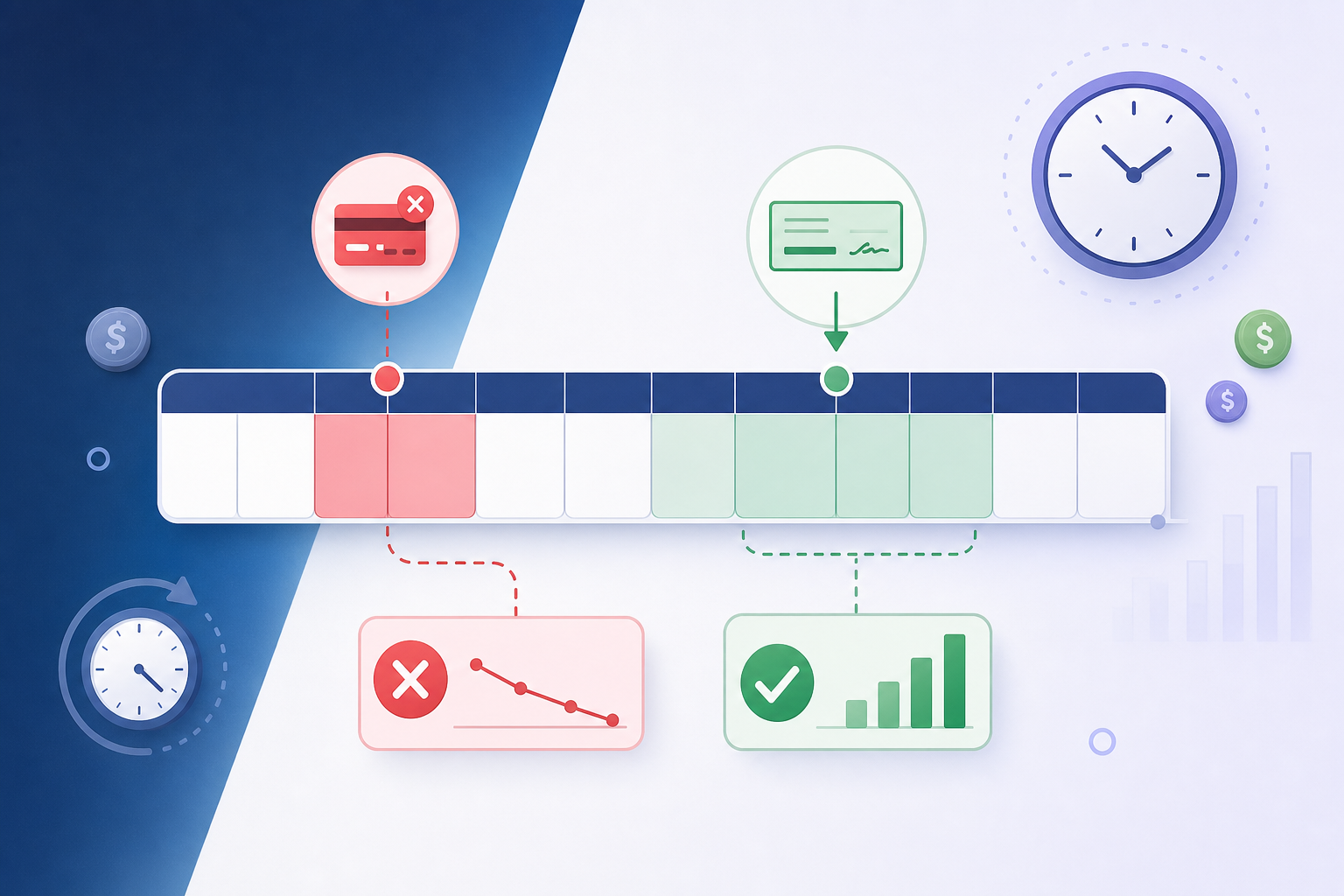
Geographic payroll cycles make this concrete. In commonly observed patterns, US payroll deposits biweekly on the 1st, 15th, or every other Friday. European and UK employers typically pay monthly, usually on the last working day. Australian payroll commonly runs weekly or fortnightly. A billing date set uniformly to the 1st hits a US subscriber whose paycheck cleared yesterday very differently than a UK subscriber still three weeks from pay day.
A $9.99 charge on a debit card carrying a $6 balance fails the same day it would have authorized cleanly four days later: no fraud signal, no issuer trust issue, a pure timing miss on a recoverable balance.
Aligning retry windows to regional payroll cadences corrects this directly:
- Payday-aligned retry scheduling two to three days after the 1st or 15th for US debit subscribers catches post-deposit availability.
- Retry within 48 hours of month-end for Western European and UK subscribers paid on the last working day.
- Run a short three-to-five-day retry cycle in Australia to match weekly or fortnightly payroll deposits.
Fixed retry schedules that ignore payroll geography miss these windows consistently. At scale, those misses convert recoverable declines into canceled subscriptions and lost MRR (monthly recurring revenue).
The Compounding Revenue Math on Low-Ticket Products
A 9% payment failure rate hits differently depending on what you charge. On a $15 consumer subscription, the per-subscriber loss looks trivial until you multiply across a large base.
Take 500,000 subscribers at $15 per month. A 9% failure rate means 45,000 failed charges every billing cycle, roughly $675,000 in revenue at risk before any recovery. At low price points, cancellation rates from unrecovered failures run higher because there's less cardholder motivation to update payment details for a $15 service than a $150 one.
The involuntary churn math underneath is what compounds. Industry data puts involuntary churn at up to 40% of all subscriber losses. For a $10 million ARR (annual recurring revenue) business with 5% monthly churn, 1 to 2 percentage points of that is payment-driven, representing $1 to $2 million annually from customers who never intended to cancel. Understanding passive churn recovery is what protects that revenue.
Low-ticket products absorb that math with less cushion. Each recovered subscriber on a $15 plan contributes less per month, so recovery rates on these accounts have to be higher, not lower, to protect the same percentage of total MRR (monthly recurring revenue).
What the Decline Code Actually Tells You (and What It Hides)
Gateway error codes were designed to communicate, but they frequently obscure more than they reveal. A "do not honor" response tells you the issuer declined the charge. It says nothing about why, whether to retry, or when. Merchants who treat identical error codes as identical recovery situations will over-retry dead charges and under-retry recoverable ones.
The same gateway code can mean opposite things depending on the issuer and the underlying network message. On a consumer debit card from a regional bank, "do not honor" may signal a temporary funds shortage. The same code from a different issuer, carrying network code 100, may signal a permanent block. One should be retried; the other should trigger dunning instead.
Network codes and Merchant Advice Codes (MACs) are the layer that resolves this ambiguity. MACs issued by Mastercard specify exactly what action to take: MAC 24 means retry after one hour, MAC 26 means retry after two days, MAC 03 means stop entirely or incur a $0.10 per-attempt penalty.
At low price points, this interpretation problem is structurally worse. The prepaid and debit card mix common to sub-$15 subscriptions generates a higher proportion of ambiguous declines with no accompanying advice code, because these instruments behave less predictably and issuers return less diagnostic information on them. A generic decline on a $9.99 prepaid subscription might reflect an empty balance, an expired virtual card, or a card the issuer quietly blocked. The code is identical; the recovery path is not.
Treating decline codes as self-explanatory at low ticket sizes leaves recoverable revenue unrecovered and burns retry attempts on unrecoverable accounts simultaneously.
How to Measure Your Own Low-Ticket Decline Rate Accurately
Most teams measuring payment failure rates are looking at the wrong number. The most common error is counting retry attempts as separate failure events, which overstates actual failure volume and obscures how many unique subscribers you're losing.
A clean failure rate calculation starts with unique invoices failed in a given period, not total declined attempts. One invoice retried four times is one failure, not four.
Segment before drawing conclusions. Aggregate rates blend high-trust credit card renewals with prepaid card first-timers, producing a number that describes neither group accurately. Minimum useful segmentation:
- Payment method (credit, debit, prepaid, digital wallet)
- Price tier ($0 to $15, $15 to $50, $50 and above)
- Acquisition channel (organic web, trial conversion, iOS/Android in-app)
For businesses with multi-tier pricing, this comparison is often the fastest diagnostic. If your $9.99 tier carries a 14% final failure rate while your $49 tier sits at 6%, card mix and acquisition channel differences explain most of the gap, and recovery strategy for each should differ accordingly.
Recovery Strategies Calibrated to Small-Payment Failure Modes
Fixing low-ticket decline rates requires matching your subscription payment retry strategy to the actual failure mix, not applying a generic retry schedule across the board.
Ranked by expected impact:
- Retry timing aligned to payroll windows. Insufficient funds is the dominant failure mode at low price points, and it's recoverable with correct timing. Soft decline retry cadence guide accounts for geographic payday cadences, card type, and time-of-day signals and consistently outperforms fixed schedules. Smart retry systems recover 70 to 85% of soft declines; fixed schedules typically land between 40 and 60%.
- Account updater services. Expired cards generate hard declines that look recoverable but aren't. Running cards through Visa Account Updater and Mastercard Automatic Billing Updater before the charge fires removes a preventable failure category entirely.
- Payment method diversification at signup. Reducing prepaid card concentration requires intervention at the acquisition stage, screening card type at trial conversion before the first charge fires.
- Failure-specific dunning: generic "update your payment method" emails perform poorly. A subscriber whose prepaid card is empty needs a different message than one whose card was stolen. Dunning calibrated to the actual decline reason gets higher completion rates.
Recovery Strategy | What It Targets | Expected Recovery Impact | When to Apply |
|---|---|---|---|
Payroll-aligned retry timing | Insufficient funds on consumer debit; narrow post-deposit window | Smart retries recover 70 to 85% of soft declines vs. 40 to 60% for fixed schedules | First: dominant failure mode at sub-$30 price points |
Account updater services (VAU / MCABU) | Expired cards generating hard declines before the charge even fires | Removes an entire preventable failure category | Run before the charge fires on cards nearing expiry |
Payment method screening at signup | Prepaid card concentration entering the subscriber base at trial | Reduces structural card-mix disadvantage over time | Intervention at trial conversion, before first charge |
Failure-specific dunning | Subscribers who genuinely need to act (stolen card, blocked instrument) | Higher completion rates vs. generic "update your payment method" emails | Second: only when decline type confirms customer action is required |
Retry timing comes first, because most low-ticket failures are recoverable soft declines with a funds-availability cause. Dunning comes second, and only when the decline type confirms that customer action is actually required.
How Slicker Handles Failure-Rate Variance by Transaction Amount
Slicker's retry AI analyzes over 40 variables per transaction, including card type, BIN data, issuing bank behavior, geographic payday patterns, and hour-level timing signals. That granularity matters most at low price points, where consumer debit concentration means recovery windows are narrow and timing is the primary lever.
Retry scheduling varies by region:
- For US debit cards, the highest-probability recovery window is 12:01am when payroll deposits clear.
- For European monthly payroll cycles, retries land within 48 hours of the last working day of the month.
- For Australia's weekly or fortnightly cadences, a three-to-five-day interval catches most payroll windows.
Each attempt is scheduled to the hour, which is what separates per-transaction AI logic from a fixed calendar schedule. The result is consistent outperformance on soft declines, the dominant failure mode at sub-$30 price points, with performance-based pricing so you pay only on revenue actually recovered.
Final Thoughts on Recovering Revenue From Low-Ticket Subscription Failures
Low-ticket payment failure is a structural problem, not a random one, and most of the losses are recoverable with the right timing logic. The card mix common to sub-$15 subscribers means payroll cadence and decline code interpretation matter more than they do at higher price points. Your retry schedule is either catching that narrow post-deposit window or consistently missing it. Reach out here if you want to see what a smarter retry approach would look like for your subscriber base.
FAQs
Why do smaller payments fail more often than larger charges on the same card?
Small recurring charges fail at higher rates because of three compounding factors: a higher concentration of prepaid and consumer debit cards in low-price subscriber bases, tighter issuer authorization margins on merchant categories associated with free-trial abuse, and narrower funds-availability windows that fixed retry schedules consistently miss. A $9.99 debit card charge can fail on billing day and authorize cleanly four days later when payroll clears. The card, the cardholder, and the merchant are identical in both scenarios; only the timing differs.
Why do free-trial-to-paid conversions have such high payment failure rates compared to regular renewals?
First post-trial charges fail at roughly four times the rate of regular renewals because card quality goes unscreened at zero-dollar trial signup. Prepaid cards with minimal balances, virtual card numbers with one-time-use limits, and debit accounts that won't carry a positive balance on billing day all pass the free trial without issue. The first real charge exposes every one of those problems simultaneously, and issuers score brand-new merchant-initiated transactions with no behavioral history to trust, so decline thresholds are effectively tighter on day one.
How can payment failure analytics help diagnose whether a high low-ticket decline rate is a real problem or normal variance?
Start by segmenting at the unique invoice level, not total retry attempts, then break results down by payment method (credit, debit, prepaid), price tier, and acquisition channel. If your $9.99 tier carries a 14% final failure rate while your $49 tier sits at 6%, the gap almost always traces back to card mix and acquisition channel differences, not a systemic processor issue. That segmentation tells you whether the problem is recoverable through retry timing, requires intervention at signup screening, or needs failure-specific dunning calibrated to the actual decline reason.
What is the difference between Slicker and Chargebee's built-in smart dunning for recovering low-ticket payment failures?
Chargebee's built-in dunning applies rule-based retry schedules that treat all failed payments the same regardless of card type, issuing bank, or geography. Slicker's AI models analyze over 40 variables per transaction, including regional payroll cadences, BIN-level issuer behavior, and hour-level timing signals, and schedule each retry attempt to the specific window when that card is most likely to authorize. The performance difference is most pronounced on consumer debit declines driven by insufficient funds, which are the dominant failure mode at sub-$15 price points and require precision timing around payroll deposits that calendar-based schedules miss entirely. Slicker proves the incremental lift against Chargebee's baseline through AABB testing on your own transaction data before you commit.
How do you measure true payment amount decline rate without overcounting retry attempts as separate failures?
Count unique invoices failed in a given period, not total declined attempts. One invoice retried four times is one failure. From there, segment by payment method, price tier, and acquisition channel before drawing any conclusions. Aggregate rates blend high-trust credit card renewals with prepaid card first-timers and produce a number that accurately describes neither group. The final failure rate, measured after the full retry window closes, is the metric that maps to actual involuntary churn and lost MRR.
Related Articles
Authorization Rate in Subscription Billing: October 2026
There's a number sitting in your payments data that most finance and retention teams never report on separately: the share of renewal charges your issuing...
Why Payment Recovery Must Live Above Billers October 2026
A payment fails. Your biller retries it three days later, then again at seven, then at fourteen. What the biller never checks is whether the issuer sent a...
Billing Migration vs Recovery Layer: The Right Call October 2026
Switching billing systems feels like the right move when revenue collection starts breaking down. Sometimes it is. But soft declines, weak retry logic, and...
Stop losing revenue to failed payments
Join leading subscription businesses using Slicker to recover failed payments automatically.
Get Started