AI and Payment Recovery: Tackling 12% Transaction Failures Oct 2026

Introduction
Payment failures are silently bleeding revenue from subscription businesses worldwide. Up to 12% of card-on-file transactions fail due to expired cards, insufficient funds, or network glitches, creating a massive involuntary churn problem that costs companies millions in lost revenue. Failed subscription payments cost businesses an estimated $129 billion in lost revenue in 2025. (Recurly) What's even more alarming is that involuntary churn accounts for 20 to 40% of total subscription churn. These are customers who never intended to leave but are forced out when a card is declined. (Slicker)
The traditional approach to payment recovery has been reactive and inefficient, relying on basic retry logic that often fails to recover lost revenue. However, artificial intelligence is reshaping this market, offering sophisticated solutions that can predict optimal retry timing, route payments through the best gateways, and recover 2-4× more failed payments than native billing provider logic. (Slicker)
As the global AI market has already reached USD 539.5 billion in 2026 and is projected to surge to USD 3.5 trillion by 2033, payment recovery stands as one of the most immediate and measurable applications of this technology. (Grand View Research) Companies that adopt AI-powered payment recovery are solving more than a technical problem, they're also gaining a competitive advantage that directly impacts their bottom line.
TLDR:
- Up to 12% of card-on-file transactions fail, costing subscription businesses an estimated $129 billion in lost revenue in 2025 (Recurly).
- Involuntary churn accounts for 20-40% of total subscription churn; these are customers who never chose to leave, making recovery a direct MRR defense.
- AI-powered smart retry systems consistently recover 70-85% of soft declines; static retry logic from native billing providers lands at the industry median of 47.6%.
- ACH and card failures require separate recovery logic: ACH R07/R10 returns are hard stops with 60-day return windows, while card soft declines are retryable within hours.
- Slicker applies an ensemble of AI models to classify each decline and schedule retries, with concurrent AABB holdout testing to prove uplift against your own baseline.
The Hidden Cost of Payment Failures
The Scale of the Problem
Payment failures represent a massive, often underestimated drain on subscription revenue. Industry estimates suggest a single payment hiccup can drive 35% of users to cancel, and that 62% of users who hit a payment error never return to the site. These figures show how quickly a technical failure becomes a permanent customer loss. In some industries, decline rates reach 30%, and each one is a potential lost subscriber. (Spreedly)
The financial impact extends beyond immediate revenue loss. It is 5-7× cheaper to save an existing subscriber than acquire a new one, making payment recovery more than a retention strategy and instead a fundamental business imperative. Baremetrics' 2026 analysis puts average MRR leakage from failed payments at 9% per month. For a business at $100K MRR, that's $9,000 walking out the door every single month. (Baremetrics) The compounding effect on involuntary churn and customer LTV makes this even more damaging. High-flying SaaS leaders publicly report "net revenue retention of 120%+", a metric impossible without strong recovery logic.
Traditional Recovery Methods Fall Short
Most billing providers rely on basic retry logic that treats all failed payments the same way. This one-size-fits-all approach ignores the subtle reasons behind payment failures and often results in:
- Poor timing: Retrying too quickly or too slowly based on failure type
- Gateway limitations: Sticking with a single payment processor despite varying success rates
- Lack of intelligence: No learning from historical data to optimize future attempts
- Customer frustration: Multiple failed attempts without proper communication
Current data puts involuntary churn at 20-40% of total subscription churn across segments, and because these are customers who never chose to leave, virtually all of it is recoverable with the right system in place. (Digital Applied, 2026)
How AI Reshapes Payment Recovery
Real-Time Intelligence and Pattern Recognition
Artificial intelligence brings unprecedented sophistication to payment recovery through advanced pattern recognition and real-time decision making. Machine learning models today have the ability to learn and improve upon themselves, process more data, make real-time decisions, and adapt instantly to new patterns with minimal human intervention. (Aeropay)
AI-powered systems analyze multiple data points for each failed transaction:
- Failure reason classification: Understanding whether a decline is due to insufficient funds, expired cards, or issuer restrictions
- Historical success patterns: Learning from previous recovery attempts to predict optimal retry strategies
- Customer behavior analysis: Identifying patterns that indicate likelihood of successful recovery
- Gateway performance metrics: Tracking which payment processors perform best for specific transaction types
Smart Retry Scheduling
Unlike static retry schedules, AI systems dynamically adjust retry timing based on failure type and historical data. Understanding the distinction between soft vs hard declines is the key distinction here, as real-time failure classification lets systems immediately categorize declined transactions and apply the most appropriate recovery strategy.
For example:
- Insufficient funds: Retry during typical payday periods
- Expired cards: Immediate retry with updated card information requests
- Issuer restrictions: Longer delays with alternative gateway routing
- Network errors: Quick retries with different processing routes
Multi-Gateway Smart Routing
AI-powered payment recovery systems use multiple payment gateways to maximize success rates. Research shows that payments success rates increase measurably when transacting with multiple gateways, as different processors have varying relationships with issuing banks and different approval algorithms. (Slicker, June 2026)
Smart routing systems analyze performance for all transactions in a trailing window, then choose the best gateway to route transactions to based on real-time success rates. This approach means each retry attempt has the highest probability of success.
The Competitive Advantage of AI-Powered Recovery
Measurable Impact on Revenue
Companies implementing AI-powered payment recovery are seeing dramatic improvements in their recovery rates and overall revenue retention. The industry median recovery rate currently sits at 47.6%, but AI-powered platforms consistently deliver 70 to 85% recovery on soft declines, more than double the results of static retry logic. (Slicker, Aug 2026)
The impact extends beyond just recovering failed payments:
- Reduced involuntary churn: Cutting involuntary churn by 30-50% without manual intervention, with Recurly data showing optimized retry strategies improving recovery from ~53% to ~71% on the same transaction set (Recurly)
- Improved customer experience: Intelligent retry scheduling reduces customer frustration
- Team capacity gains: Automated processes free up team resources for strategic initiatives
- Better cash flow: Faster recovery of failed payments improves working capital
Enhanced Fraud Detection and Security
AI's impact on payment processing extends beyond recovery to fraud prevention. 83% of industry leaders report that AI has materially reduced false positives and customer churn rates in the past year, and 42% of issuers have saved more than $5 million in fraud attempts over the past two years through AI. (Mastercard, 2026) As a prior-year benchmark, global payment fraud losses were estimated at $48.7 billion in 2025 (Dataintelo). That figure shows why AI-driven detection has become a business necessity and more than a competitive edge.
Productivity and Speed Gains
AI dramatically accelerates payment processing workflows, cutting time and manual effort across the board. Invoice reconciliation now takes 1-2 minutes instead of 5-8 minutes due to AI automation. Recurly's 2026 enterprise case data shows a single optimized retry deployment generating $1.9 million in incremental recovered revenue over two months, approximately $11.6 million annualized, from the same transaction set, with zero infrastructure changes. (Recurly)
Implementation Strategies and Best Practices
Choosing the Right AI-Powered Solution
When weighing AI-powered payment recovery solutions, companies should consider several key factors:
Feature | Traditional Systems | AI-Powered Systems |
|---|---|---|
Retry Logic | Static schedules | Adaptive, learning-based scheduling |
Gateway Management | Single processor | Multi-gateway smart routing |
Failure Analysis | Basic categorization | Real-time intelligent classification |
Success Rates | Baseline recovery | 2-4× improvement over native logic |
Implementation | Complex integration | No-code, 5-minute setup |
Pricing Model | Fixed monthly fees | Pay-for-success pricing |
Integration and Setup Considerations
Modern AI-powered payment recovery platforms put ease of implementation first. Leading solutions offer no-code integration with 5-minute setup times, supporting major billing providers like Stripe, Chargebee, Recurly, Zuora, and Recharge. (Slicker)
Key implementation steps include:
- Assessment: Analyze current payment failure rates and recovery performance
- Integration: Connect the AI system to existing billing infrastructure
- Configuration: Set up intelligent retry rules and gateway preferences
- Monitoring: Track performance metrics and recovery improvements
- Optimization: Continuously refine strategies based on AI insights
Compliance and Security
As payment recovery systems handle sensitive financial data, security and compliance come first. Leading AI-powered solutions pursue SOC 2 Type-II compliance and provide fully transparent analytics with enterprise-grade security measures. (Slicker)
Industry Applications and Case Studies
SaaS and Subscription Businesses
SaaS companies are among the earliest adopters of AI-powered payment recovery, driven by the recurring revenue model's sensitivity to churn. These businesses benefit from:
- Predictable revenue streams: Reduced involuntary churn directly impacts MRR and ARR
- Customer lifetime value: Longer retention periods increase overall customer value
- Scalability: Automated recovery processes support business growth
E-commerce and Digital Services
E-commerce platforms face unique payment challenges, including seasonal fluctuations and diverse customer payment methods. AI-powered recovery helps by:
- Seasonal optimization: Learning from historical patterns to optimize retry timing
- Geographic intelligence: Adapting strategies based on regional payment behaviors
- Customer segmentation: Tailoring recovery approaches to different customer types
Financial Services and Fintech
Financial services companies use AI for both payment recovery and broader debt collection strategies. The future of debt collection with AI shows promise for automating routine tasks, analyzing data for creative strategies, and making the collection process faster and more efficient. (Prodigal Tech)
The Technology Behind AI Payment Recovery
Machine Learning Algorithms
AI-powered payment recovery systems use sophisticated machine learning algorithms that continuously learn and adapt. These systems process each failing payment individually and convert past-due invoices into revenue through intelligent analysis and decision-making.
Key algorithmic approaches include:
- Classification algorithms: Categorizing failure types for targeted responses
- Predictive modeling: Forecasting optimal retry timing and methods
- Clustering analysis: Grouping similar transactions for pattern recognition
- Reinforcement learning: Continuously improving strategies based on outcomes
Data Processing and Analytics
Modern AI systems can analyze vast datasets to identify patterns and optimize recovery strategies. AI in payments has now matured to the point where companies including PayPal, Visa, and major acquirers use it to analyze, predict, and optimize payment routes based on transaction costs, processing times, and network congestion, driving rapid advances in data processing capabilities. (McKinsey, 2025 Global Payments Report)
Advanced data analysis and prediction tools help businesses create collection strategies that target high-risk individuals, predict payment patterns, and adjust approaches to reduce missed payments. (Prodigal Tech)
Real-Time Decision Making
AI systems excel at making split-second decisions based on multiple data points. This capability is central to payment recovery, where timing can impact success rates. Real-time processing supports:
- Immediate failure analysis: Instant categorization of declined transactions
- Adaptive routing decisions: Real-time selection of optimal payment gateways
- Adaptive retry scheduling: Continuous adjustment of retry timing based on new data
- Customer communication: Automated, contextual messaging to customers
Future Trends and Developments
Generative AI Integration
Generative AI, including ChatGPT-style technologies, is being heavily invested in by businesses for its potential to enhance payment recovery offerings. (Aeropay) Future applications may include:
- Personalized customer communications: AI-generated messages tailored to specific failure scenarios
- Adaptive policy creation: Automatically generated retry strategies based on business rules
- Predictive analytics reporting: Natural language insights into payment performance
Enhanced Fraud Prevention
83% of industry leaders report AI has materially reduced false positives and improved fraud outcomes in the past year, with global payment fraud losses standing at $48.7 billion in 2025, driving continued investment across the industry. (Mastercard, 2026) Future developments will tightly integrate fraud prevention with payment recovery, collapsing two formerly separate workflows into one intelligent decision layer.
Cross-System Intelligence
As AI systems become more sophisticated, we can expect greater integration across different payment platforms and services. This will allow:
- Universal payment intelligence: Learning from patterns across multiple payment processors
- Industry-specific optimization: Tailored strategies for different business sectors
- Predictive customer behavior: Anticipating payment issues before they occur
Where Things Stand: September 2026
The pace of adoption has accelerated sharply this year. Recurly's 2026 State of Subscriptions report found that 40% of subscription companies are now actively using AI for revenue recovery and churn reduction, up sharply from prior years, and identifies agentic AI as the defining frontier: systems that surface recommendations and take autonomous action, recovering failed payments and personalizing offers without human intervention. (Recurly, 2026)
Alongside the adoption surge, network-level data is sharpening the picture of what's actually recoverable. Involuntary churn data from Stripe shows that recovered subscribers stay an average of seven additional months after a payment failure is resolved, meaning recovery is more than a cash-flow fix, it's a lifetime value multiplier. (Beast Insights, 2026) And with roughly 40% of cardholders replacing a card each year through expiry, loss, or fraud, most without updating their stored credentials: the upstream prevention layer has become just as critical as downstream retry logic.
The AI for debt collection market, which encompasses payment recovery, is forecast to grow from $3.22 billion in 2026 to $11.38 billion by 2035, a path that signals this is no longer a young niche but a core infrastructure category. (Precedence Research) For subscription businesses weighing their recovery stack right now, the strategic question has shifted: not whether to deploy AI-powered recovery, but whether your current solution operates with the agentic intelligence (autonomous decisions, concurrent holdout testing, real-time decline classification) that separates median 47.6% recovery from the 70 to 85% achieved by top-performing platforms.
ACH and Direct Debit Failures: A Different Recovery Playbook
Why Card Retry Logic Doesn't Work for ACH
Card declines and ACH returns operate under completely different rule sets, and applying card-style retry logic to ACH payments is one of the most common (and costly) mistakes subscription businesses make. Card declines are synchronous: you know within seconds whether a charge succeeded. ACH returns are asynchronous: a payment that appears to clear can come back as a return up to 60 business days later for unauthorized transactions (Nacha R10/R07 return codes), and 2 business days for insufficient funds (R01). That lag means revenue you've already recognized can disappear weeks after the fact.
Key ACH Return Codes and Recovery Windows
Nacha's return code framework defines the rules of engagement for every ACH failure. The codes most relevant to subscription recovery are:
Return Code | Reason | Return Window | Reinitiation Rules |
|---|---|---|---|
R01 | Insufficient Funds | 2 banking days | Max 2 reinitiation attempts after original return |
R02 | Account Closed | 2 banking days | No reinitiation. Account is closed |
R03 | No Account / Unable to Locate | 2 banking days | No reinitiation. Routing/account number invalid |
R07 | Authorization Revoked | 60 calendar days | No reinitiation. Authorization is void |
R10 | Customer Advises Not Authorized | 60 calendar days | No reinitiation. Treat as dispute |
R16 | Account Frozen | 2 banking days | No reinitiation until account status resolves |
Nacha also enforces an unauthorized return rate threshold of 0.5%: breaching it can result in your ODFI suspending your ACH origination privileges entirely. This makes distinguishing R07/R10 returns from R01 returns a critical compliance priority: the former are hard stops; the latter are recoverable with a compliant reinitiation strategy.
ACH vs. Card: Recovery Strategy Differences
The practical implications for your recovery stack:
- Retry timing: Card soft declines can be retried within hours or days. ACH R01 failures should be queued for reinitiation after a payday-aligned window, and capped at two attempts to stay within Nacha rules.
- Reinitiation caps: Nacha limits reinitiation to two additional attempts for returned entries. No such hard cap exists for card retries (though Visa and Mastercard impose their own excessive retry fees; see FAQ below).
- Dispute risk: ACH R07/R10 returns carry dispute and compliance risk that card declines do not. An AI recovery system must classify these as hard stops and trigger a customer re-authorization flow, not a retry.
- Latency: ACH settlement takes 1 to 3 banking days. Recovery timelines are inherently longer than card, which means earlier intervention (proactive account verification, balance checks) delivers more value than downstream retries.
AI-powered recovery platforms that handle both card and ACH apply separate model logic to each payment rail, classifying ACH returns by code before deciding whether to reinitiate, escalate to a re-authorization flow, or close the recovery attempt. Treating both rails identically is the fastest route to a Nacha compliance problem and lost revenue.
Making the Business Case for AI Payment Recovery
ROI Calculation Framework
To support investment in AI-powered payment recovery, businesses should consider multiple financial metrics:
Direct Revenue Impact:
- Current monthly payment failures × average transaction value × improved recovery rate
- Reduced customer acquisition costs from lower involuntary churn
- Improved cash flow from faster payment recovery
Cost Savings:
- Reduced manual intervention in payment processing
- Lower customer service costs from fewer payment-related inquiries
- Decreased administrative overhead from automated retry processes
Strategic Benefits:
- Enhanced customer experience leading to higher retention
- Competitive advantage in payment processing capabilities
- Scalability to support business growth without proportional cost increases
Implementation Timeline and Milestones
Successful AI payment recovery implementation typically follows this timeline:
Week 1-2: Assessment and Planning
- Analyze current payment failure rates and recovery performance
- Identify key stakeholders and integration requirements
- Select appropriate AI-powered solution
Week 3-4: Integration and Setup
- Implement no-code integration with existing billing systems
- Configure intelligent retry rules and gateway preferences
- Set up monitoring and analytics dashboards
Month 2-3: Optimization and Refinement
- Monitor performance metrics and recovery improvements
- Fine-tune AI algorithms based on initial results
- Expand integration to additional payment scenarios
Month 4+: Scaling and Advanced Features
- Implement advanced features like predictive analytics
- Expand to additional markets or customer segments
- Integrate with broader business intelligence systems
Conclusion
The rise of AI in payment recovery represents more than a technological upgrade; it marks a fundamental shift toward intelligent, data-driven revenue optimization. With up to 12% of card-on-file transactions failing and traditional recovery methods proving inadequate, businesses can no longer afford to treat payment failures as an inevitable cost of doing business.
AI-powered payment recovery systems offer a compelling solution that targets the root causes of payment failures through intelligent analysis, adaptive retry scheduling, and multi-gateway routing. The industry median recovery rate sits at 47.6%, yet top AI-powered platforms consistently reach 70 to 85% recovery on soft declines, and Recurly enterprise data shows that closing that gap is worth millions in annualized recovered revenue per merchant. (Recurly)
The competitive advantage extends beyond immediate revenue recovery. With the global AI market already at $539.5 billion in 2026 and projected to reach $3.5 trillion by 2033, early adopters of AI-powered payment recovery will be better positioned to apply these technologies across their entire business operations. (Grand View Research)
For subscription businesses, SaaS companies, and e-commerce platforms, AI-powered payment recovery is rapidly becoming a necessity instead of a luxury. The technology is mature, implementation is straightforward with no-code solutions offering 5-minute setup times, and the ROI is measurable and immediate. (Slicker)
As payment failures continue to drain revenue from businesses worldwide, those who adopt AI-powered recovery solutions will protect their existing revenue streams and gain a sustainable competitive advantage in an increasingly digital economy. The question is no longer whether to adopt AI for payment recovery, but how quickly businesses can implement these solutions to start capturing the revenue they're currently losing to preventable payment failures.
Frequently Asked Questions
How do I avoid Visa and Mastercard retry fees when retrying failed subscription payments?
Both Visa and Mastercard now levy excessive retry fees on merchants who retry declined transactions too aggressively, a cost that compounds quickly for subscription businesses with high payment volumes. Visa charges a $0.10 fee per excessive retry on transactions declined with certain decline codes, after a merchant has exceeded the retry attempt threshold within a 30-day window. Mastercard applies a similar excessive attempts fee on a per-transaction basis for retries beyond permitted limits.
The specific decline codes that trigger fee exposure differ by network and evolve as the networks update their stored credential and retry frameworks. For a full breakdown of costs, see hard decline retry penalties. Broadly, the rules distinguish between:
- Do-not-retry codes (hard declines): Retrying these at all incurs fees and risks card network penalties. Examples include "Do Not Honor" (05) and "Lost/Stolen Card" (41/43).
- Retryable codes (soft declines): Permitted for retry, but subject to attempt caps and timing rules. "Insufficient Funds" (51) and "Issuer Unavailable" (91) fall here.
The practical safeguards are: (1) classify every decline code before retrying; never retry hard declines; (2) respect per-code retry windows, typically one retry per day for soft declines; (3) cap total retry attempts per billing cycle. AI-powered retry systems automate this classification in real time, eliminating the human error that turns a recoverable decline into a fee liability. A system operating on Stored Credential Transaction (SCT) frameworks and real-time decline code classification will stay within network rules while maximizing recovery, without exposing you to penalty fees that erode the economics of recovery.
What percentage of card-on-file transactions typically fail?
Up to 12% of card-on-file transactions fail due to various reasons including expired cards, insufficient funds, or network glitches. Across the subscription economy, this translated to an estimated $129 billion in lost revenue in 2025 alone, making AI-powered payment recovery one of the highest-ROI investments available to subscription businesses. (Recurly)
What tools should a SaaS CFO use to recover lost revenue from failed payments in 2026?
The modern SaaS payment recovery stack layers four complementary tools, each targeting a different failure mode:
- Smart retries / AI-powered dunning: Platforms like Slicker apply machine learning to classify each decline and schedule retries at the statistically optimal moment. Stripe Billing's Smart Retries and Adaptive Acceptance offer network-level optimization for merchants already on Stripe. Churn Buster and Retain (by Paddle) provide dunning-focused recovery for Stripe and Braintree stacks. The key differentiator in 2026 is whether the system runs concurrent holdout testing, proving its uplift against your baseline instead of asking you to trust aggregate benchmarks.
- Account Updater (AU): Visa and Mastercard's network services automatically push updated card credentials to merchants when a cardholder's card is reissued. Stripe, Chargebee, and Recurly all surface AU natively, but coverage is limited to participating U.S. and Canadian issuers, and AU only resolves expiry/reissue failures, not insufficient-funds declines.
- Network Tokens: A step beyond Account Updater, network tokens replace the PAN with a token that the network updates automatically, improving authorization rates and reducing the card-expiry failure vector at source. Stripe and major processors support network tokenization; Recurly and Chargebee are expanding native support. For CFOs weighing infrastructure, network tokens reduce the volume of failures that need to be recovered downstream.
- Multi-gateway / cascade routing: Routing a retry through a different acquirer or processor can flip a decline to an approval, particularly for cross-border transactions where issuer relationships differ by processor. Chargebee and Recurly offer gateway failover configurations; dedicated orchestration layers (Spreedly, Primer) provide deeper routing logic.
The CFO's ROI calculus: Account Updater and network tokens reduce failure volume upstream. Smart retries with AI classification recover the failures that still occur. Multi-gateway routing maximizes the per-attempt approval rate. Together, these payment decline recovery layers close the gap between the industry median 47.6% recovery rate and the 70-85% achieved by top-performing platforms.
How much can AI improve payment recovery rates?
The industry median recovery rate sits at 47.6%, while AI-powered platforms consistently reach 70 to 85% recovery on soft declines. Recurly's 2026 enterprise analysis found that closing this gap generated $1.9 million in incremental recovered revenue in just two months for a single merchant, approximately $11.6 million annualized. These systems use machine learning to analyze payment patterns, optimize retry timing, and personalize recovery strategies for each failed transaction. (Recurly)
What tools should I use to reduce payment failures on my Chargebee or Recurly billing stack?
Both Chargebee and Recurly offer native dunning and retry features, but native tooling has a ceiling. Here's how to layer additional recovery on top of each:
On Chargebee: Chargebee's built-in Smart Retry logic allows configurable retry schedules, and its Account Updater integration refreshes expired card credentials automatically via connected gateways (Stripe, Braintree, Adyen). Network token support is available through compatible gateways. To go beyond native limits, connect an AI recovery layer (such as Slicker) via Chargebee's billing API; it receives webhook events for failed charges, applies decline-code-specific retry logic, and routes retries through the optimal gateway without requiring a system migration.
On Recurly: Recurly's Revenue Optimization Engine (ROE) uses machine learning to schedule retries and has published recovery rate improvements of ~53% to ~71% on the same transaction set with optimized retry logic. Recurly also supports Account Updater and is expanding network token coverage. Cascading gateway configuration allows retry routing across multiple processors. For merchants whose recovery gap is still material after turning on ROE, a purpose-built AI recovery system operating via Recurly's webhook layer adds a holdout-tested uplift on top, with the statistical proof to support the cost.
The layered approach for both stacks:
- Turn on Account Updater and/or network tokens at the gateway level first; reduces failure volume at source.
- Activate the billing stack's native smart retry / dunning engine; baseline coverage with no additional vendor.
- Add an AI recovery layer for holdout-tested uplift that captures the residual failure volume the native engine doesn't recover, measured against your own data.
How does AI enhance payment recovery compared to traditional methods?
AI enhances payment recovery by processing each failing payment individually using intelligent algorithms that learn from past patterns. Unlike traditional retry methods, AI can predict the optimal timing for retries, identify the root cause of failures, and adapt strategies in real-time to maximize recovery success rates.
What role does machine learning play in fraud detection for payments?
Machine learning is central to payment fraud detection. Mastercard's 2026 research found that 83% of industry leaders report AI has materially reduced false positives and churn, and 42% of issuers have saved over $5 million in fraud losses over two years through AI deployment. With global payment fraud losses estimated at $48.7 billion in 2025, ML models that process transaction data in real time, identifying suspicious patterns while minimizing false positives, have become mission-critical infrastructure. (Mastercard, 2026)
How quickly can AI process payment reconciliation tasks?
AI has dramatically reduced payment processing times, with invoice reconciliation now taking just 1-2 minutes instead of the traditional 5-8 minutes. This speed improvement allows businesses to identify and resolve payment issues faster, reducing the window for revenue loss from failed transactions.
What are the best alternatives to Churn Buster for AI-powered dunning and payment retries in 2026?
The dunning and payment recovery market has matured a great deal since Churn Buster pioneered email-based dunning for Stripe merchants. In 2026, the relevant alternatives split into two categories depending on what your recovery gap actually is:
Native recovery (built into your billing stack):
- Stripe Billing Smart Retries + Adaptive Acceptance: Stripe's ML-based retry engine and issuer-network optimization are available natively for Stripe Billing merchants. Best suited for businesses whose entire stack runs on Stripe and whose failure volume doesn't warrant a standalone vendor.
- Recurly Revenue Optimization Engine: Recurly's built-in ML retry logic, available to all Recurly merchants. Documented recovery improvement from ~53% to ~71% on comparable transaction sets.
- Retain by Paddle: Focuses on cancellation prevention and dunning for Paddle-billed SaaS products.
Dedicated AI recovery platforms (stack-agnostic, holdout-tested):
- Slicker: Applies an ensemble of AI models to classify each decline and schedule retries at the statistically optimal moment, across Stripe, Chargebee, Recurly, Zuora, and Recharge. The differentiator versus Churn Buster is the methodology: Slicker runs concurrent AABB holdout testing (splitting traffic 50/50 and proving uplift against your own baseline with p-value reporting) instead of relying on aggregate benchmark claims. No-code integration with 5-minute setup; pay-for-success pricing.
- Churn Buster: Email-based dunning sequences for Stripe and Braintree. Strong at customer communication flows; relies on static retry logic instead of ML-based decline classification. Best for teams whose primary gap is customer-facing dunning emails instead of server-side retry optimization.
- Recover (by Chargebee): Chargebee's branded revenue recovery product, available to Chargebee merchants, offering dunning email sequences and retry configuration within the billing stack.
The key question when weighing any alternative: does the vendor measure recovery uplift against your own holdout group, or does it report aggregate network benchmarks? The former is the only methodology that tells you what the tool is actually worth on your specific transaction mix.
What are the main benefits of implementing AI in payment recovery systems?
AI implementation in payment recovery offers multiple benefits including automated routine tasks, advanced data analysis for strategic insights, improved customer interactions, and enhanced compliance with regulations. These systems can predict payment patterns, target high-risk scenarios, and adjust approaches dynamically to reduce missed payments and boost overall recovery rates.
How does delta-based (incremental) pricing work, and why is it fairer than a percentage of all successful recoveries?
Most payment recovery vendors charge a percentage of every successful payment collected after a failure, including payments your existing billing logic would have recovered on its own. That means you're paying a fee on recoveries you didn't need help with, which inflates the vendor's apparent value and distorts your actual ROI.
Delta-based (or incremental) pricing charges only on the uplift, the additional revenue recovered above and beyond what your baseline would have produced without the vendor. This is measured by splitting traffic into a treatment group (handled by the AI recovery system) and a control group (handled by your existing logic), then comparing outcomes. The vendor earns a share of the delta between the two groups, zero dollars if there's no measurable uplift.
For businesses that already recover some failed payments through native billing-provider logic, dunning emails, or manual retries, this model matters a great deal. A 10% fee on all recoveries sounds low until you realize 60% of those recoveries were going to happen anyway. Delta pricing aligns vendor incentives with yours: they only win when you win incrementally. When weighing any recovery vendor, ask directly whether fees apply to gross recovered revenue or net uplift, and whether the vendor publishes the p-value and holdout methodology behind its uplift claims.
How does Slicker handle data privacy, GDPR compliance, and PII from payment processor API calls?
This question comes up consistently with enterprise buyers, and rightly so: a payment recovery vendor necessarily touches billing events and, depending on the integration, may receive cardholder data or customer identifiers through payment processor webhooks.
The key questions to press any recovery vendor on:
Does raw PII persist in your databases, logs, or cloud infrastructure?
A well-designed recovery system should process payment identifiers (charge IDs, invoice IDs, tokenized card references) instead of raw cardholder data. PII that is not stored cannot be breached or subpoenaed. Ask whether the vendor's data model is built on token references or on raw PAN, name, and location data.
What is the data retention and deletion policy?
Under GDPR Article 17 (right to erasure) and data minimization principles (Article 5(1)(c)), vendors should retain only the minimum data necessary for the stated purpose and delete it promptly when the relationship ends. Get the specific retention periods in writing.
Is a Data Processing Agreement (DPA) available?
For any EU-touching data flow, a GDPR-compliant DPA that designates the vendor as a sub-processor, with documented processing purposes, security measures, sub-processor lists, and data transfer mechanisms (SCCs for non-EU storage), is a legal requirement, not a negotiating point.
Can enterprise customers operate in a pseudonymized or anonymized mode?
Enterprises with strict PII policies should ask whether the integration can function on tokenized/anonymized identifiers alone, without the recovery system ever receiving non-anonymized customer data. Some architectures support this; others do not.
Slicker holds SOC 2 Type-II compliance and provides fully transparent analytics with enterprise-grade security measures. For specific DPA terms, data residency requirements, or anonymized-mode integration, engage the vendor's security and legal team before contracting, not after.
What are the risks of giving a third-party recovery service access to your Stripe account, and what happens to that data if you stop using the service?
Granting a third-party service OAuth or API key access to your Stripe account creates a real, and manageable, risk surface. The risks break into three categories:
- Scope of access: Stripe's permission model allows read-only, restricted, or full access. A recovery service needs write access to initiate retries (creating charge attempts) but should not need access to payouts, refunds, or account settings. Request a minimum-scope API key scoped only to payment intents and invoices, and revoke it immediately if the integration is paused or terminated.
- Data retention after offboarding: Ask explicitly: what data does the service retain after you disconnect the integration? A responsible vendor's offboarding process should include deletion of all customer-identifiable data within a defined period (30 to 90 days is typical; GDPR-covered merchants should require this in the DPA). Get the answer in the contract, not a sales call.
- Third-party breach liability: Your customers' payment data is your responsibility under GDPR even when a sub-processor holds it. In practice, the vendor's security posture (SOC 2 Type-II, pen testing cadence, incident response SLAs) is your liability exposure. Require evidence of certifications and a breach notification clause with a defined response window (72 hours to notify you, matching GDPR's supervisory authority deadline).
The practical checklist before connecting any recovery service: confirm minimum-scope API access, sign the DPA before go-live, document the offboarding data deletion process, and verify the vendor's SOC 2 status. These aren't bureaucratic hurdles; they're the controls that protect your revenue and your customers.
What technical and contractual safeguards should enterprises require from payment recovery vendors to manage GDPR sub-processor risk?
When a payment recovery service processes personal data on your behalf, it is a data processor under GDPR, and if you are the controller, you bear accountability for its compliance. The safeguards to require, in order of priority:
- A signed Data Processing Agreement (DPA) that specifies: subject matter and duration of processing, nature and purpose of processing, type of personal data and categories of data subjects, your obligations and rights as controller, and the vendor's obligations as processor (GDPR Article 28(3)). Without this, the relationship is non-compliant on its face.
- Standard Contractual Clauses (SCCs) for any data transfer outside the EU/EEA. Verify that the vendor's cloud infrastructure region and any sub-processors are covered by current SCCs (2021 EU Commission SCCs or equivalent).
- Sub-processor transparency: The DPA should list all sub-processors the vendor uses (cloud providers, analytics tools, support services) and require advance notice, with a right to object, before adding new sub-processors.
- Liability and indemnification clauses: Negotiate explicit caps and indemnification for data breaches caused by the vendor's negligence. GDPR fines can reach 4% of global annual turnover; your liability clause should reflect that exposure, not a boilerplate limitation to fees paid.
- Cyber insurance: Require evidence of cyber liability insurance with a minimum coverage threshold appropriate to your transaction volume. $5 to 10M is a reasonable floor for enterprise payment workloads; confirm coverage extends to third-party data breach liability, and not merely first-party losses.
- Right to audit: GDPR Article 28(3)(h) requires that processors allow for and contribute to audits. The DPA should explicitly preserve your right to audit (or commission a third-party audit of) the vendor's security controls.
Enterprise procurement teams should treat these as go/no-go checklist items, not negotiating chips. A vendor that resists signing a standard DPA or declines to provide sub-processor lists is a red flag, regardless of recovery rate claims.
How can we investigate why 3DS authentication challenges are not being shown to customers during checkout?
3DS challenge rates are controlled by the issuing bank's risk engine, not by the merchant or the payment processor, in most cases. When a 3DS challenge is expected but not appearing, the investigation typically starts in three places:
- Exemption flags in the payment request: SCA exemptions (low-value, merchant-initiated, transaction risk analysis) instruct the issuer to skip the challenge. Check whether your payment processor configuration or billing provider is automatically requesting exemptions that override the challenge. In Stripe, inspect the
payment_method_options.card.request_three_d_secureparameter. If set toautomatic, Stripe's fraud model may be suppressing challenges on low-risk transactions. - Stored credential (MIT) transaction flags: Subscription renewals are Merchant-Initiated Transactions (MITs) and are explicitly out of scope for SCA under the EBA guidelines, so they should not trigger 3DS challenges. If challenges are missing on initial checkout (Customer-Initiated Transaction, CIT) instead of renewals, the MIT flag may be incorrectly set on first-use transactions.
- Issuer-side suppression: Some issuers apply TRA (Transaction Risk Analysis) exemptions unilaterally on their end, approving transactions frictionlessly without presenting a challenge even when the merchant requested one. This is outside merchant control: the payment event data from your processor (Stripe's
three_d_secureobject, or equivalent) will show whether 3DS wasattemptedvs.authenticatedvs.declined_by_issuer.
Note: 3DS challenge optimization is upstream of payment recovery; it affects authorization rates on first attempts, not retry logic. If missing challenges are causing a pattern of declines on renewals, that's worth surfacing to your processor's technical support team with raw decline code data.
How does Slicker handle A/B testing and invoice segmentation for manual payment runs outside of Zuora CPR, and can it support multi-way vendor splits?
Slicker's core testing methodology, concurrent AABB holdout testing, splits failing invoices into treatment and control groups in real time, compares recovered revenue between them, and reports p-values to prove statistical significance. This runs automatically on the invoice stream flowing through the integration.
For manual payment runs outside of Zuora's Collected Payments Run (CPR), for example, custom retry jobs or bulk re-attempt scripts, the relevant questions are:
- Invoice segmentation: Slicker classifies each invoice individually using its AI models, so segmentation (by amount tier, billing cycle day, decline code, geography) is applied per-invoice instead of at the batch level. Manual runs that bypass the standard webhook path may need to be routed through the API to preserve segmentation logic.
- Multi-way vendor splits: Running three or more recovery vendors simultaneously (e.g., Slicker + native Zuora logic + a third tool) requires careful holdout design to avoid contamination between treatment arms. Multi-way splits are technically supported, but each additional vendor reduces the statistical power available per arm, lengthening the time to significance. Two-way holdout (Slicker vs. control) delivers cleaner, faster results for most transaction volumes.
For Zuora-specific integration architecture and CPR bypass configurations, engage Slicker's implementation team directly. The right setup depends on your Zuora edition, webhook configuration, and whether you're on Zuora Central or Zuora Revenue.
How can I monitor invoice recovery performance in Slicker after a dunning window change, and what visibility tools exist beyond the A/B test dashboard?
Changing your dunning window, the number of days between a payment failure and subscription cancellation, affects how much time the recovery system has to work with each invoice. A shorter window compresses the retry sequence; a longer window expands it. Either change will shift recovery metrics in the days following, and interpreting that shift correctly requires the right visibility layer.
Monitoring options to use after a dunning window change:
- Cohort-level recovery tracking: Instead of looking at aggregate daily recovery rates, which will be noisy during the transition, segment by invoice cohort (grouped by original failure date) and track recovery-to-date curves per cohort. This isolates the effect of the window change from seasonal or volume noise.
- Retry sequence completion rates: Check what percentage of invoices in the new window are reaching the final retry attempt before the cancellation cutoff. A compressed window may be truncating retry sequences that previously had time to fully execute.
- Decline code distribution over time: After a window change, watch whether the mix of decline codes at the point of write-off changes. An increase in R01/insufficient funds write-offs relative to hard declines may indicate the window is closing before payday-aligned retries can execute.
- Analytics exports: Beyond the A/B test dashboard, Slicker provides fully transparent analytics, with invoice-level data exportable for analysis in your own BI tooling (Looker, Metabase, dbt, etc.). This is the most flexible layer for custom cohort analysis post-window-change.
Slicker's support team can flag anomalies in recovery curves following configuration changes. It's worth opening a ticket at the time of the change so there's a documented baseline to compare against.
Sources
- https://stripe.com/resources/more/how-machine-learning-works-for-payment-fraud-detection-and-prevention
- https://tennisfinance.com/blog/how-ai-enhances-real-time-payment-tracking
- https://www.aeropay.com/blog/artificial-intelligence-ai-improves-payments
- https://www.edgardunn.com/articles/the-impact-of-artificial-intelligence-and-machine-learning-on-the-payments-industry
- https://www.prodigaltech.com/ltblogs/future-ai-debt-collection
- https://www.slickerhq.com/blog/how-ai-enhances-payment-recovery
- https://www.slickerhq.com/blog/how-to-implement-ai-powered-payment-recovery-to-mi-00819b74
- https://www.spreedly.com/blog/improving-success-rates-true-dynamic-routing
- https://www.slickerhq.com/resources/blog/multi-gateway-payment-routing-tools-subscription-businesses
Related Articles
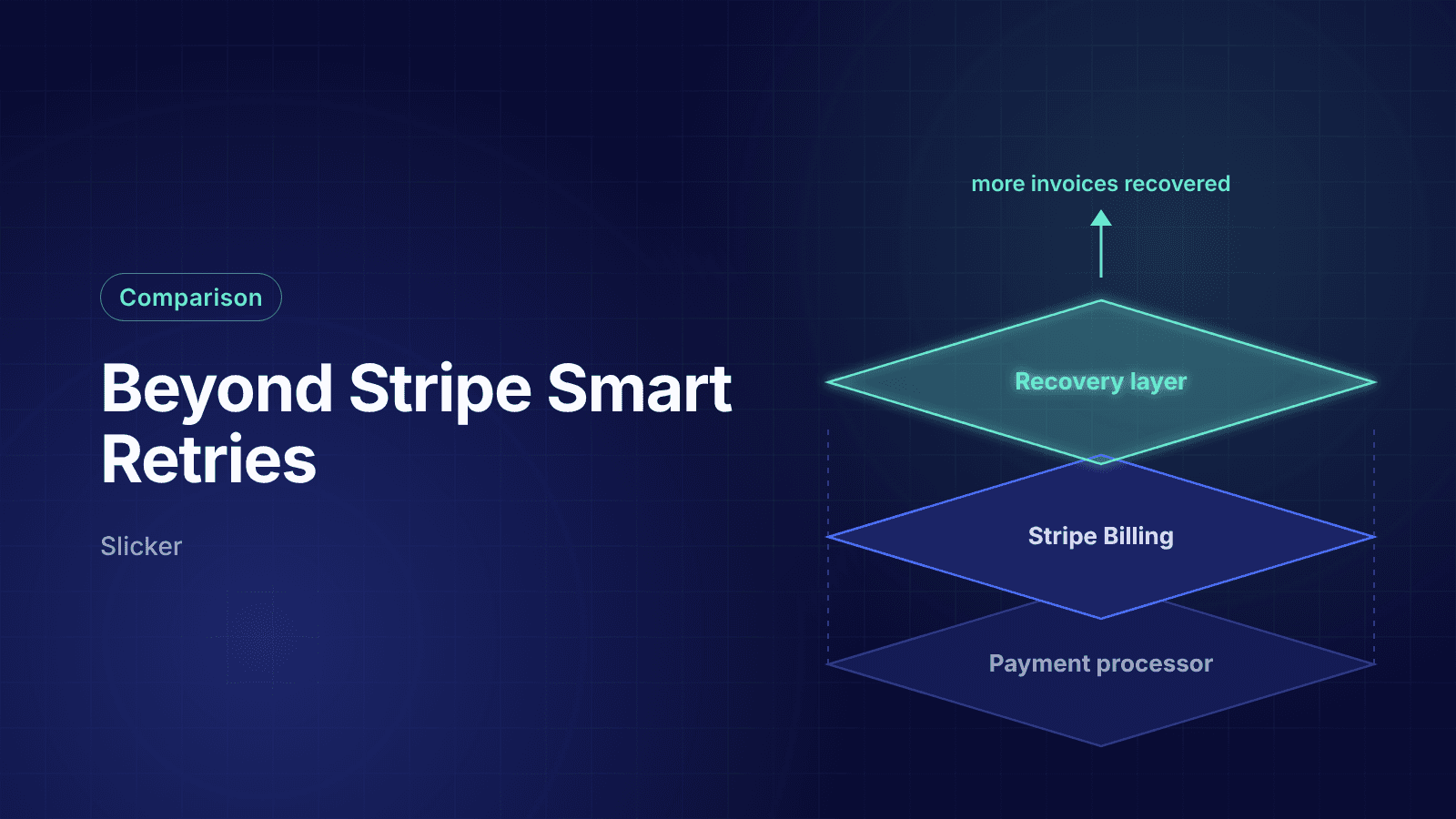
Stripe Smart Retries Alternatives for Subscription Businesses (October 2026)
You turned on Stripe Smart Retries because it was free, it was one toggle, and Stripe said it beats a fixed schedule. Months later your past-due list still...
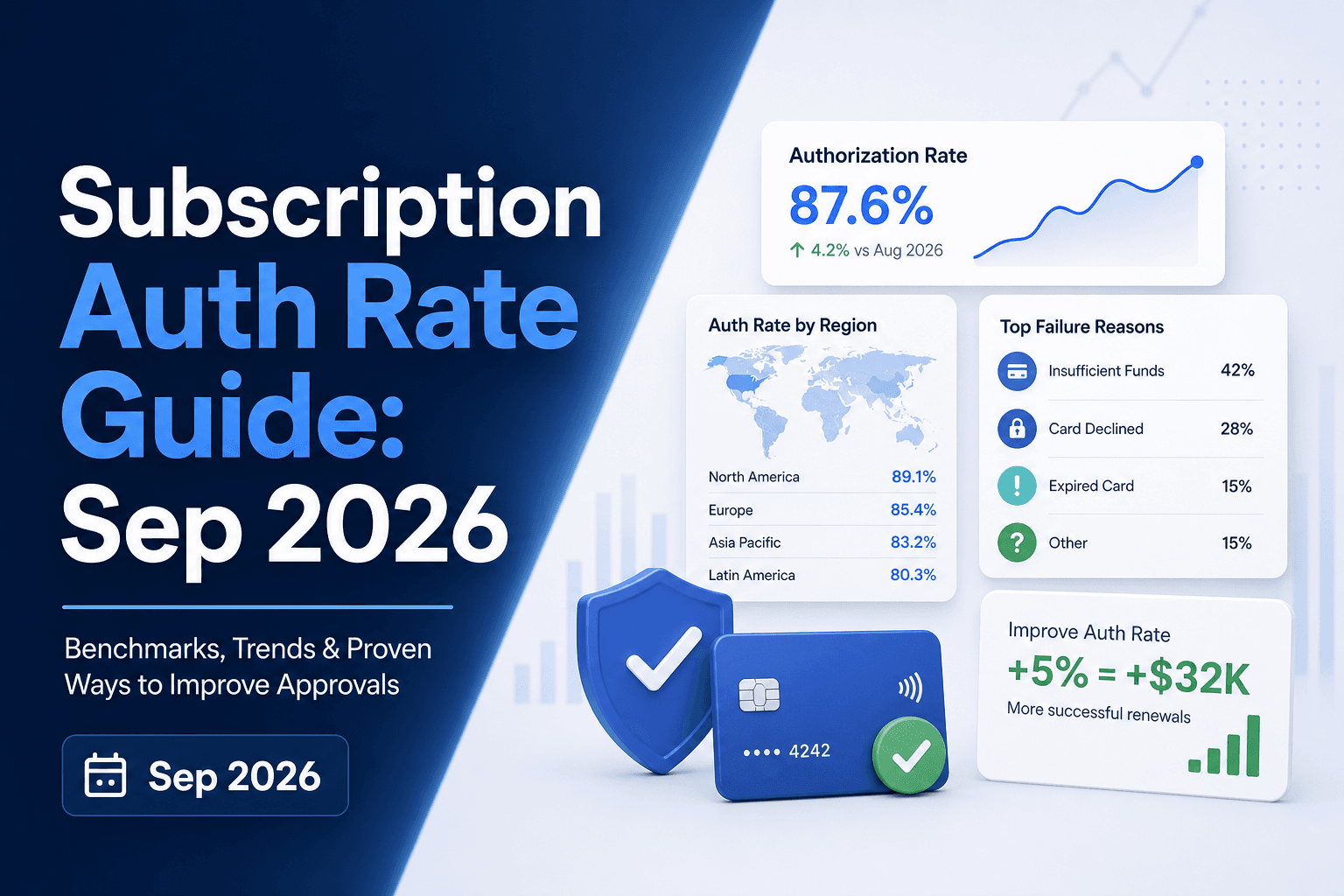
Authorization Rate in Subscription Billing: October 2026
There's a number sitting in your payments data that most finance and retention teams never report on separately: the share of renewal charges your issuing...
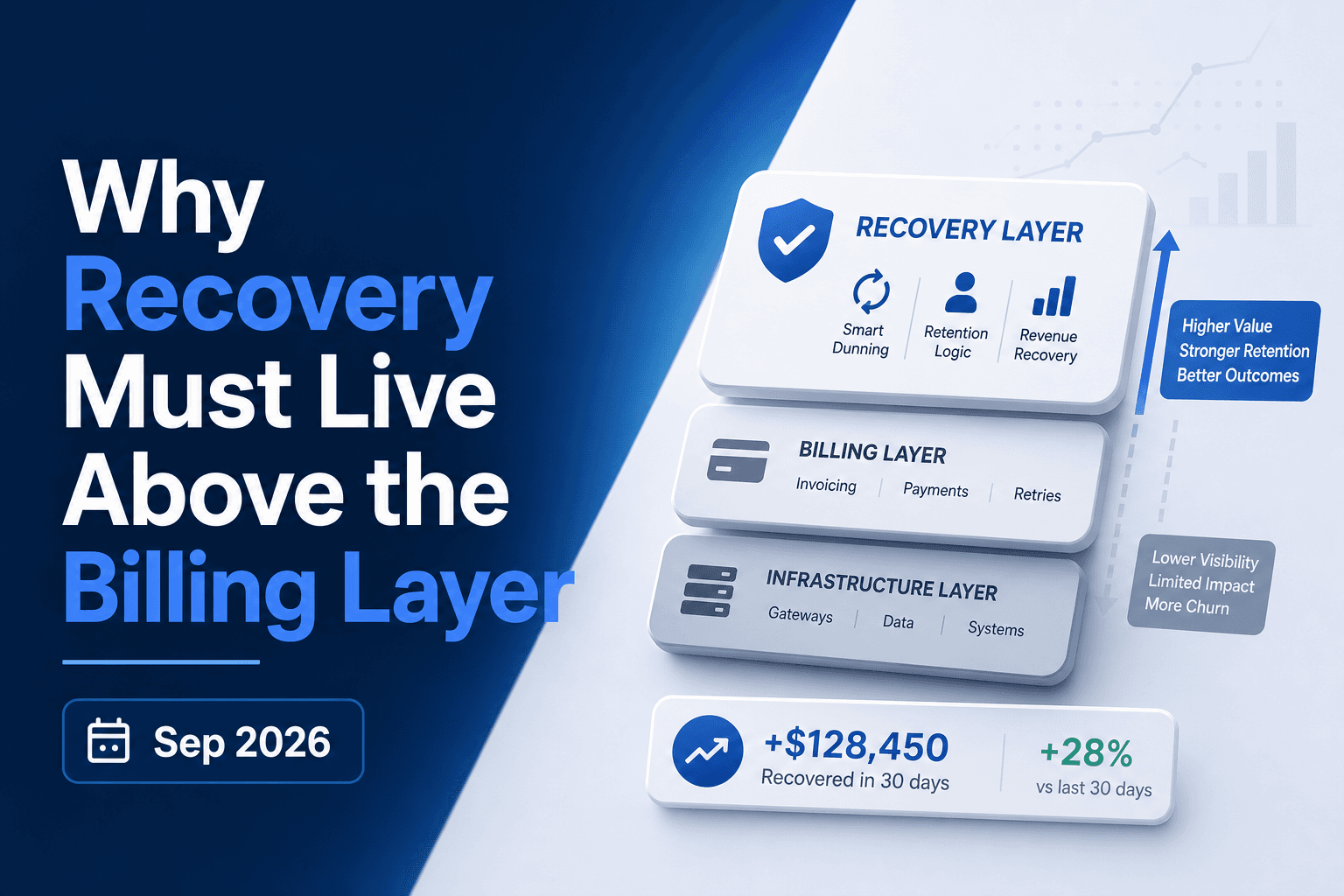
Why Payment Recovery Must Live Above Billers October 2026
A payment fails. Your biller retries it three days later, then again at seven, then at fourteen. What the biller never checks is whether the issuer sent a...
Stop losing revenue to failed payments
Join leading subscription businesses using Slicker to recover failed payments automatically.
Get Started