Card Velocity Exceeded: Retry Cadence Fixes (October 2026)
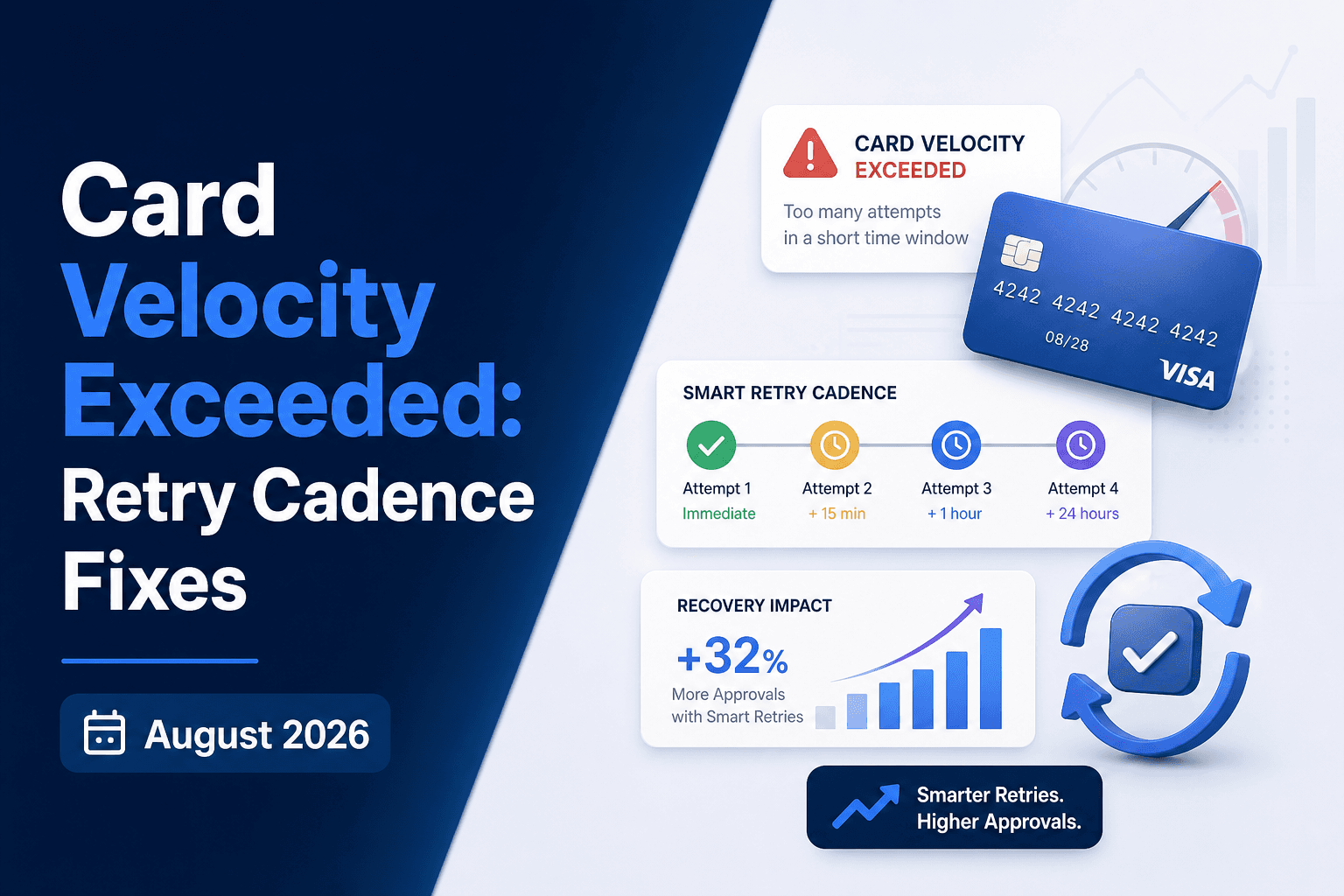
Your retry schedule fired, the code came back card_velocity_exceeded, and now you're not sure whether to wait it out or stop entirely. That uncertainty is the problem. The same decline code can mean the cardholder hit an issuer spending cap, or it can mean your own retry logic triggered a fraud signal at the network level. Getting that distinction wrong means either burning through your remaining attempts or abandoning a card that was actually recoverable.
TLDR:
card_velocity_exceededhas two root causes: a cardholder spending limit, or your own retry cadence triggering the block.- Retrying during an active velocity block resets the cooldown clock; spacing attempts further apart clears it faster.
- Visa charges $0.10 per retry beyond 15 attempts in 30 days; Mastercard charges $0.10 per attempt after MAC 03 or MAC 21.
- Align retry timing to payday cycles: US debit cards authorize at 12:01am on the 1st and 15th when payroll clears.
- Slicker reads the full decline signal set, including MAC codes and error code changes, across 40+ variables per transaction to decide whether to retry or route to failure-specific dunning.
What "Velocity Exceeded" Actually Means on a Payment Decline
When a payment fails with a card_velocity_exceeded decline, the message is coming from the issuing bank, not your processor. The issuer has detected that a card hit a threshold (too many attempts in a short window, a spending limit, or a transaction count ceiling) and is refusing to authorize further charges. That decision travels through the card network and lands in your processor's response as a decline code your team sees.
The label varies by processor. Stripe surfaces it as card_velocity_exceeded. Others may return a generic do_not_honor or a network code with no plain-language label. Same underlying block, different packaging.
The mistake most teams make is assuming the flag belongs to the card and retrying on a timer, or assuming their merchant account has been flagged and panicking. Both reactions can make things worse. The code has two distinct root causes, and which one you're facing changes everything about the correct response.
The Two Root Causes Behind Velocity Exceeded
The same decline code, two completely different problems. Understanding which one you're dealing with determines whether the fix takes seconds or weeks.
The first cause is cardholder-side: the issuer flagged the card because the account hit a spending cap, a daily transaction count limit, or a credit utilization ceiling. The issuer is protecting its customer. Your retry logic had nothing to do with it.
The second cause is merchant-side, and it's more common than teams expect. Your retry cadence fired too many authorization attempts against the same card in a short window. The issuer saw repeated charges from the same merchant ID and blocked further attempts as a fraud or abuse signal. Your retries created the velocity block.
Most teams assume cause one and keep retrying on a timer. If cause two is the actual problem, that response deepens the block and can push the card into a longer cooldown period.
Hard vs. Soft Decline: How Classification Determines Retryability
Before you can fix a velocity exceeded error, you need to know whether you're looking at a soft or hard decline. The distinction determines whether retrying the card is a reasonable recovery action or a guaranteed waste of attempts.
Soft declines are temporary. Insufficient funds, network timeouts, and short-term issuer holds all fall here. The card is valid, the account exists, and a retry at the right moment has a genuine chance of succeeding. Hard declines are permanent for that instrument: stolen cards, closed accounts, fraud flags. No retry cadence fixes those. The correct response is to stop and route to customer outreach.
Velocity exceeded sits awkwardly between the two. An issuer-side spending limit hit is effectively a hard stop for the current period, and continuing to retry compounds the problem. A processor-triggered velocity block, though, may clear once the time window resets, making it closer to a soft decline with a mandatory waiting period. Fixed retry schedules cannot make that distinction, so they either keep firing until a hard limit is hit or abandon the card entirely. Either way, revenue leaks.
Visa and Mastercard Retry Limits and Penalty Structures
Both Visa and Mastercard have formalized Visa and Mastercard payment retry rules with real costs at the transaction level.
Network | Retry Limit | Domestic Fee | Cross-Border Fee | Hard-Stop Trigger |
|---|---|---|---|---|
Visa | 15 per card, per 30 days | $0.10 per excess retry | $0.15 per excess retry | Category 1 never-retry declines |
Mastercard | MAC code dependent | $0.10 per retry on MAC 03 violations | N/A | MAC 03 (Do Not Try Again), MAC 21 (Stop Recurring Payment) |
Visa's Excessive Reattempts Rule (in effect since April 2022) charges per retry beyond the 15th attempt in a 30-day window. Retry a Category 1 hard decline even once and the fee applies immediately, regardless of attempt count. Mastercard's Transaction Processing Excellence (TPE) program runs parallel logic: retry after receiving Mastercard excessive retry penalties and each attempt costs $0.10. At sufficient volume, violations escalate beyond per-transaction fees into formal acquirer reviews and, in serious cases, merchant account suspension. Retry cadence calibration is a compliance issue, and equally a strategic optimization decision.
Merchant Advice Codes (MACs): Reading Mastercard's Retry Instructions
Mastercard Merchant Advice Codes (MACs) are transaction-level instructions the network attaches to decline responses, telling merchants exactly what to do next. Where a generic decline code leaves you guessing, a MAC removes ambiguity.
The codes most relevant to retry decisions:
- MAC 02 (Try Again Later): a soft stop. The payment isn't permanently blocked, but timing matters. If a more specific time-window code accompanies it, follow that instead.
- MAC 03 (Do Not Try Again): a hard stop, and the primary trigger for Mastercard's $0.10 per-attempt penalty. Retrying after receiving MAC 03 costs money on every attempt.
- MAC 21 (Stop Recurring Payment): not a generic decline. This is a cardholder-initiated instruction to cancel recurring billing entirely. Retrying after MAC 21 violates the cardholder's explicit intent.
- MACs 24 through 30: time-specific retry windows. MAC 24 instructs a 1-hour wait; MAC 25, 24 hours; MAC 26, 2 days; MAC 27, 4 days; MAC 28, 6 days; MAC 29, 8 days; MAC 30, 10 days.
Visa does not publish a comparable MAC set, so this level of network-level retry guidance is Mastercard-specific.
Following MACs rigidly can work against you. If MAC 30 instructs a 10-day wait but your dunning window closes in 5 days, strict compliance means missing the last recovery window before the subscription cancels. The right approach weighs MAC guidance against dunning deadlines, card type, and historical issuer behavior before deciding whether to wait, attempt, or escalate to customer outreach.
How Aggressive Retry Cadences Trigger Velocity Exceeded Errors
The error code chain is the clearest diagnostic signal. A card declines with insufficient_funds on the first attempt. Your retry schedule fires again four hours later: insufficient_funds again. Another attempt six hours after that, and the response moves to card_velocity_exceeded. The card hasn't changed. The issuer has. Seeing repeated authorization requests from the same merchant ID in a compressed window, it triggered a velocity block as a fraud or abuse signal.
That block is temporary, but its window resets from the last attempt, not the first. Every retry you fire during the blocked period restarts the clock. Retrying more aggressively doesn't clear the block; it extends it.
The fix requires reading what the issuer returned before scheduling the next attempt. A shift from insufficient_funds to velocity_exceeded is the issuer telling you to stop, not to try harder. Space attempts further apart, give the window time to reset, and treat that error code transition as a hard signal to pause. For a full framework, see the soft decline retry playbook.
Building a Retry Schedule Aligned to Decline Type and Payday Cycles
Retry cadence calibration starts with two questions: what did the issuer return, and when is the cardholder most likely to have funds? Calendar-based scheduling ignores both. The alternative is matching attempt timing to failure type first, then to payroll deposit patterns for the cards most likely to recover.
For insufficient funds declines on consumer debit cards, payday alignment retries are the highest-impact timing signal available:
- United States (biweekly pay): Retry 2 to 3 days after the 1st or 15th of the month. Consumer debit cards commonly authorize around 12:01am when ACH payroll deposits post, per industry ACH settlement schedules.
- Western Europe and UK (monthly pay): Retry within 48 hours of the last working day of the month, then hold until the same window the following month.
- Australia (weekly or fortnightly pay): A 3 to 5 day retry interval after the initial decline covers most payroll cadences, with mid-week retries tending to perform well for weekly pay cycles, per Chargeblast retry analysis.
Exponential backoff applies as the structural foundation: each failed attempt extends the wait before the next, instead of firing at fixed intervals. A card that declines Monday should see the next attempt timed to the next likely fund-refresh window, not four days later on a fixed schedule. Burning through Visa's 15-attempt limit in a week versus spacing attempts across the full dunning window is, in practice, the difference between recovering the payment and permanently losing the subscriber.
When to Stop Retrying and Route to Customer Outreach
Automated retries earn their keep on soft declines, but some failure signals are unambiguous: a stolen card, a closed account, a fraud flag, MAC 03, or a velocity block that hasn't cleared across multiple spaced attempts. These are not timing problems. The instrument cannot recover without the cardholder taking action, and every remaining network-compliant attempt spent against it is one less available for a card that can actually authorize.
The trigger for dunning should be failure type, not attempt count. Stopping retries earlier than most teams expect is often the right call. A card returning MAC 21 on the first try warrants immediate outreach. Waiting for a fixed retry ceiling before escalating costs days of service disruption, and each of those days reduces the subscriber's likelihood to re-engage.
When outreach is the right move, the message has to be specific. A stolen card requires the subscriber to contact their bank. An expired card requires an update. Generic "update your payment method" copy converts poorly because it gives subscribers no actionable direction tied to their actual situation. Framing outreach around the service continuity they stand to lose, rather than the payment mechanics, lifts completion rates and protects the subscriber relationship.
The cost of getting this timing wrong shows up directly in monthly recurring revenue (MRR): every day spent retrying an unrecoverable instrument narrows the window for dunning to succeed before the subscription cancels.
Measuring Whether Your Retry Cadence Is Actually Working
Recovery rate is a deceptively simple metric. The most common calculation divides recovered payments by total failures, then credits the result to whatever retry strategy was running. The problem: some of those payments would have self-resolved regardless. A cardholder tops up their account, a payroll deposit clears, and the card authorizes on the next attempt with zero strategic input from your retry logic. Crediting that recovery to your cadence inflates apparent performance without proving anything.
Reporting granularity compounds this. At the transaction level, a single invoice with four retry attempts can surface as four events, not one, which matters when you're building an internal business case or vetting a vendor.
Payday cycles, billing cycle clustering, and seasonal cardholder behavior all introduce natural variance that has nothing to do with strategy quality. Without controlling for these patterns, the signal and the noise are indistinguishable.
Measuring recovery in aggregate compounds the distortion further. Insufficient funds declines on active consumer debit cards have a meaningfully different recovery ceiling than generic declines on prepaid cards. Segmenting by decline category gives you a baseline for each bucket, and from there you can assess whether timing changes within a category are moving the number.
A retry schedule that can't be measured against a credible baseline has no feedback loop, and without a feedback loop, optimization is guesswork. The metric framework matters as much as the cadence itself.
How Slicker Recovers Payments Affected by Velocity Exceeded
When Slicker receives a velocity_exceeded decline, the retry engine reads the full signal set before scheduling anything: the gateway code, any accompanying Mastercard Merchant Advice Code, BIN data, issuer behavior patterns, and whether prior attempts on the same invoice showed an error code shift from insufficient_funds to velocity_exceeded. That shift is the tell. It indicates a merchant-triggered velocity block, not an issuer-side spending limit, and the recovery path differs for each.
From there, an ensemble of AI models weighs over 40 variables per transaction to determine whether to retry, when, and at what specific time of day. For velocity blocks with a viable cooldown window, the system targets the authorization window most likely to succeed. For cases where MAC 03, MAC 21, or a hard decline code closes the retry path entirely, the system stops immediately and routes to failure-reason-specific dunning sent from your domain, personalized to what the decline actually requires.
Performance is verified through AABB testing in payment recovery, a crossover design borrowed from clinical trials, which isolates Slicker's incremental recovery lift from payments that would have self-resolved anyway. Smart retry systems consistently outperform fixed schedules on soft decline recovery; your own historical baseline is the most reliable reference point. Slicker has recovered over 1 million failed payments across its customer base, verified through AABB testing on customer billing data, with setup taking roughly 5 minutes through no-code integration with Stripe Billing, Chargebee, Recurly, Zuora, and Recharge.
Final Thoughts on Understanding and Fixing Velocity Exceeded Errors
Not every card_velocity_exceeded decline means the same thing, and that distinction is where recovery decisions either hold up or fall apart. Reading the full signal set before the next attempt, knowing when MAC codes are telling you to stop versus wait, and aligning retries to fund-refresh windows are what move the recovery needle in a measurable way. The retry window is finite, and how you spend it determines whether a subscriber stays or churns. Reach out to Slicker to see how AI-driven retry logic handles these decisions for your billing setup.
FAQs
How does an AI-powered retry system make smarter decisions than a fixed retry schedule on velocity exceeded errors?
A fixed retry schedule fires on a timer regardless of what the issuer returned, so it can deepen a velocity block or burn through Visa's 15-attempt limit on a card that cannot recover. An AI-powered retry engine reads the full signal set first: the gateway code, any accompanying Mastercard Merchant Advice Code, BIN data, and whether the error moved from insufficient_funds to card_velocity_exceeded across attempts. That transition tells the system whether the block is merchant-triggered (requiring a cooldown) or issuer-side (requiring a different recovery path entirely), and the retry decision follows from that classification, not from a calendar.
How do I prove that my payment recovery vendor is actually improving my recovery rate, and not simply taking credit for self-recoveries?
The core problem is that some failed payments self-resolve regardless of retry logic, so crediting all recoveries to your vendor inflates apparent performance. The only way to isolate incremental lift is a controlled split test: divide failed payments into a control group (your existing logic) and a treatment group (the vendor), measure dollars recovered in each, and calculate statistical significance. Slicker uses AABB testing, a crossover design borrowed from clinical trials, which controls for payday cycles, billing clustering, and decline-category mix. If the treatment group does not outperform with statistical significance, you have no basis for the vendor's recovery claim.
How do Slicker retries work with Stripe Billing, and what configuration do I need to align to avoid conflicts?
Slicker runs alongside Stripe's native Smart Retries during evaluation, splitting failed payments between Stripe's logic (control) and Slicker's AI retry logic (treatment) to measure incremental lift. The critical configuration requirement is extending Stripe's default subscription cancellation grace period to match Slicker's multi-week retry windows: if Stripe closes the subscription before Slicker can execute its attempts, those recovery opportunities are lost. For full orchestration deployments where Slicker manages grace period extensions and edge-case handling, Stripe's native Smart Retries must be disabled entirely, as running them in parallel is not supported.
What is a Merchant Advice Code (MAC) and how does it affect retry decisions on Mastercard declines?
A MAC is a transaction-level instruction Mastercard attaches to decline responses, specifying the correct next action for the merchant. MAC 03 means do not retry at all, and each attempt after receiving it costs $0.10 under Mastercard's Transaction Processing Excellence program. MAC 21 signals that the cardholder has cancelled recurring billing entirely. MACs 24 through 30 prescribe specific waiting periods before the next attempt, ranging from 1 hour to 10 days. Visa does not publish a comparable code set. MACs should be treated as a floor for compliance decisions, not a ceiling: if MAC 30 instructs a 10-day wait but your dunning window closes in 5 days, following the code blindly means missing the last viable recovery attempt before the subscription cancels.
Can I recover failed subscription payments without any engineering work?
Yes. Slicker connects to Stripe Billing, Chargebee, Recurly, Zuora, and Recharge through a no-code integration that takes roughly 5 minutes: you add API keys to the Slicker dashboard and the system begins monitoring failed payments immediately. No changes are required to your existing payment infrastructure, and recovered payments flow back through your billing system indistinguishable from regular charges. The one exception is in-house billing systems built entirely on proprietary infrastructure, which require a custom API integration with engineering involvement on your side.
Related Articles

Stripe Dunning Configuration Guide (September 2026)
A surprising share of the subscribers leaving your list every month never chose to cancel. Their payment failed, your retry window ran out, and Stripe...

Stripe Recovery Add-On Evaluation Guide (September 2026)
Stripe's built-in recovery tools cover real ground. Smart Retries, Account Updater, dunning emails. For a lot of subscription businesses, that's a reasonable...

What Subscription Operators Miss About Built-In Retries (Oct 2026)
If your billing platform retries run on a fixed 14-to-21-day countdown from the failure date, they have no idea when your subscriber's paycheck actually...
Stop losing revenue to failed payments
Join leading subscription businesses using Slicker to recover failed payments automatically.
Get Started