Failed Payment Recovery: Evaluating Categories and Vendors (July 2026)
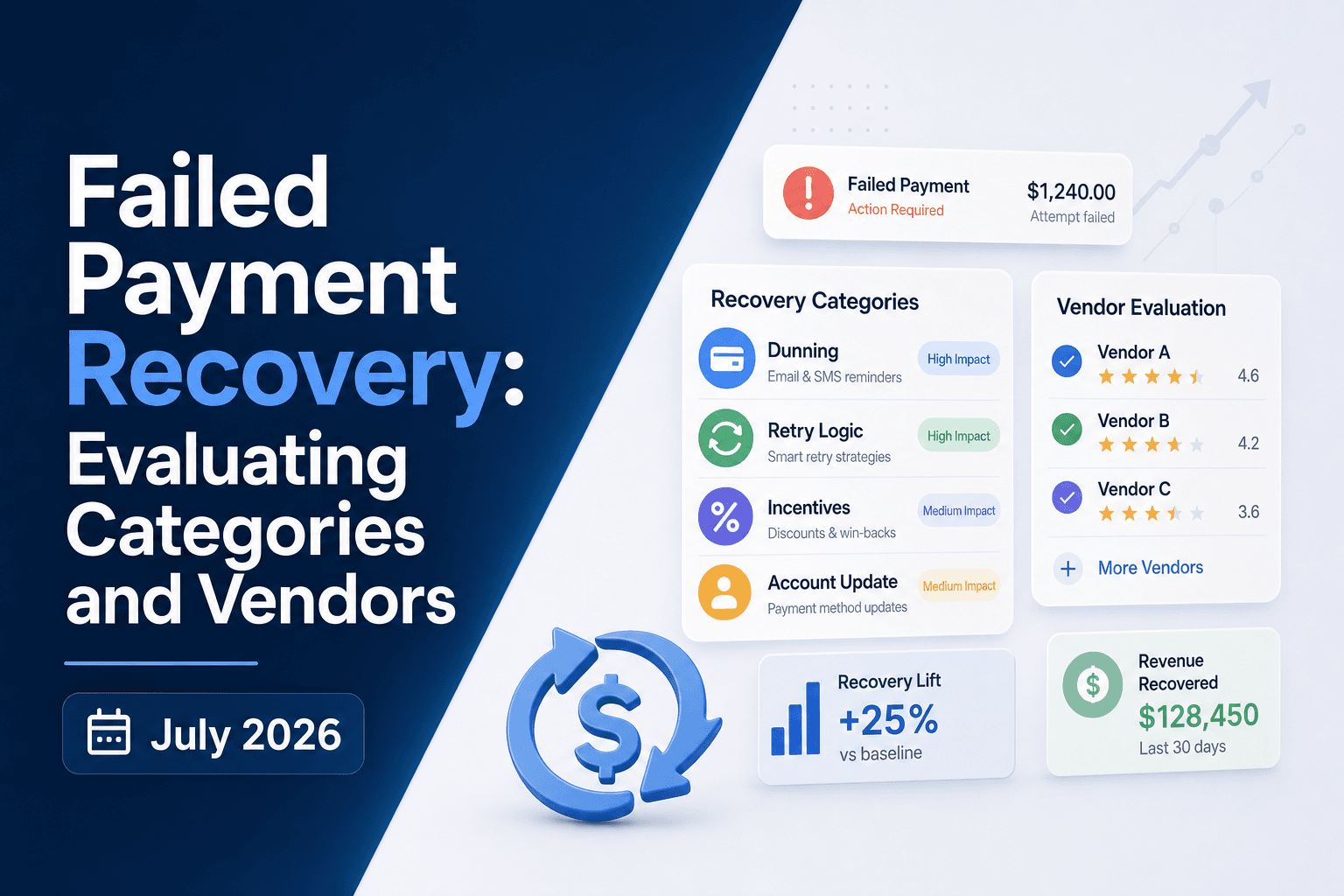
Choosing failed payment recovery software gets complicated quickly. There are standalone retry engines, dunning tools, billing-native recovery, and full-stack vendors, and each one makes a version of the same pitch. Before you start comparing features, it helps to know what category of solution actually fits your gap, and how to hold payment recovery vendors to a standard of proof that goes beyond their own benchmarks. That's what this guide is for.
TLDR:
- Industry data puts recurring payment decline rates at roughly 15%; at $10M monthly recurring revenue (MRR), that is $1.5M in failed charges every billing cycle.
- Soft declines are recoverable with smart retry logic; hard declines require failure-specific dunning from your own domain or no action at all. Treating them identically costs you revenue.
- AI retry timing accounts for issuer behavior, card type, and geographic pay cycles; static schedules ignore all of it and leave recoverable MRR on the table.
- Require AABB (A/B split with a concurrent holdout) testing on your own traffic before committing; vendors who can only quote aggregate benchmarks are asking you to accept unverifiable claims.
- Slicker runs a 4-month pilot structured around clinical-grade AABB testing, with zero engineering lift required and payment credentials flowing through your existing infrastructure.
What Failed Payment Recovery Software Does
Failed payment recovery software sits between your billing system and your bottom line, catching declined transactions before they become lost revenue. When a payment fails, the software decides whether the failure is recoverable, then acts: retrying the charge at an optimized time, contacting the subscriber with a reason-specific message, or both.
The core job is recovering MRR you already earned from customers who already said yes.
The Revenue Scale of Failed Payments
Involuntary churn from failed payments costs subscription businesses billions each year. Industry data puts the average decline rate for recurring transactions at roughly 15%, and for high-volume businesses, that translates to a material share of MRR walking out the door every billing cycle without a single cancellation request.
The math compounds quickly. A business processing $10M in monthly recurring revenue with a 15% decline rate is looking at $1.5M in attempted charges that fail on the first try each month.
Soft Declines vs. Hard Declines: The Foundational Distinction
Soft declines are temporary authorization failures where the issuing bank signals that the payment cannot go through right now, but may succeed if retried under different conditions. Common causes include insufficient funds, velocity limits, or generic bank-side processing errors. Hard declines are permanent rejections: the card is stolen, expired, or the account is closed, and no retry will succeed.
Getting this distinction right shapes your entire recovery approach. Retrying hard declines wastes processing cycles, risks card network penalties, and burns subscriber goodwill. The hidden cost of failed payments extends well beyond the initial decline. Soft declines, by contrast, represent recoverable revenue if your retry logic is intelligent about timing, frequency, and context.
Why This Matters for Recovery Software Selection
When assessing failed payment recovery software, ask vendors how their system classifies decline types and what action each triggers:
- Soft declines should route into automated smart retry logic, with timing informed by subscriber behavior, billing cycle, and issuer patterns instead of a fixed schedule.
- Hard declines requiring customer action (stolen or expired card) should route into dunning workflows, with messaging anchored to the specific failure reason, not a generic "update your payment info" prompt.
- Hard declines that require no customer action (closed account) should be flagged for review without triggering unnecessary retries or outreach.
The recovery rate gap between vendors who treat all declines identically and those who act on the distinction can mean meaningfully different recovery outcomes. Your own historical decline-code breakdown is the most reliable starting point for sizing that opportunity.
Categories of Failed Payment Recovery Software
Subscription businesses have more recovery software options than ever, but the categories vary widely in scope, logic, and where they sit in your billing stack. Understanding the differences helps you spend evaluation time on vendors that actually fit your situation.
The main categories worth knowing
- Standalone retry engines focus purely on smart retry logic, using AI to decide when and how to reattempt failed charges based on issuer behavior, card type, and timing.
- Dunning management tools handle customer-facing recovery, sending payment failure emails and SMS from your own domain when a charge requires customer action.
- Billing-native recovery comes bundled with your payment processor or subscription billing tool, typically offering fixed retry schedules with little customization.
- Full-stack recovery vendors combine retry logic, dunning, and analytics into one layer sitting above your existing billing infrastructure.
The category you need depends on where your recovery gaps actually are. If your processor-native retries are leaving recoverable soft declines on the table, a dedicated retry engine closes that gap directly. If your dunning emails are generic and untested, a messaging-focused tool may be the better fit. Knowing your gap before you assess vendors keeps the process grounded in revenue impact over feature lists.
Native Billing Dunning vs. Dedicated Solutions
Most subscription billing tools include some form of dunning out of the box. You get a basic retry schedule and a handful of email templates. For early-stage companies with low payment volume, that may be enough.
But as your MRR (monthly recurring revenue) scales, the gaps become expensive. Native billing dunning treats every failed payment the same way, regardless of decline code, card type, or issuer behavior. There is no signal-based retry logic, no AI, and no statistical proof that the schedule you are running is better than an alternative. Smart retries beat fixed retry schedules for exactly this reason.
Dedicated failed payment recovery software is built for exactly this problem. The difference shows up in three areas:
- Retry intelligence: purpose-built solutions analyze issuer patterns, decline codes, and subscriber history to time retries when approval odds are highest, instead of firing on a fixed interval.
- Dunning personalization: recovery emails are sent from your domain, with messaging tied to the specific failure reason, which produces materially better response rates than generic "update your card" templates.
- Proof of performance: dedicated vendors can run controlled tests against your own traffic to confirm what is actually being recovered, instead of asking you to accept a reported number at face value.
For high-volume subscription businesses, signal-driven retries measurably outperform generic schedules on recoverable soft declines. The question is whether your current tool was designed to close that gap, or just to check a feature box.
Key Features to Assess in a Recovery Solution
When comparing failed payment recovery vendors, a few capabilities tend to separate solutions that move the needle from those that don't.
- Smart retry logic goes beyond fixed schedules. Look for AI-driven timing that accounts for decline codes, card type, geography, and issuer behavior, not a generic cadence.
- Dunning email personalization should reflect the specific failure reason. A stolen card requires different messaging than a soft decline from insufficient funds.
- AABB testing in payment recovery with statistical significance tells you whether the vendor's approach actually outperforms your baseline on your own data, not on aggregated averages.
- Reporting should show recovered dollars, beyond retry attempts or open rates. Revenue impact is the metric that matters.
Vendors that can't offer controlled testing against your own traffic are asking you to take their word for results. That's a meaningful gap when your recovered MRR is on the line.
How AI Retry Timing Differs from Static Schedules
AI retry timing goes beyond simple "wait X days and try again" logic. Static vs adaptive retry comes down to this: static schedules fire at fixed intervals regardless of context, while AI models analyze issuer behavior patterns, card type, geographic pay cycles, and historical recovery signals to select the highest-probability retry window for each individual transaction.
The revenue difference between a well-timed retry and a poorly timed one is material. Retrying a soft decline at the wrong moment often triggers additional decline codes that make subsequent attempts harder, effectively reducing your recovery ceiling before you've exhausted your options.
What AI Models Actually Assess
AI retry engines pull from multiple signals simultaneously:
- Issuer-level patterns that indicate when a specific bank is more likely to approve a retry, based on aggregate settlement behavior, not a generic calendar.
- Card type and BIN-level data that reflect the funding source behind the card, since prepaid, debit, and credit instruments fail and recover for different reasons on different timelines.
- Geographic pay cycles, because a subscriber in the UK on a bi-weekly pay schedule has a meaningfully different optimal retry window than a subscriber in the US paid monthly.
- Prior decline code sequences for that transaction, since a progression of soft declines carries different recovery probability than a single isolated one.
Static schedules ignore all of this. They treat a debit card failure in Germany the same as a credit card failure in California, which leaves recoverable revenue on the table every billing cycle. Stripe's payment retries primer outlines the baseline mechanics of retry logic; dedicated AI-driven solutions go substantially further. A soft decline retry playbook helps clarify when to retry, when to stop, and what to change.
Dunning Personalization and Grace Period Strategy
When a payment fails and silent retry hasn't resolved it, the next line of defense is customer outreach. How you reach out matters as much as whether you do.
Generic "please update your payment info" emails leave recovery on the table. The failure reason should shape the message: an expired card needs different copy than a stolen card or a temporarily frozen account. Understanding smart dunning vs rules-based recovery clarifies why this distinction matters. Personalizing to the specific decline type lifts response rates and preserves the subscriber relationship.
Grace periods follow the same logic. Too short, and you cancel customers who would have self-resolved. Too long, and you carry delinquent accounts that inflate reported MRR.
Pricing Structures Across Vendor Types
Pricing models vary widely across vendor categories, and the structure you pay under shapes your incentives as much as the dollar amount does.
Most vendors fall into one of three models:
- Percentage of recovered revenue: you pay only when the vendor recovers a payment, which aligns incentives on paper but can obscure whether the vendor actually caused the recovery or whether the payment would have resolved on its own.
- Flat monthly fee: predictable cost, but no built-in accountability for whether recovery rates improve.
- Hybrid: a base fee plus a performance component, common among mid-tier specialists.
Whichever model a vendor offers, the question worth asking is whether they can prove incrementality, meaning recovered revenue that would not have come back without their intervention. Building a smart retry strategy for recurring payments is what separates vendors who drive real uplift from those who simply take credit for organic recoveries. Without that proof, a percentage-of-recovery fee may simply be a tax on payments that were never truly at risk.
How to Structure a Meaningful Vendor Evaluation
A structured evaluation separates vendors who can prove results from those who only promise them. Start by mapping your own failure data: what share of declines are soft versus hard, which card types fail most, and where your current retry logic leaves recoverable revenue on the table. That baseline shapes every criterion that follows.
The criteria that separate serious vendors from the rest
Once you have your baseline, score vendors across three dimensions:
- Recovery methodology: Does the vendor use a fixed retry schedule or an AI-driven approach that factors in card type, issuer behavior, and timing? Fixed schedules leave money on the table.
- Proof standards: Can the vendor run a statistically valid test against your own traffic before you commit? Without AABB testing and a reported p-value, recovery claims are unverifiable. Ask for p < 0.05 and a minimum sample size discussed upfront.
- Integration depth: How long does setup actually take, and does your engineering team need to be involved? A setup that requires heavy engineering work delays the time to recovered revenue.
How to run the final comparison
Before signing, ask each shortlisted vendor for a controlled test on a defined segment of your declined transactions. Compare recovered dollars, not recovery rate percentages in isolation, since rate figures without volume context can obscure real revenue impact. The vendor whose proof holds up on your data, not their aggregate benchmarks, earns the contract.
Vendor Market Overview: What Buyers Are Assessing in 2026
The vendor market for failed payment recovery has organized itself around four distinct buyer profiles. Which cluster fits your context depends on billing stack compatibility, transaction volume, and whether your primary gap is retry logic, dunning quality, or reporting visibility.
Category | Vendors | Primary Fit |
|---|---|---|
Enterprise subscription recovery | Vindicia, Revaly | High-subscriber-count media and publishing businesses; deep billing integrations and account updater services |
AI retry and dunning | Slicker, Butter, FlyCode | Mid-market to enterprise subscriptions focused on intelligent retry optimization and failure-specific dunning |
Dunning-first tools | Churn Buster, Churnkey | Businesses where customer communication workflows and cancellation saves are the primary recovery lever |
Billing-native recovery | Stripe Smart Retries, Chargebee Smart Dunning, Recurly Revenue Optimization | Baseline recovery within an existing billing relationship, without adding a dedicated recovery layer |
No single category dominates every use case. A publishing business on Zuora with millions of subscribers has different requirements than a SaaS company on Stripe Billing at $2M MRR, and the right involuntary churn prevention tools differ accordingly. Use this as a shortlisting tool, not a ranking. Competitive positioning in this space changes frequently; the above reflects publicly available vendor information as of July 2026 and should be independently verified during procurement.
How Slicker Fits This Evaluation Framework
Slicker is built around the core tension in failed payment recovery software evaluation: most vendors ask you to trust their claims, while the math demands proof on your own subscriber base.
Slicker's approach starts with a 4-month pilot (first month free, three paid months, cancel anytime) structured around clinical-grade AABB testing. Your traffic splits 50/50 between Slicker's AI-driven retry logic and your existing control. Recovery rates, dollars recovered, and statistical significance are all reported before you commit to anything longer-term.
Setup requires zero engineering lift and takes roughly five minutes, connecting to your existing billing infrastructure with no code changes. SOC 2 Type 2 compliance is in place, and payment credentials flow through your existing PCI-compliant rails.
Where Slicker differs from the vendors covered in this guide is the evidence model. Instead of quoting a generic recovery range upfront, Slicker measures what your specific subscriber mix actually recovers, then reports the p-value. If the result lacks statistical significance, you don't pay for a result that wasn't proven.
Final Thoughts on Building a Smarter Payment Recovery Strategy
Failed payment recovery is a revenue problem first, and the fix depends on knowing where your specific gaps are. Generic retry schedules and untested dunning emails leave recoverable MRR on the table every billing cycle. The vendors worth your time are the ones who can run a controlled test on your own traffic and report the results with statistical significance, not a generic quoted recovery range. Connect with Slicker to see how that test works against your own declined transactions.
FAQ
How do Slicker's AABB tests differ from the standard A/B testing most payment recovery vendors offer?
Slicker's AABB testing borrows its design from clinical drug trials: your failed payments split 50/50 between Slicker's AI retry logic and your existing control, with stratified randomization to prevent selection bias, and results reported in recovered dollars alongside a p-value. Standard vendor A/B tests typically report recovery rate percentages on aggregated traffic without statistical significance thresholds, making it impossible to confirm whether the vendor caused the recovery or the payment would have resolved on its own. If Slicker's results don't reach statistical significance on your data, you don't pay.
What's the best failed payment recovery software for a mid-market subscription business already on Stripe Billing?
The right choice depends on where your recovery gap actually sits. If Stripe Smart Retries is already running and your primary gap is retry timing precision and failure-specific dunning, a dedicated layer like Slicker adds measurable incremental lift by analyzing over 40 variables per transaction, including issuer behavior, card type, and geographic pay cycles, instead of retrying on a fixed schedule. For smaller Stripe Billing merchants where the incremental recovery lift doesn't yet warrant a performance-based fee on top of Stripe's built-in retries, Stripe Smart Retries is the appropriate baseline. Slicker's value becomes commercially compelling at sufficient transaction scale, and its 4-month pilot (first month free) is structured to prove that on your own subscriber data before any longer commitment.
How do I determine whether a payment recovery vendor is recovering revenue I would have lost, or just claiming credit for payments that would have resolved anyway?
Ask every shortlisted vendor whether they can run a statistically valid controlled test against your own declined transactions before you sign. Without AABB testing and a reported p-value, there is no way to separate incremental recovery from payments that would have self-resolved, which means a percentage-of-recovery fee may simply be a tax on revenue that was never genuinely at risk. Vendors that can only offer aggregate benchmarks or reported recovery rates without a control group are presenting unverifiable claims.
What is the difference between soft declines and hard declines in payment recovery?
Soft declines are temporary authorization failures where the issuing bank signals the payment cannot go through right now but may succeed under different conditions, with common causes including insufficient funds, velocity limits, and generic processing errors. Hard declines are permanent rejections, such as stolen cards, closed accounts, or fraud flags, where no retry will succeed and the correct response is either targeted customer outreach or flagging for review without further retry attempts. Getting this classification right before any retry or dunning action is the foundational step in payment recovery; retrying hard declines burns retry attempts, risks card network penalties from Visa and Mastercard, and can damage your merchant account standing.
Slicker vs. Churnkey vs. Churn Buster: which is the right fit for a subscription business focused on proven recovery over dunning workflows?
Churn Buster has strong email campaigns but limited retry intelligence and no gateway routing (per publicly available product information as of July 2026); Churnkey lacks native integrations with enterprise billing systems like Zuora and Chargebee, and does not offer decline-code-level email branching (based on publicly available information as of July 2026).
Related Articles

Authorization Rate in Subscription Billing: October 2026
There's a number sitting in your payments data that most finance and retention teams never report on separately: the share of renewal charges your issuing...
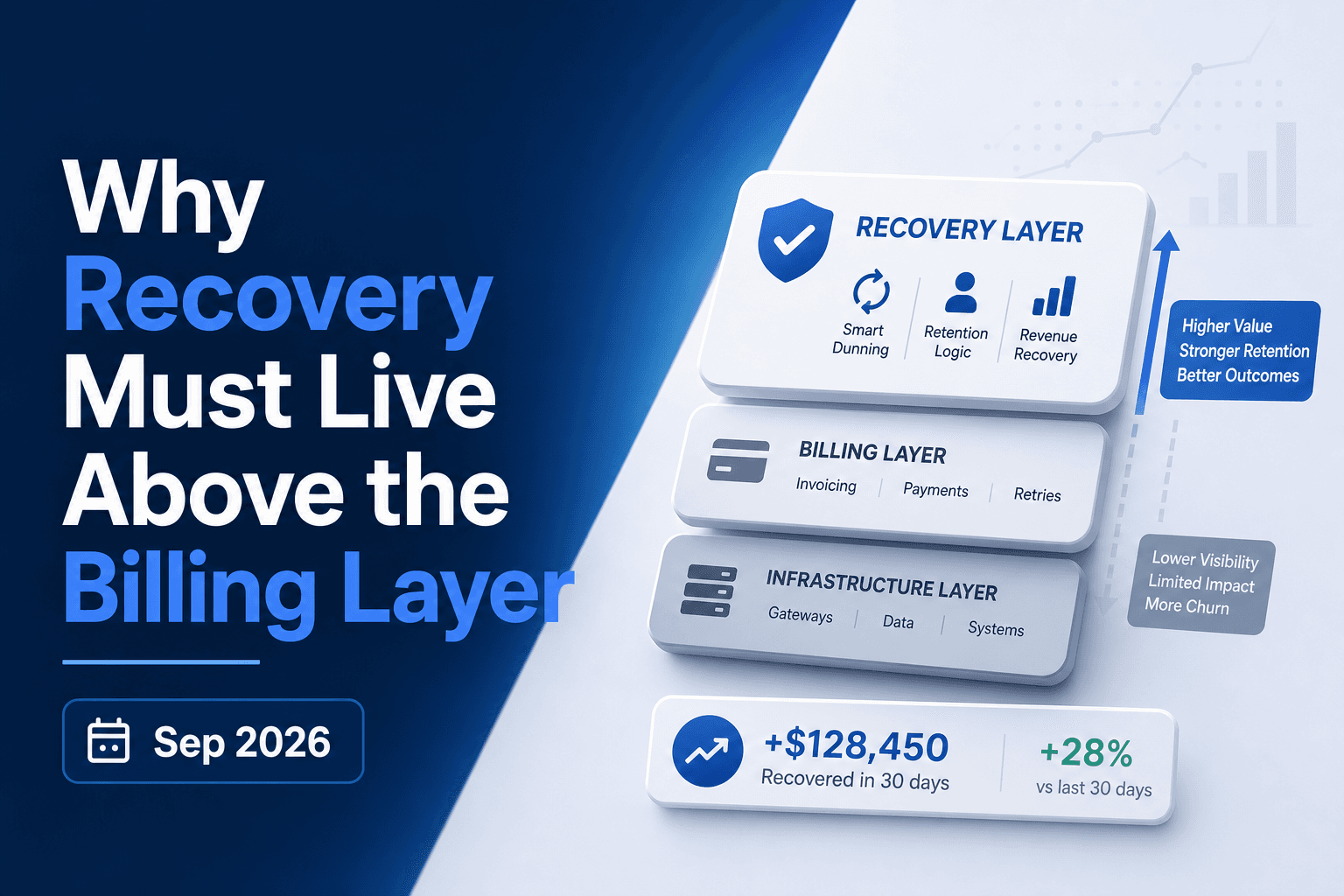
Why Payment Recovery Must Live Above Billers October 2026
A payment fails. Your biller retries it three days later, then again at seven, then at fourteen. What the biller never checks is whether the issuer sent a...
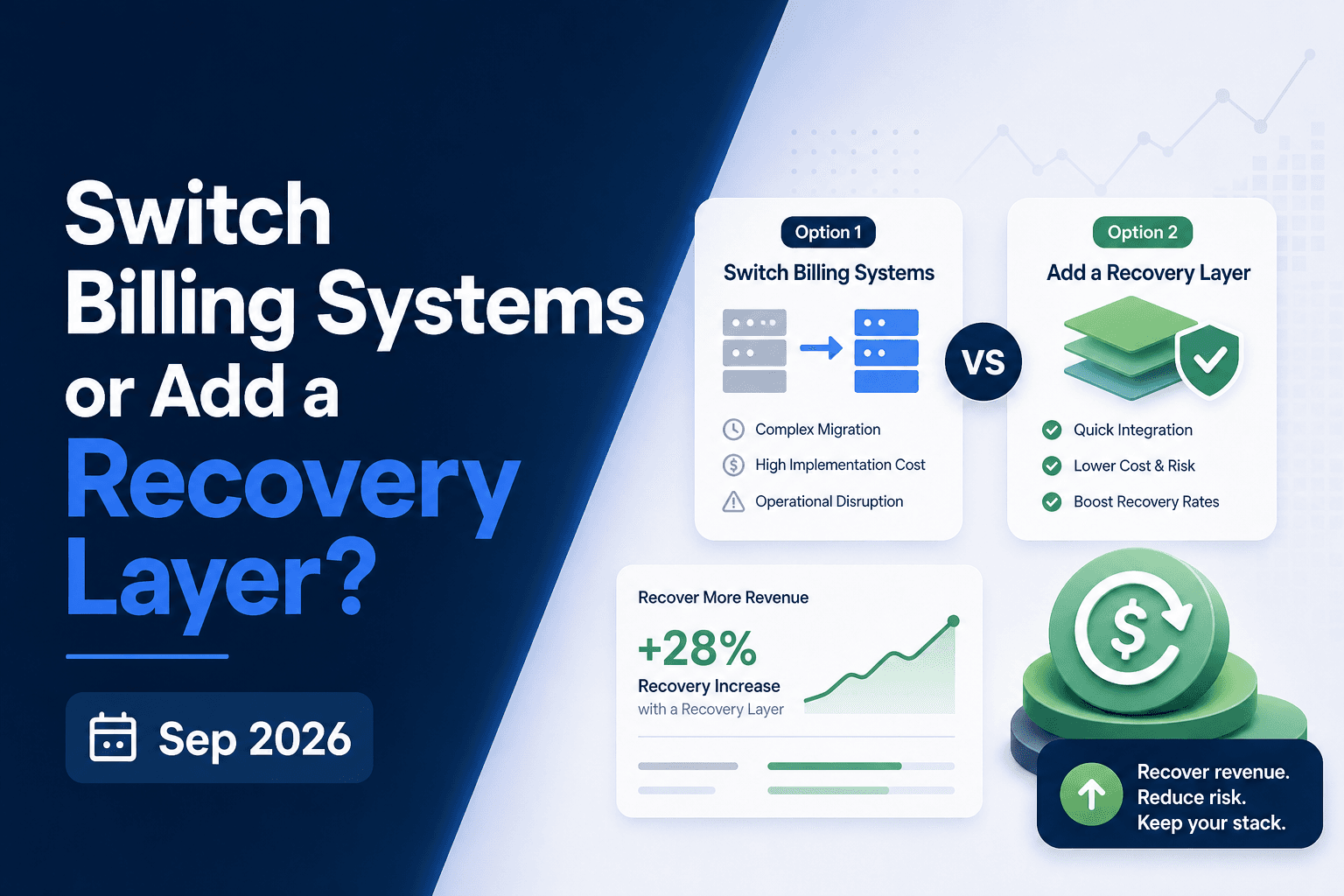
Billing Migration vs Recovery Layer: The Right Call October 2026
Switching billing systems feels like the right move when revenue collection starts breaking down. Sometimes it is. But soft declines, weak retry logic, and...
Stop losing revenue to failed payments
Join leading subscription businesses using Slicker to recover failed payments automatically.
Get Started