Top 7 AI-Driven Payment Recovery Platforms: October 2026

Involuntary churn has become the silent killer of subscription revenue, with up to 70% of customer departures stemming from failed transactions, not customers who chose to leave. Card declines, bank rejections, and soft errors collectively wipe out as much as 4% of MRR (monthly recurring revenue) in high-growth subscription businesses. The stakes are enormous: a staggering 62% of users who hit a payment error never return to the site.
AI-driven recovery solutions now serve as the antidote to this revenue hemorrhage, interpreting decline reasons, adjusting retries in real time, and automating outreach with precision (Slicker). AI models unlock granular segmentation, predicting which failures are soft vs. hard declines and tailoring actions accordingly (Slicker). Every 1% lift in recovery can translate into tens of thousands in annual revenue.
This analysis covers the top 7 AI-powered payment recovery solutions active in August 2026, complete with recovery-rate claims, pricing models, compliance status, and target merchant profiles. Our interactive comparison chart helps you filter by gateway compatibility and SOC 2 readiness to find your best match.
TLDR:
- Up to 70% of subscription departures are involuntary churn from failed payments, draining as much as 4% of MRR.
- Smart retry systems recover 70-85% of soft declines; fixed retry schedules land between 40-60%, a gap that compounds into material revenue differences.
- Pricing models split three ways: pay-for-success, revenue share, and bundled service fees; your risk tolerance should drive the choice.
- Select your shortlist based on gateway compatibility, SOC 2 status, and whether the vendor can prove lift on your own data before you commit.
- Slicker offers AI-powered smart retries with a no-code setup, multi-gateway routing, and a pay-for-success pricing model.
The AI Revolution in Payment Recovery
The payment recovery space has changed fundamentally with the integration of artificial intelligence. Traditional static retry systems operated on rigid schedules, often bombarding failed payments with attempts at predetermined intervals. Modern AI engines weigh tens of parameters per failed transaction, including issuer, MCC (Merchant Category Code), day-part, and historical behavior, to compute the best retry timing.
AI engines predict the optimal moment, method, and gateway for each retry, lifting recovery rates 2-4× above native billing logic. According to Sardine's 2026 Fraud and AML Report, AI-driven fraud attacks are growing materially in 2026, raising the stakes for any recovery solution that handles sensitive payment data.
Adyen's Uplift service, launched in early 2025 and now fully embedded in merchant deployments, shows the industry's commitment to AI-powered optimization, built on more than $1 trillion in transaction data to optimize the full payment funnel. Results from live deployments show conversion improvements of up to 6% (Adyen Uplift).
Payment Recovery in August 2026: What's Changed
Industry benchmarks have sharpened considerably since this comparison was first published. As of August 2026, smart retry systems recover 70-85% of soft declines as an observed industry benchmark; fixed retry schedules typically land between 40-60%. The gap between those two figures is where AI-driven platforms earn their fees.
Three numbers now define the business case heading into late 2026:
- ~15% of recurring payments decline each billing cycle (industry data), and the majority are soft declines recoverable with well-timed retries.
- Of all subscription churn, 20-40% is involuntary, meaning payments failed instead of customers choosing to leave.
- AI-driven recovery tools hit 70-85% success rates versus 40-60% with basic retry schedules, a gap that compounds into material MRR differences at scale.
The competitive field has also shifted. Newer entrants such as Revaly, Butter, FlyCode, and Churnkey have matured into credible alternatives alongside the platforms covered in this guide. Selection criteria that once centered on gateway compatibility now extend to pricing model risk (pay-for-success versus flat-fee), A/B testing capability, and statistical proof of recovery lift on your own data before you commit.
Three developments in the past 60 days are reshaping how subscription businesses assess recovery tools right now. First, Recurly's 2026 sector data shows the software vertical alone recovered $155 million through payment recovery tooling in 2026, with digital media contributing another $100 million, numbers that confirm recovery at scale is no longer a startup concern but a core finance function. Second, the proportion of subscription companies using AI for revenue recovery reached 40% by early 2026 (Recurly 2026 State of Subscriptions), meaning teams still on static retry schedules are now the laggards, not the majority. Third, dedicated recovery platforms have matured their proof frameworks: AABB (A/A, B/B split-test) statistical testing before commitment has moved from a differentiator to a procurement expectation among finance and payments leaders.
The platforms reviewed below remain active in the market as of August 2026. Verify current pricing and certification status directly with each vendor before finalizing a shortlist.
Recovery Benchmarks: What the Data Shows in August 2026
Baremetrics' mid-year benchmark report from June 2026 tracked 119 B2B SaaS companies and found businesses collectively recovered more than $1.24 million in failed payments in a single month, at a median attempted recovery rate of 12.7%. The median company earned an 808% return on its recovery tooling investment that month, and 95% saw it pay for itself within month one (Baremetrics 2026 benchmark).
Industry benchmarks point to a consistent pattern: approximately 9% of all subscription payment attempts fail on the first attempt (Recurly benchmark data), and roughly 15% of recurring charges decline at least once per billing cycle. Of that volume, the majority are soft declines, temporary authorization failures recoverable with well-timed retries. The revenue impact grows quickly: failed payments account for 20-40% of total subscription churn and, at the portfolio level, drain 1-4% of MRR (monthly recurring revenue) each month. The 2026 Baremetrics data shows a median per-customer return of 808% on active recovery tooling, confirming how much MRR remains unrecovered at most companies running only their billing provider's default logic.
Detailed Service Analysis
AI-Driven Payment Recovery Platforms at a Glance
Solution | Recovery Rate Claim | Pricing Model | SOC 2 Status | Target Merchant Size | Gateway Support |
|---|---|---|---|---|---|
Slicker | 2-4× better than native | Pay-for-success | Type 2 Certified | SMB to Enterprise | Stripe, Chargebee, Recurly, Zuora, Recharge |
Revaly (formerly FlexPay) | Up to 15% lift | Revenue share | Compliant | Mid-market to Enterprise | Multi-gateway |
GoCardless Success+ | 70% recovery rate | Flat fee + success | Certified | SMB to Enterprise | GoCardless, Stripe |
Recurly | AI-optimized timing | Service fee | Compliant | Mid-market | Native service |
Stripe Smart Retries | 25% churn reduction | Included in Stripe | Certified | All sizes | Stripe native |
Vindicia Retain | 15-20% improvement | Revenue share | Compliant | Enterprise | Multi-gateway |
Chargebee Precision Retries | Intelligent scheduling | Service fee | Type II Certified | SMB to Mid-market | Chargebee native |
Slicker
Why Choose Slicker: Founded in 2023 by payments veterans and backed by Y Combinator (S23), Slicker delivers 2-4x better recovery than native billing-provider logic through its proprietary AI engine (based on AABB-validated customer data; results vary by merchant).
Key Features:
- AI-Powered Retry Engine: Assesses tens of parameters per failed transaction to optimize retry timing and method
- Multi-Gateway Smart Routing: Automatically routes payments across multiple gateways to maximize success rates
- No-Code Integration: Five-minute setup minimizes developer lift
- Transparent Analytics: Fully transparent analytics dashboard with real-time recovery insights
- Pre-Dunning Messaging: At-risk customer alerts and pre-dunning messaging reduce support surprises
Pricing: Pay-for-success model guarantees you only pay when recoveries succeed
Gateway Support: Stripe, Chargebee, Recurly, Zuora, and Recharge
Compliance: SOC 2 Type 2 certified
Best For: Subscription businesses seeking intelligent retry timing and multi-gateway routing with transparent, pay-for-success pricing
Revaly (formerly FlexPay)
Why Choose Revaly: Rebranded from FlexPay in October 2025, Revaly specializes in high-risk merchant categories with AI models trained on billions of transactions.
Key Features:
- Advanced decline code analysis and issuer-specific optimization
- Real-time transaction routing across multiple payment processors
- Complete fraud prevention integration
- Detailed reporting and analytics dashboard
Recovery Rate: Claims up to 15% lift in payment success rates
Pricing: Revenue-sharing model based on recovered transactions
Compliance: SOC 2 Type II compliant
Best For: Mid-market to enterprise merchants in high-risk categories requiring sophisticated fraud prevention
GoCardless Success+
Why Choose GoCardless Success+: Draws on GoCardless's extensive direct debit network with AI-powered retry intelligence.
Key Features:
- Intelligent retry scheduling based on failure reasons
- Direct debit optimization for recurring payments
- Automated customer communication workflows
- Integration with major billing platforms
Recovery Rate: Achieves 70% recovery rate on failed direct debit payments
Pricing: Flat fee plus success-based pricing
Compliance: SOC 2 certified with PCI DSS compliance
Best For: Businesses heavily reliant on direct debit payments and European market focus
Recurly
Why Choose Recurly: Uses AI models to craft ideal retry schedules based on historical data from hundreds of millions of transactions.
Key Features:
- Adaptive retry scheduling based on transaction history
- Complete subscription management service
- Advanced analytics and reporting
- Dunning management and customer communication
Recovery Approach: AI-powered logic optimizes retry timing for each individual invoice.
Pricing: Integrated into Recurly service pricing
Compliance: SOC 2 Type II compliant
Best For: Mid-market subscription businesses already using or considering Recurly's service
Stripe Smart Retries
Why Choose Stripe Smart Retries: Built into the world's most popular payment service, Smart Retries tackles the fact that 25% of lapsed subscriptions are due to payment failures.
Key Features:
- Automatic retry optimization based on decline reasons
- Integration with Stripe's global payment network
- No additional setup required for Stripe users
- AI models trained on Stripe's transaction data
Recovery Impact: Subscriptions recovered by Stripe tools continue on average for seven more months.
Pricing: Included in standard Stripe pricing
Compliance: SOC 2 Type II certified with extensive security certifications
Best For: Businesses already using Stripe seeking smooth retry optimization without additional integration
Vindicia Retain
Why Choose Vindicia Retain: Enterprise-focused service with deep expertise in subscription billing and churn prevention.
Key Features:
- Advanced AI models for retry optimization
- Complete subscription lifecycle management
- Sophisticated dunning and customer retention workflows
- Multi-gateway payment processing
Recovery Rate: Delivers 15-20% improvement in payment recovery rates
Pricing: Revenue-sharing model with enterprise-grade support
Compliance: SOC 2 Type II compliant with additional enterprise certifications
Best For: Large enterprises with complex subscription models requiring complete retention strategies
Chargebee Precision Retries
Why Choose Chargebee Precision Retries: Integrated into Chargebee's subscription management service with intelligent retry scheduling.
Key Features:
- Smart retry logic based on decline codes and customer behavior
- Native integration with Chargebee's billing system
- Automated dunning management
- Complete subscription analytics
Recovery Approach: Uses intelligent scheduling algorithms to optimize retry timing
Pricing: Included in Chargebee service pricing tiers
Compliance: Pursuing SOC 2 certification with existing security frameworks
Best For: SMB to mid-market businesses using Chargebee for subscription management
Interactive Comparison: Key Decision Factors
Recovery Rate Performance
Recovery rate claims vary widely across platforms. Slicker leads with its bold 2-4× improvement claim over native billing logic, while GoCardless Success+ focuses on direct debit recovery with a 70% success rate. Stripe's approach stresses longevity, with recovered subscriptions continuing for an average of seven additional months.
The key differentiator lies in methodology. Solutions like Recurly use AI models to craft retry schedules for each individual invoice based on historical data, while others focus on real-time decision-making across multiple parameters.
Pricing Model Analysis
Pricing structures fall into three main categories:
- Pay-for-Success: Slicker's model guarantees you only pay when recoveries succeed, aligning vendor incentives with merchant outcomes
- Revenue Share: Revaly and Vindicia Retain take a percentage of recovered revenue
- Service Integration: Stripe, Recurly, and Chargebee include retry optimization in their core service pricing
The pay-for-success model offers the lowest risk for merchants testing AI-driven recovery, while integrated-solution options provide convenience for existing users.
Compliance and Security Considerations
SOC 2 compliance has become table stakes in 2026, with most platforms either certified or actively pursuing certification. Slicker has achieved SOC 2 Type 2 certification. Long-standing players like Stripe and Vindicia also hold complete certification portfolios.
According to Sardine's 2026 Fraud and AML Report, AI-driven fraud attacks continue to grow, making security and compliance considerations more pressing for payment recovery platforms.
Implementation Strategy: Choosing Your Service
For Early-Stage Startups
Startups should focus on platforms with:
- No-code integration capabilities
- Pay-for-success pricing models
- Complete analytics for learning
Slicker's five-minute setup and pay-for-success model make it ideal for lean teams. Its transparent analytics help startups understand payment-failure patterns without a large upfront investment.
For Mid-Market Companies
Mid-market businesses benefit from:
- Advanced AI model capabilities
- Multi-gateway support
- Complete reporting and analytics
Platforms like Revaly and Vindicia Retain offer AI models trained on billions of transactions, giving mid-market teams the depth needed for complex payment scenarios.
For Enterprise Organizations
Enterprise requirements include:
- Complete compliance certifications
- Advanced customization capabilities
- Dedicated support and professional services
Vindicia Retain and enterprise-tier offerings from Stripe provide the strong feature sets and support structures large organizations require.
The Future of AI-Driven Payment Recovery
The payment recovery field continues evolving rapidly. Uplift modeling, a predictive analytics technique that estimates the incremental impact of targeted recovery actions, is increasingly central to how AI platforms warrant their fees. Recurly's own transaction data shows optimized retry logic projected a recovery uplift of $3.6 million over two months for one global subscription business, versus its existing retry performance. This kind of measurable lift is what buyers now expect vendors to prove before signing.
The integration of generative AI into payment recovery workflows is the next major frontier. As tools develop more sophisticated language-understanding capabilities, we can expect to see AI-generated customer communications, adaptive dunning strategies, and predictive churn prevention measures.
Making Your Decision: Key Takeaways
Selecting the right AI-driven payment recovery solution requires careful consideration of your specific needs:
- Start with Integration Complexity: Platforms offering no-code integration like Slicker minimize technical overhead
- Weigh Pricing Risk: Pay-for-success models reduce financial risk while revenue-sharing aligns long-term incentives
- Consider Gateway Dependencies: Multi-gateway platforms provide more flexibility than single-gateway solutions
- Assess Compliance Requirements: Confirm your chosen service meets your industry's security and compliance standards
- Analyze Recovery Methodology: Understand whether the service uses static rules, machine learning, or advanced AI for decision-making
The involuntary churn problem isn't going away. In fact, Recurly's 2026 analysis across more than 2,200 merchants shows involuntary churn accounts for 20-40% of total subscription churn, with the exact share varying by ARPC tier (Recurly 2026 State of Subscriptions). The solutions that succeed in 2026 will be those that combine sophisticated AI capabilities with practical implementation approaches and transparent pricing models.
As the payment recovery field continues maturing, the winners will be merchants who act quickly to implement AI-driven solutions. With recovery rate improvements of 2-4× possible (Slicker), the revenue impact of choosing the right service can be transformational for subscription businesses of all sizes.
Frequently Asked Questions
What percentage of subscription churn is actually involuntary?
According to industry research, up to 70% of customer departures stem from failed transactions instead of intentional cancellations. For a deeper breakdown of how this plays out across billing scenarios, see our guide on subscription involuntary churn.
How much revenue can AI payment recovery platforms actually save?
AI payment recovery platforms can substantially impact revenue retention. Stripe's data shows that subscriptions recovered from involuntary churn continue on average for seven more months. With 25% of lapsed subscriptions being due to payment failures, the revenue recovery potential is substantial for subscription businesses.
What makes Slicker's AI approach different from other payment recovery solutions?
Slicker's AI engine processes each failing payment individually instead of using generic retry schedules. According to their comparative analysis, this personalized approach allows them to convert past due invoices into revenue more effectively by analyzing specific failure patterns and optimizing retry timing for each transaction.
How do AI-optimized retry schedules compare to static retry models?
AI-optimized retry schedules greatly outperform static models. Recurly's research using data from hundreds of millions of transactions shows that adaptive, AI-powered retry schedules deliver stronger results than static approaches. These systems craft ideal retry schedules for each individual invoice based on historical payment data.
What compliance considerations should businesses weigh when choosing AI payment recovery platforms?
Businesses should weigh PCI DSS compliance, GDPR data protection standards, and regional payment regulations. Sardine's 2026 Fraud and AML Report confirms AI-driven fraud attacks continued growing materially into 2026, making security posture and transparent AI decision-making processes more pressing requirements when selecting any service that handles sensitive payment data.
Which payment recovery tool offers the best integration capabilities?
Integration capabilities vary widely across platforms. Stripe Smart Retries offers native integration within the Stripe ecosystem, while solutions like Slicker can modernize legacy billing providers or enhance new-generation solutions. The best choice depends on your existing payment infrastructure and technical requirements.
Can AI payment recovery help with failed payments at the free-trial-to-paid conversion stage?
AI retry logic handles recurring subscription payment failures most reliably, since those failures often reflect temporary card conditions that resolve with well-timed retries. Initial signup failures from unfunded or prepaid cards submitted during free trials represent a structurally different failure pattern, where the card itself may be low quality instead of temporarily unavailable. Merchants experiencing high first-payment failure rates on post-trial charges should review upstream card-quality signals and pre-authorization strategies for that specific scenario, since automated retries work best on genuinely recoverable declines.
How does smart dunning differ from generic payment-failure emails?
Smart dunning routes each outreach message based on the specific decline reason; for example, a stolen card triggers a fraud-alert message telling the subscriber to contact their bank, while an expired card generates a card-update request. Messages come from the merchant's own domain, so the subscriber sees a trusted brand name, not a third-party sender. Outreach fires only when customer action is the sole path to recovery, keeping email volume low and brand trust high. That targeted approach contrasts sharply with generic "update your payment method" blasts, which ignore the decline reason and erode subscriber confidence over time.
What is the difference between a full subscription billing system and a dedicated payment recovery tool?
Subscription billing systems like Chargebee, Recurly, and Zuora include basic retry logic as part of their core offering, but these are generally rule-based schedules with limited configurability. A dedicated payment recovery tool focuses exclusively on the retry problem, applying AI models trained on broader transaction data to make smarter decisions about timing, method, and sequence. The trade-off is added integration complexity versus measurably higher recovery rates. This is something prospects consistently raise when weighing whether their billing provider's built-in retries are enough.
At what stage of growth should a subscription business invest in AI payment recovery?
Failed payments occur as soon as recurring billing goes live, regardless of company size or monthly volume, so the case for acting early is straightforward. A no-code, five-minute integration and a pay-for-success pricing model mean the financial risk of starting early is low: you pay only when recoveries succeed. Teams spending engineering time on manual retry logic are leaving recoverable revenue on the table when a purpose-built AI recovery tool can handle that work from day one.
Does automated payment recovery increase the risk of chargebacks?
This is a common concern, but the evidence from real deployments shows minimal chargeback risk when retries follow card network guidelines. AI-driven systems respect Visa and Mastercard retry limits, avoiding penalty fees and preserving authorization rates. Customers most at risk for chargebacks, those flagged for suspected fraud or hard declines, are identified early and excluded from the retry queue, so retries concentrate on soft, recoverable failures.
How does AABB testing prove that a payment recovery tool is actually delivering results?
AABB testing (borrowed from clinical trial design) splits a merchant's transaction volume 50/50 into a control group and a treatment group, then measures dollars recovered in each group over the same period. Statistical significance calculations confirm whether any observed lift reflects genuine recovery improvement or random variation, so a CFO or Head of Payments can see incremental gains on their own data before signing a contract. If the treatment group does not outperform the control with statistical significance, the merchant does not pay. This approach replaces vendor-supplied case studies with proof drawn from your own subscriber base and your own billing infrastructure.
What are Mastercard Merchant Advice Codes, and how do they affect subscription payment retries?
Mastercard issues Merchant Advice Codes (MACs) at the transaction level to tell merchants exactly what to do after a decline. Code 02 (Try Again Later) is a soft stop; Code 03 (Do Not Try Again) is a hard stop. Retrying on a Code 03 can trigger a $0.10 per-attempt network penalty from Mastercard. Codes 24 through 30 give precise retry windows (for example, Code 27 means retry after 4 days; Code 30 means retry after 10 days), though these are Mastercard-internal signals. Code 21 (Stop Recurring Payment) tells merchants to cancel the subscription entirely. Visa does not publish a comparable code set, so never apply MAC logic to Visa transactions. An AI retry engine reads these codes on every failed transaction and routes accordingly, avoiding penalties and concentrating retries where they have a real chance of success.
How does multi-gateway payment routing improve subscription payment recovery?
When a payment fails on one processor, the issuing bank may still approve the same charge routed through a different gateway. Different processors carry different issuer relationships, BIN routing rules, and network agreements, so a decline on one rail does not always mean the card is genuinely unavailable. Multi-gateway routing sends the retry through the gateway most likely to get a different response from the issuer. For merchants already connected to more than one processor, this can recover payments that a single-gateway retry strategy would permanently lose, particularly when distinguishing between soft vs hard declines to determine which failures are worth routing to another processor.
How does delta-based pricing work for payment recovery, and why is it fairer than charging a percentage of all recovered revenue?
Delta-based (incremental) pricing charges only on the recoveries a vendor delivers above the merchant's own existing baseline. If a merchant already recovers 40% of failed payments through their billing service's default logic, the vendor earns fees only on the recoveries beyond that 40%, not on the full recovered pool. This matters because some payments would have self-recovered regardless, through the customer noticing a payment failure email, updating their card, or simply having funds clear by month-end. Paying a revenue share on those self-recoveries inflates the cost without reflecting genuine vendor lift. Delta pricing aligns fees with actual incremental value.
Why do payment failure rates often spike at the second billing cycle, and what can merchants do about it?
The first billing cycle processes the card a customer entered at signup, when the card data is fresh, the authorization is recent, and the customer is engaged. By the second cycle, several things can go wrong simultaneously: cards may have hit their monthly limit, insufficient funds may have built up before the next payday, or the customer may not have expected an auto-renewal. Subscription platforms show a measurable spike in declines at cycle two across card types and markets. AI retry systems account for this by timing second-cycle retries around likely payday dates, segmenting by failure reason, and separating recoverable soft declines from hard stops early so retries focus where they will actually land.
Related Articles
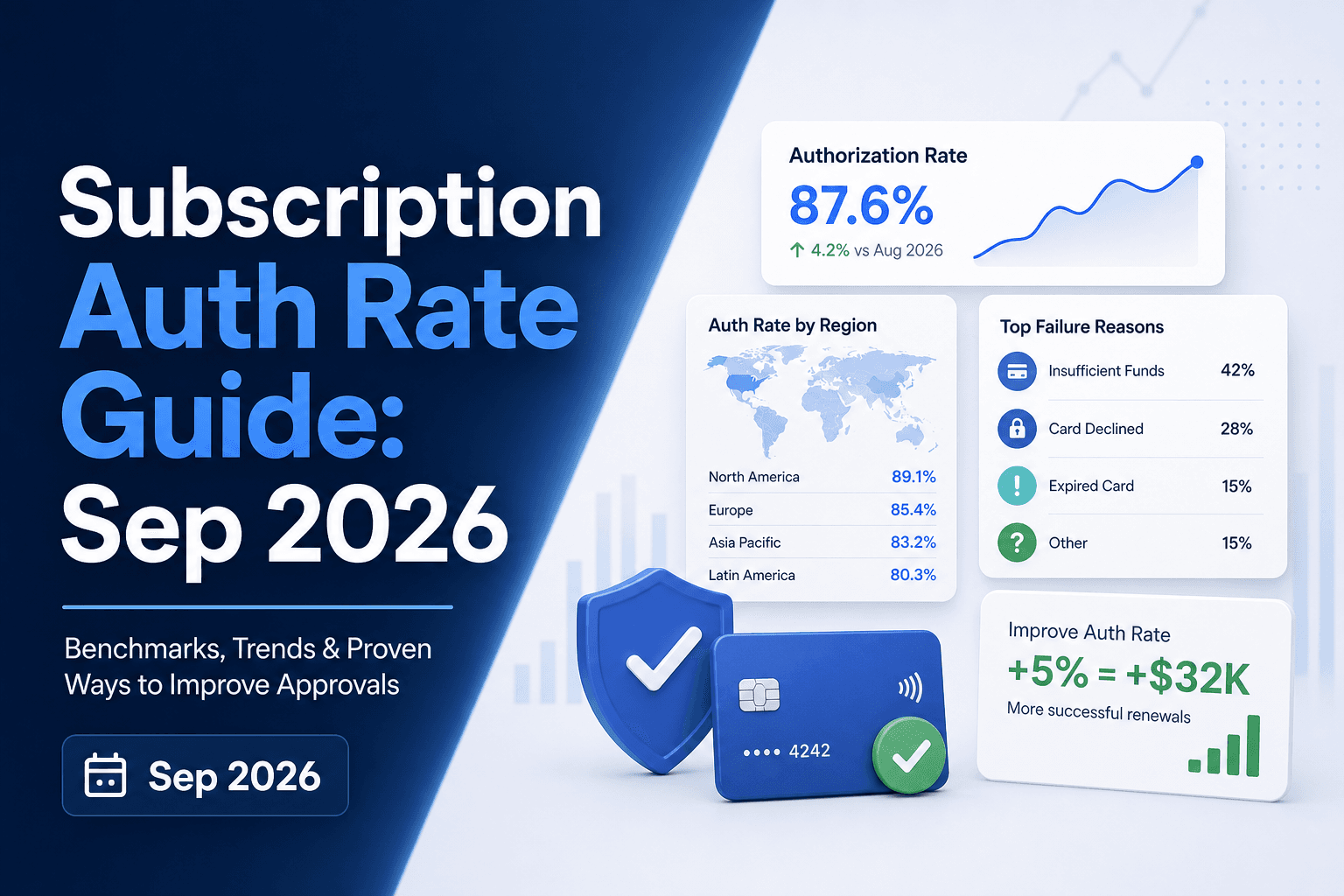
Authorization Rate in Subscription Billing: October 2026
There's a number sitting in your payments data that most finance and retention teams never report on separately: the share of renewal charges your issuing...
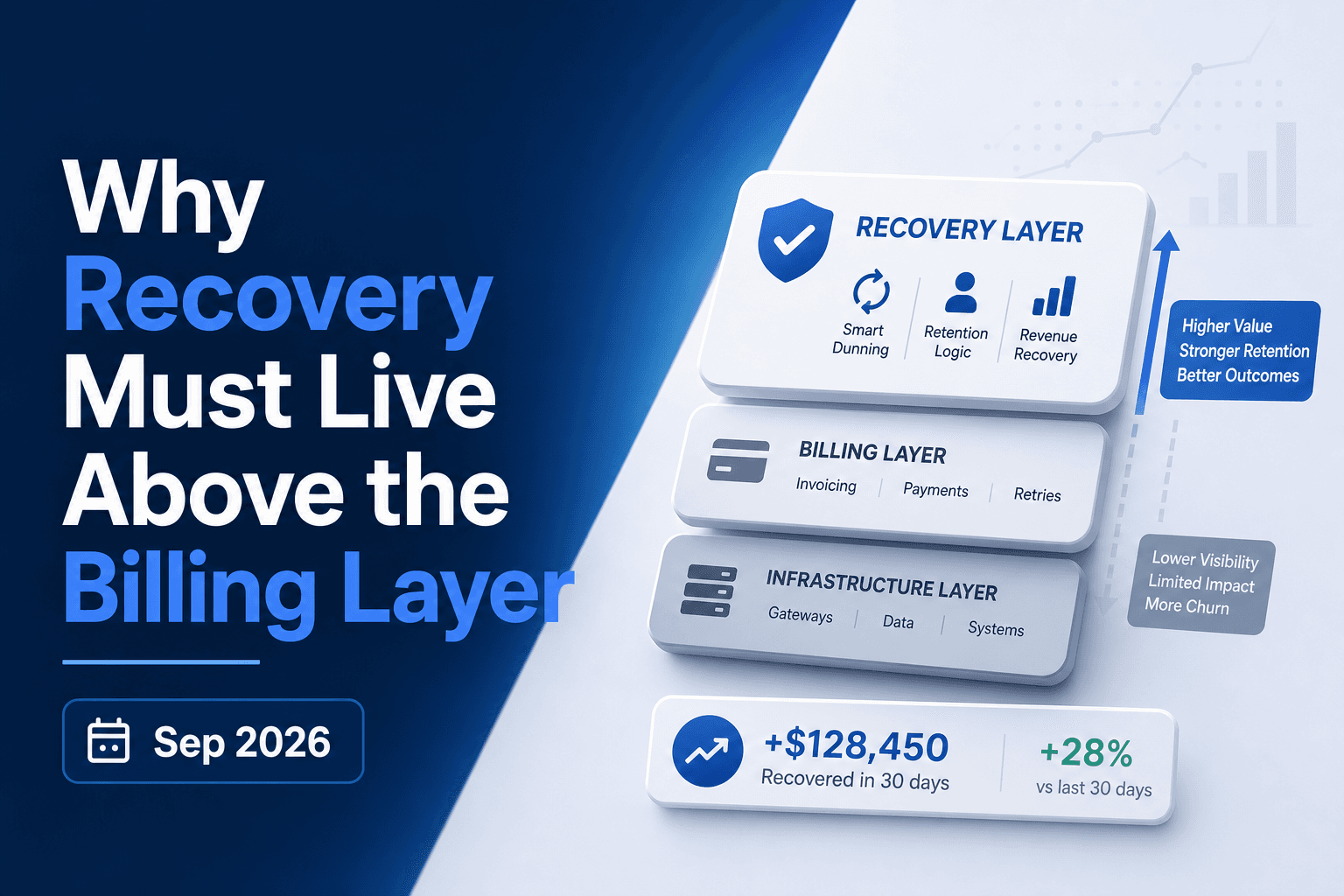
Why Payment Recovery Must Live Above Billers October 2026
A payment fails. Your biller retries it three days later, then again at seven, then at fourteen. What the biller never checks is whether the issuer sent a...
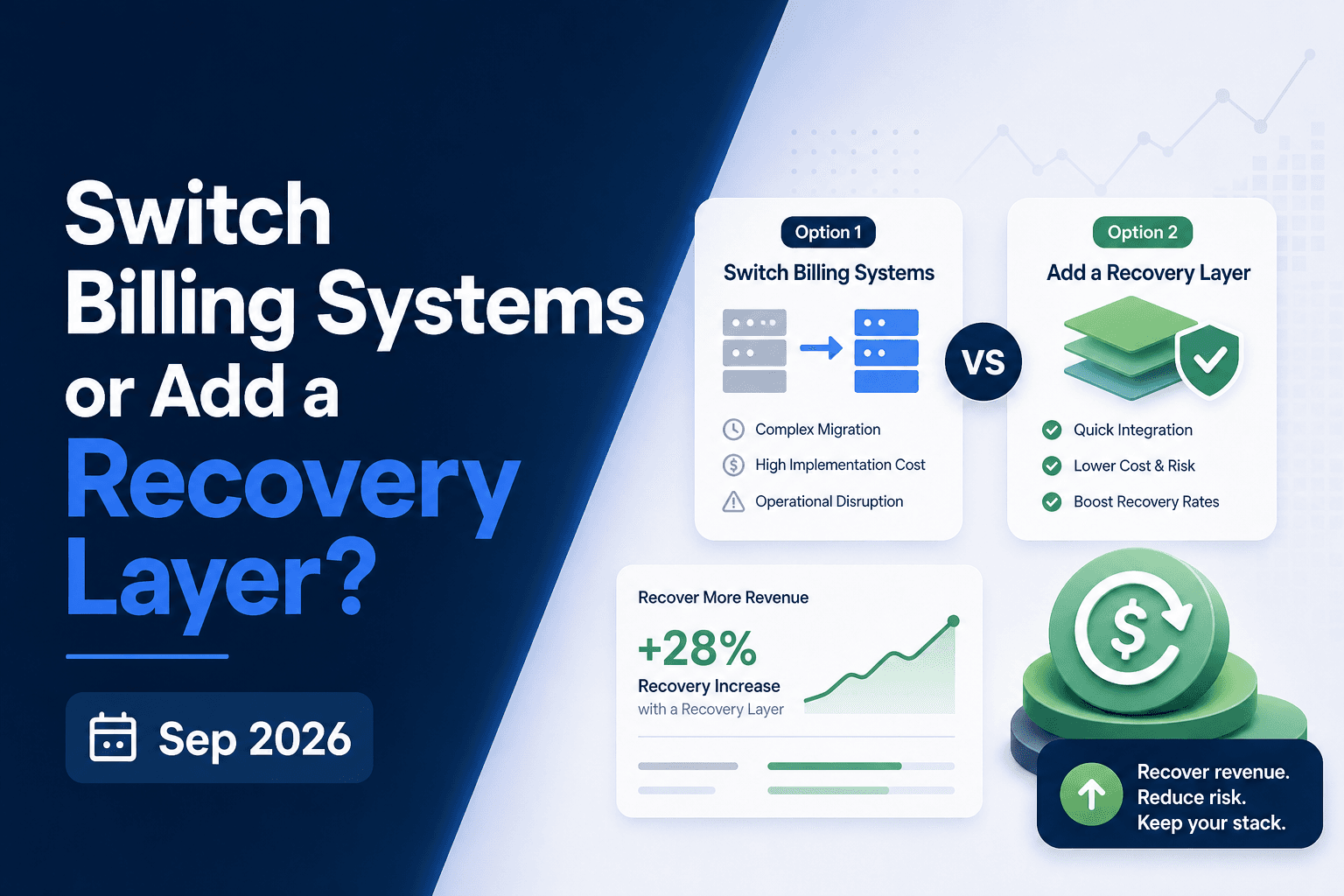
Billing Migration vs Recovery Layer: The Right Call October 2026
Switching billing systems feels like the right move when revenue collection starts breaking down. Sometimes it is. But soft declines, weak retry logic, and...
Stop losing revenue to failed payments
Join leading subscription businesses using Slicker to recover failed payments automatically.
Get Started